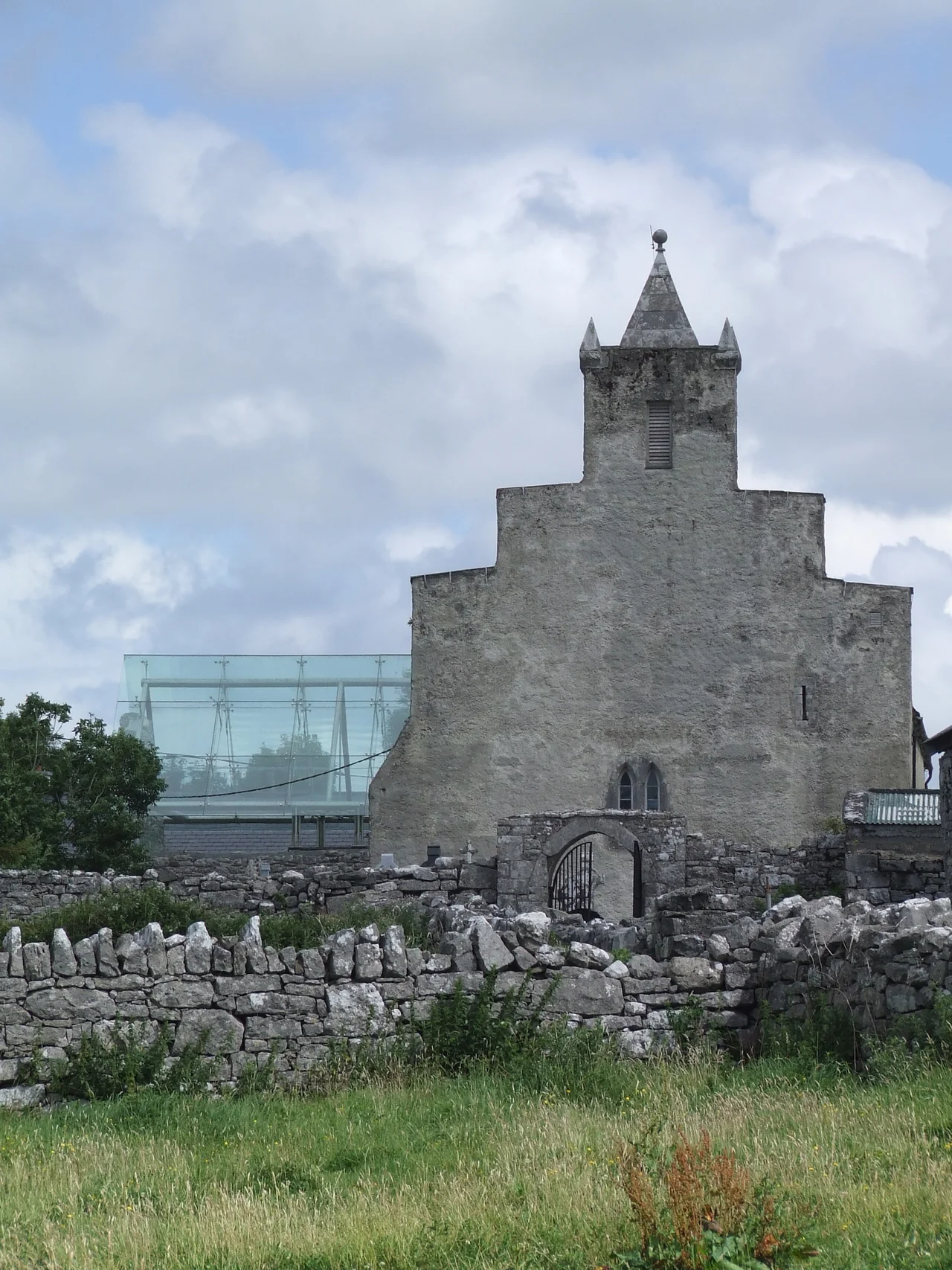

Kilfenora Cathedral
The diocese of Kilfenora is so small that for the last 250 years no one has actually lived as its bishop. Since 1750 it has been administered by another bishop - first the Bishop of Kilmacduagh, then since 1883 the Bishop of Galway. The current title runs to twenty-eight words: Bishop of Galway and Kilmacduagh and Apostolic Administrator of Kilfenora. The cathedral at the heart of this tiny see is partially roofless, has been since 1839, and stands in a small Burren village where the population would have been larger when Saint Fachanan founded a wooden church here in the sixth century.
Saint Fachanan's Foundation
Tradition gives the first church at Kilfenora to Saint Fachanan, also called Fachtna or Fachtnan, in the sixth century. The first building was probably wood, replaced at some point by a stone church. The stone church was burned down in 1055 by Murchad O'Brien, in one of those medieval Irish episodes where dynastic politics, Viking-era warlords, and church reform all collided. The cathedral standing today was built between 1189 and 1200, in what architectural historians call the transitional style - the moment when Romanesque rounded arches were giving way to Gothic pointed ones.
The diocese this cathedral served corresponded to the ancient territory of Corcomroe in northwest Clare. It covered only about 200 square miles of thinly populated stone country. There were just thirteen parishes. By any measure it was the smallest and poorest diocese in Ireland. The first recorded bishop appears in 1189. Few candidates ever wanted the job. After the Reformation, when the Catholic Church kept appointing diocesan bishops alongside the established Church of Ireland's appointees, the parallel structure lasted until 1749, when the last Catholic Bishop of Kilfenora, James Augustine O'Daly, died. The diocese was then merged with Kilmacduagh.
A Curious Mix of Styles
By 1839 the eastern thirty-six feet of the cathedral were roofless. The nave was preserved with a roof and is still used for occasional Church of Ireland worship - the bishop's throne was donated in 1981. The chancel, beyond the dividing arch, is open to the Clare sky. A large square stone baptismal font sits somewhere in the structure, possibly contemporary with the original construction around 1200.
The surviving architecture is a layered record of what each century wanted from the building. The fifteenth century added a doorway and a Gothic sedilia. The Romanesque east window has three lights divided by triangular pillars topped with carved capitals - a feature shared with Corcomroe Abbey nearby, in what architectural historians call the school of the west. Two carved effigies flank that window. On the north side, a bishop with his right hand raised in blessing, possibly from the early fourteenth century. On the south, a tonsured bareheaded cleric holding a book, possibly thirteenth. One nineteenth-century visitor was unkind: "The attempt at a tower is conspicuously mean and hideous. A pile of emigrants' luggage with a rabbit-hutch or bird-cage overhead would look equally imposing." The cathedral remains, the visitor does not.
The Crosses Under Glass
What makes Kilfenora most distinctive is what stands in the churchyard and what now stands in the Lady Chapel. The village is sometimes called the City of the Crosses - seven high crosses survive, of which four remain reasonably intact, in styles spanning the ninth to twelfth centuries. The most famous, the Doorty Cross, stands about 4.5 meters tall and bears intricate panels showing bishops, possible apostles, and what may be Christ in glory. The level of carving puts these among the most ambitious sculptural works to survive from medieval Ireland.
In 2005, conservation work moved three of the crosses indoors, into what had been the Lady Chapel - a small rectangular wing leading north from the chancel, dating to the same period as the main cathedral. A glass roof was installed over the chapel space to protect the high crosses from weather and acid rain that had been gradually eroding them outdoors. The arrangement now lets visitors view nine centuries of stone carving in a single sheltered space, with daylight falling through the glass onto the curling shapes of bishops, abbots, the Tree of Life, and serpentine interlace whose meaning we can guess at but not quite read.
An Administered Diocese
Kilfenora today has only a few hundred residents. The Catholic parish operates as part of the diocese of Galway, Kilmacduagh, and Kilfenora, with the bishop based in Galway city. The Church of Ireland's nave still gets used for occasional services. The Pope has, in canon law, technically been the bishop of Kilfenora since the merger with Galway in 1883, with the actual bishop of Galway acting as his apostolic administrator. The diocese exists more as a memorial than as a working ecclesiastical unit - one of the smaller curiosities of the long sediment of Irish church history.
For pilgrims and tourists, the cathedral is a stop on a Burren itinerary that often takes in Corcomroe Abbey, the Caherconnell stone fort, and the Poulnabrone dolmen - the Neolithic portal tomb whose photograph is on half the postcards of County Clare. Kilfenora itself has the Burren Centre, an interpretive museum about the karst landscape, the village's pubs, and a long musical tradition: the Kilfenora Ceili Band, formed in 1909, is one of the oldest still-active traditional Irish music groups in the country. They still play here. The cathedral, roofless and complete in its incompleteness, still stands.
From the Air
Kilfenora Cathedral sits at 52.99 N, 9.22 W, in the village of Kilfenora in the southwestern Burren of County Clare. Shannon Airport (EINN) is 60 km southeast; Galway (EICM) is 55 km northeast; Connemara (EICA) is 35 km north. Recommended viewing altitude is 1,500 to 3,000 feet AGL. The cathedral appears as a small stone structure with a partial roof in the village centre. The Burren limestone pavement stretches in all directions - look for the distinctive grey-white karst surface and the absence of trees, with stone walls dividing the landscape into small fields. Corcomroe Abbey lies 10 km north-northeast; the Cliffs of Moher are 12 km west. Weather is changeable Atlantic - cloud bases under 2,500 feet are normal, and rain is more common than not.
Nearby Stories
- Saint Macdara's Island 6.8 km away
- Limerick Institute of Technology 12 km away
- County Galway 15 km away
- 2003 Derrybrien Landslide 15 km away
- Kilrush 16 km away
- Knockmoy Abbey 20 km away
- Mace Head Atmospheric Research Station 37 km away
- Illauntannig Monastic Site 47 km away