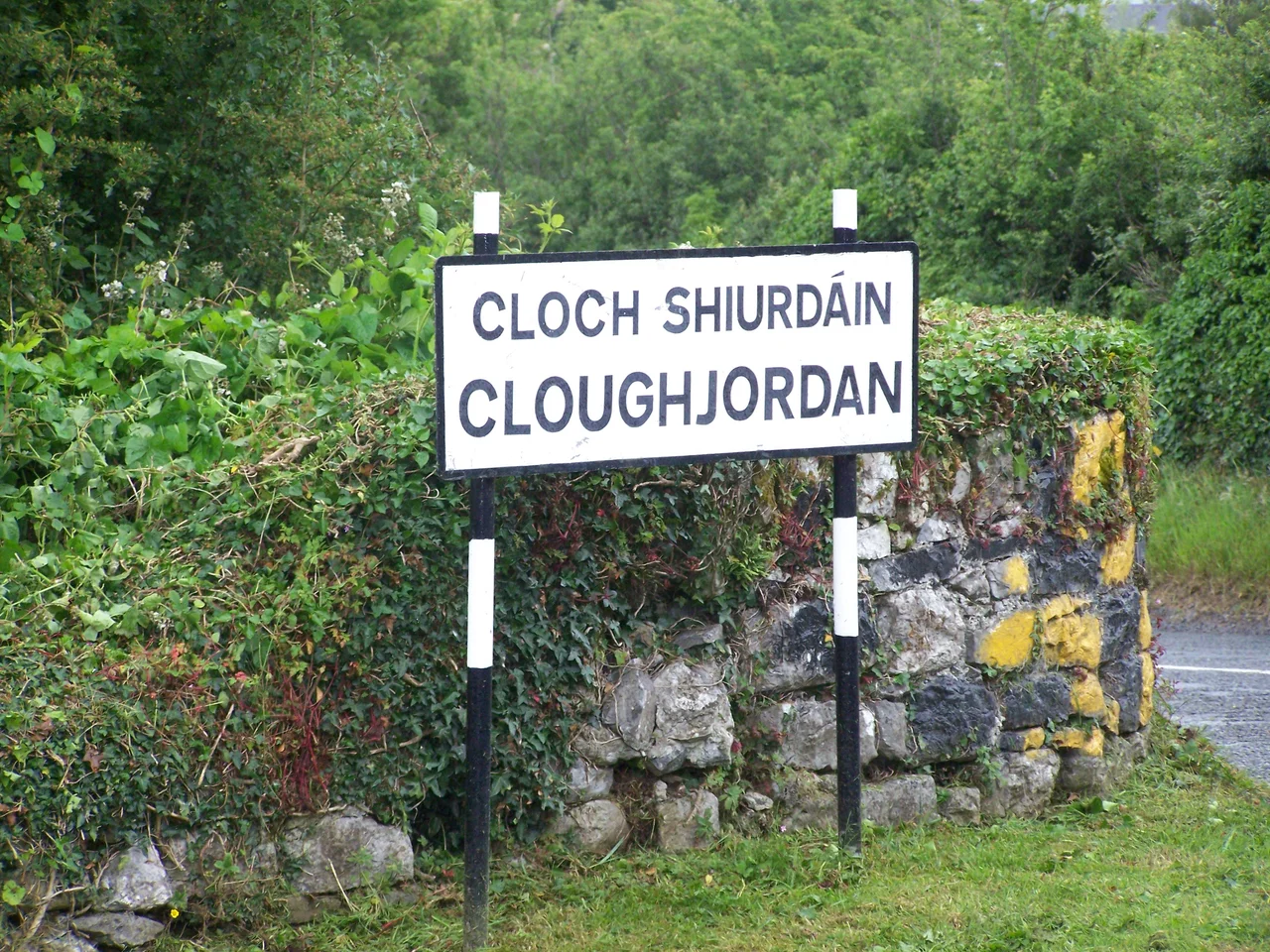
_for_the_village_of_Cloughjordan_in_North_Tipperary,_Ireland.jpg)
Cloughjordan
Thomas MacDonagh, the poet who would face a British firing squad at Kilmainham Gaol on the morning of 3 May 1916, once described his birthplace as a place 'in calm of middle country.' The phrase is exact. Cloughjordan sits in the north-western corner of County Tipperary, almost equidistant from Nenagh, Roscrea and Birr, with the Shannon and Lough Derg a short drive west. There is no industry of consequence, no tourist circus, no cathedral. There is a long Main Street with a hardware shop and three churches, a railway station built in 1863, and—on the outskirts—67 acres of fields where a few hundred people are quietly running one of the most ambitious experiments in Irish village life since independence.
A Family of Rebels and Artists
The MacDonaghs taught at Cloughjordan's first national school when it opened in 1876. Joseph and Mary Louise MacDonagh were the first teachers; their son Thomas, born in 1878, grew up in the schoolhouse on Lower Main Street—now the Thomas MacDonagh Museum, opened in 2013 in the family home. Thomas became a poet, a scholar of English literature at University College Dublin, and one of the seven signatories of the 1916 Proclamation of the Irish Republic. His brother Joseph, a Sinn Féin politician, died in December 1922 from the effects of a burst appendix suffered while on hunger strike during the Civil War. His brother John became a film director and playwright. A statue of Thomas stands at the top of Main Street, looking out at the village he could not stop describing in his verse. The GAA park bears his name. The school where his parents taught is still standing.
The Branch Line That Almost Closed
The railway came in 1863, threading Cloughjordan onto the Limerick–Ballybrophy line, where it still connects—just—to the main Dublin–Cork spine. The classically-influenced station building, the stationmaster's house, the road bridge over the tracks: all part of a small cluster that has somehow survived the long Irish habit of closing rural lines. The service has been reduced repeatedly. In January 2012 a national newspaper reported that Iarnród Éireann was preparing to close it entirely. Enhanced trial timetables came and went. The service was cut back again in February 2013. The trains still run—a few a day—and the local protest is constant. Lose the line and the village loses one of its last threads to somewhere else.
The Ecovillage
In December 2009, the first residents moved into the Cloughjordan Ecovillage. The community had bought 67 acres of farmland adjoining the existing village and laid it out around an extension of one of the side streets opposite the Church of Ireland. The design brief was strict: ecological, social, and economic sustainability, with houses meeting passive-house standards, a district heating system fed by renewable sources, and a working community farm. The Village Education Research and Training group runs courses in sustainable living. Twenty-nine of the homes opened to the public for the European Near Zero-Energy Buildings open-doors event in November 2013. Cloughjordan won the National Green Community Award three years running, in 2012, 2013, and 2014. The ecovillage merges with the old village through a single street, like a thought that wandered in from the future and decided to stay.
Stained Glass and Stone
Three churches face one another across a small town. St Kieran's Church of Ireland, on the Square, dates from 1837—designed by James and George Richard Pain for the Board of First Fruits, its cut-stone spire rising over the meadow once intended as a parade ground for the barracks. Cloughjordan Methodist Church, with its polychromic tiling, opened in 1875. SS Michael and John's Roman Catholic Church, built around 1898, holds something more precious than its modest exterior suggests: stained-glass windows by Harry Clarke, Ireland's greatest twentieth-century glass artist, behind the altar, and windows by Evie Hone to the side. Three congregations, three architectural moments, one parade ground turned village square. The Pain brothers were among Cork's most prolific architects; that Cloughjordan has a Pain-designed spire and a Clarke-designed altarpiece is the kind of accident of generosity rural Ireland sometimes produces.
The People Who Stay and the People Who Came Back
As of the 2022 census, 701 people live in Cloughjordan. The actor Patrick Bergin lives here. So did, briefly, the hurlers Dinny Cahill and Len Gaynor before careers carried them onto county sidelines. Cloughtoberfest, an unlikely annual marriage of gypsy jazz and Irish craft brewing, ran from 2011 to 2015. The Cloughjordan Festival still runs each summer. In April 2017, President Michael D. Higgins opened the community amphitheatre. A free 5 km parkrun winds through Knockanacree Woods every Saturday. There is no secondary school in Cloughjordan; teenagers travel to Nenagh, Borrisokane, or Birr. There is, instead, an ecovillage, a railway, a poet's statue, three churches with Harry Clarke glass, and a village quietly proving that 'calm of middle country' is not a synonym for empty.
From the Air
Cloughjordan is at 52.94°N, 8.04°W, in north-western Tipperary near the Offaly border. Cruise at 3,000–6,000 feet and the village reveals itself as a long, narrow ribbon along Main Street with the distinctive ecovillage cluster on the western edge—the curved street layout and high concentration of solar arrays mark it from above. Nearest airports are Shannon (EINN) about 50 km south-west and Casement Aerodrome (EIME) near Dublin to the east. The railway runs north-south through the village; Lough Derg's northern tip lies 12 km west, the Shannon shimmering beyond.
Nearby Stories
- Portlaoise 6.6 km away
- Clonmacnoise 8.8 km away
- Thurles 8.9 km away
- Castletroy 11 km away
- St Canice's Cathedral 12 km away
- 2003 Derrybrien Landslide 16 km away
- Mountbellew 24 km away
- Mullingar 29 km away