.jpg)
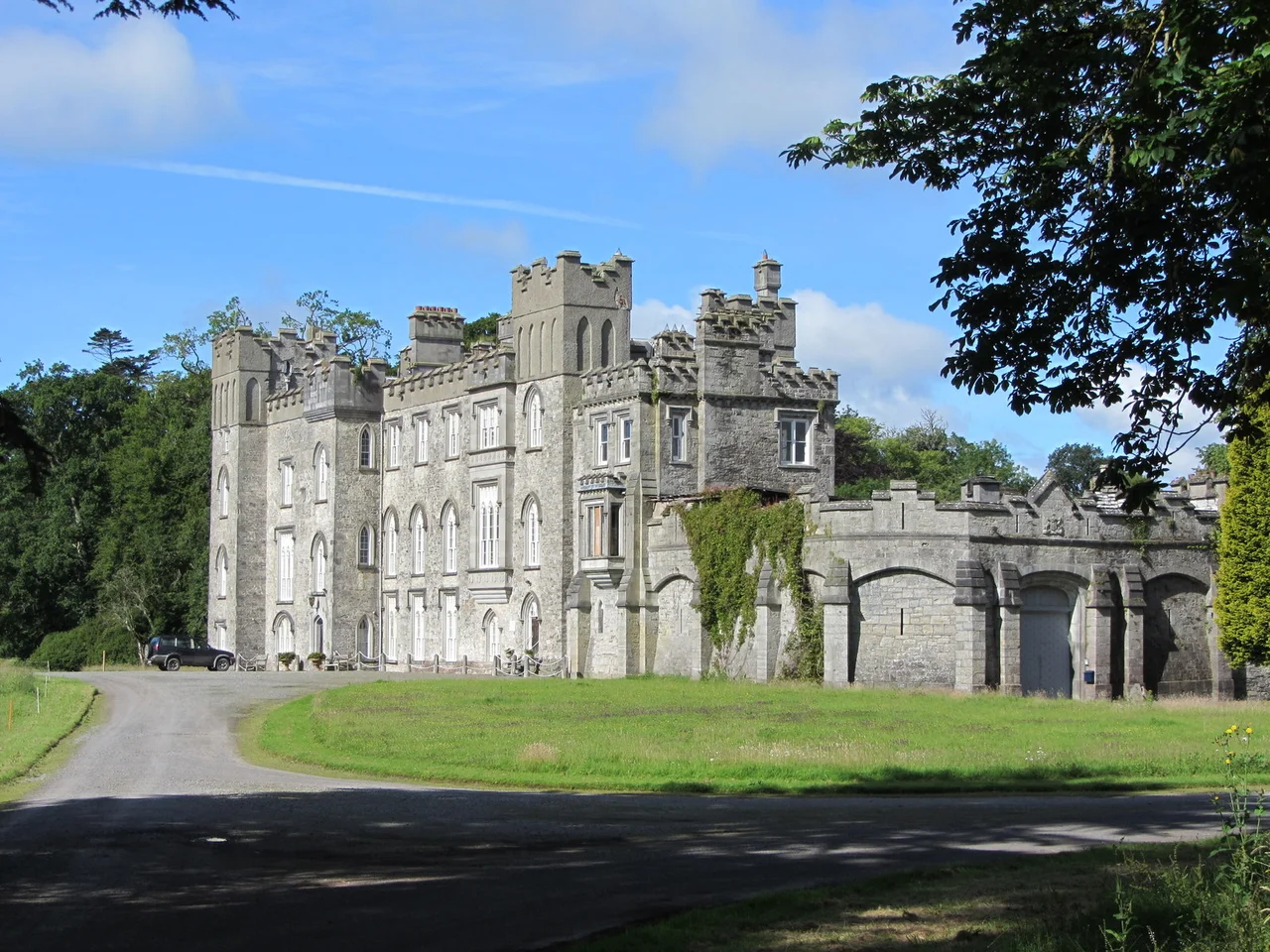
Dunsany Castle and Demesne
Hugh de Lacy started Dunsany Castle in 1180, around the same time he was raising the great keep at Trim eight miles away. The Cusack family took over not long after. They passed it to the Plunketts by marriage in the fifteenth century, and the Plunketts are still there. Dunsany has been continuously occupied by one extended family for over 800 years - quite possibly the longest single-family occupation of any house in Ireland.
Four Towers and a Passage
The current castle keeps the lower stones of its four original corner towers, but most of what a visitor sees is the work of the eighteenth and nineteenth centuries, when successive Barons of Dunsany made the place habitable rather than merely defensible. The central hallway has a vaulted ceiling and a principal stairway that climbs to a first floor of high rooms. The drawing-room is finished with Stapleton plasterwork from 1780, all delicate plaster swags and medallions of the late Georgian style. The library is Gothic Revival, possibly worked on by the Dublin architect James Shiel, with a curious beehive ceiling that arches upward in concentric ribs. A spinal corridor known simply as the passage runs through the historic core, connecting the ancient kitchen, the modern kitchen, bedroom suites, and the gallery of Eddie Plunkett, the 20th Baron, who was a working artist before his death in 2011. Off the secondary stairway is what used to be a priest's hole - a small chamber where Catholic priests could be hidden during the centuries when their presence in an Anglo-Norman house was a hanging offence.
The Plunketts
The Plunkett family is one of the great Old English dynasties of the Pale, the medieval band of English-controlled territory around Dublin. They acquired Dunsany when Christopher Plunkett married Joan Cusack in the fourteenth century, and the title Baron of Dunsany has descended in the family ever since - a fact that makes it one of the oldest baronies in Britain or Ireland still held by the original line. The most famous Plunkett was Edward, the 18th Baron, who wrote fantasy fiction under the name Lord Dunsany. His stories - The Gods of Pegana, The King of Elfland's Daughter, the Jorkens tales - influenced Tolkien, Lovecraft, and Ursula Le Guin. He hunted and wrote in roughly equal measure, often in a quill pen by candlelight in the castle library, sometimes by the campfire on safari in East Africa. The Plunketts also held Trim Castle, the largest Norman ruin in Ireland, until they transferred it to the Irish state in 1993.
The Church and the Wedding
Set apart from the castle, in the trees of the demesne, is the medieval Church of St Nicholas. It fell out of use at some point - possibly damaged by Cromwellian forces in the 1640s - and a replacement was built at Dunsany Crossroads. But the old church remained consecrated, just empty. In 1994, the production crew for Mel Gibson's Braveheart partly restored the ruin to film the royal wedding scene — Prince Edward of England marrying Princess Isabella of France — using the church to stand in for Westminster Abbey. After the cameras left, the church returned to its half-restored quiet. It is still consecrated, but services are not held there. The film stayed; the silence returned.
The Demesne
Around the castle stretches the demesne - the inner core of what was once a much larger Dunsany Estate. Two artificial mounds flank the front of the castle, at least one of them possibly part of an earlier Irish fortification that predates the Normans by centuries. The poet Oliver St John Gogarty memorialised the western mound, with its twin-dune profile, in his writing. The demesne also holds a stone walled garden, a complex of estate farm buildings, an ice-house for the days before refrigeration, and acres of mature woodland. The estate has been managed in recent decades as a private nature reserve, and small group tours are occasionally arranged. The castle itself opens to guided tours on a limited number of days each year. Most of the time, Dunsany goes on being what it has been since 1180 - a working family home that just happens to have been working for thirty-five generations.
From the Air
Dunsany Castle is at 53.54 degrees north, 6.62 degrees west, in County Meath about 25 miles northwest of Dublin and 8 miles east of Trim. Nearest airport is Dublin (EIDW) about 25 miles southeast. From 2,000-4,000 feet in clear weather, the castle and demesne stand among extensive woodland east of Trim - a green patch in the open Meath farmland with the four corner towers of the castle visible at its centre. The medieval church and walled garden lie within the surrounding parkland. Meath weather offers best visibility on bright spring days; the typical pattern is cloud and occasional rain.
Nearby Stories
- Virginia, County Cavan 6 km away
- Athclare Castle 7.5 km away
- Kilbride, County Wicklow 7.5 km away
- Edward Pakenham 7.6 km away
- Monasterevin 14 km away
- German submarine U-1051 42 km away
- Slieve Donard 44 km away
- Irish Sea Bridge 71 km away