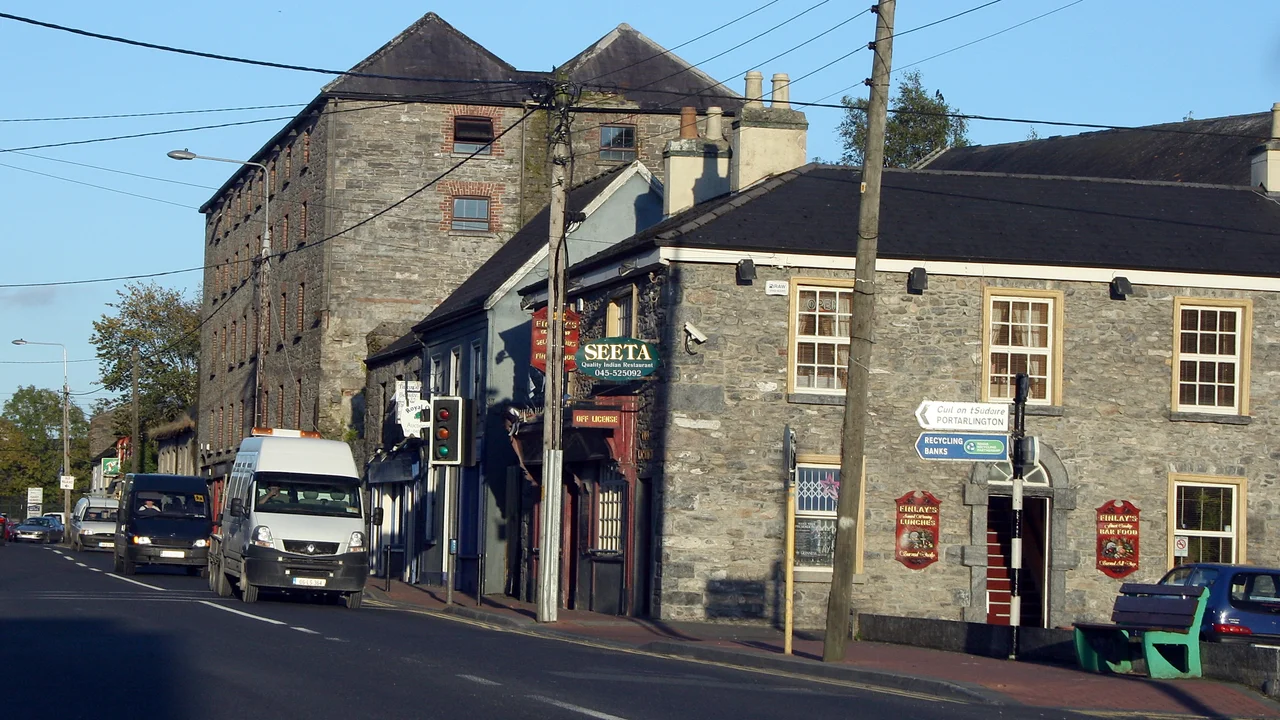

Monasterevin
In 1826, Irish canal engineers did something audacious. They carried the Grand Canal over the River Barrow on a stone aqueduct - one waterway flying above another, sixty feet of arch and parapet, with boats moving in two different directions on two different elevations. They added a lift drawbridge where the R424 main road crosses the Barrowline. The result is Monasterevin: a small town in County Kildare with more bridges per resident than almost anywhere in Ireland, nicknamed the Venice of Ireland for reasons that become clear the moment you stand on Main Street and watch the water flow in three different planes around you.
The Spin Doctor Saint
In the sixth century, Saint Abban of New Ross - a contemporary of Patrick - founded a monastery at a place called Rosglas, on a curve of the Barrow. He put it in the charge of his protégé, a young monk named Evin. The name comes from the Irish word eimh, meaning swift or active; Latinized as Eminus. Evin had political instincts. He brought monks with him from his native Munster, which earned the place the local name Rosglos-na-Moinneach, the greenwood of the Munstermen. More importantly, he negotiated special status for his foundation: the area around Monasterevin was placed outside common law, made a sanctuary, given protection that the local kings respected. His personal bell became famous as a swearing-implement; tribes from across the region came to take oaths on it, knowing those oaths would hold. He co-wrote the Tripartite Life of St. Patrick. His political writing, the Cain Emhin, survives. He was, as the Wikipedia article phrases it, a sixth-century spin doctor.
The Earls Who Built the Streets
Saint Evin's monastery faded around the time of the Viking raids. A Cistercian abbey took over in the twelfth century, under the patronage of Dermot O'Dempsey. The abbots of Monasterevin held seats in the Irish Parliament while quietly assisting rebels against the English crown - a balancing act that would have made Evin proud. Henry VIII suppressed the abbey in 1541. King James I granted the lands in 1613 to Sir Adam Loftus. By 1699 the estate had passed through marriage to the Moore family - the Earls of Drogheda - whose fourth Earl sold his Mellifont estate and made Monasterevin the family seat. The Moores were Dublin city planners by inheritance: the first Earl had laid out Drogheda Street (now O'Connell Street), Moore Street, Henry Street, and Mary Street. His descendants applied the same grid logic to Monasterevin, creating the parallel Main Street and Drogheda Street still visible today.
Whiskey, Canal, Rebellion
The Grand Canal arrived in 1786, connecting Monasterevin directly to Dublin and points west. The town became a transport hub overnight, and the Cassidy family built a distilling empire on the back of cheap canal freight. Cassidy whiskey and St. Patrick Cross Pale Ale travelled the world; the wealth they generated made the Cassidys the most powerful family in the town. In 1798, Cassidy was the local magistrate. That May, during the United Irishmen rising, insurgents from the surrounding countryside marched on Monasterevin in an attempt to capture it. The Battle of Monasterevin was fought in the Main Street, with local yeomanry and militiamen firing from a fortified St. John's church. The Monasterevin Yeomanry Cavalry charged and routed the insurgents. Later that year, Fr. Edward Prendergast was arrested for ministering to insurgents camped on Iron Hill near Nurney. He was hanged in the garden of Monasterevin House and buried there. A Captain Padraig O'Bierne and a group of Derryoughter boatmen later slipped into the town under cover of darkness, dug up the body, and carried it home to Harristown for proper burial.
British Racing Green
On 2 July 1903, the Gordon Bennett Cup ran through Monasterevin. It was the first international motor race ever held on the islands of Britain or Ireland, organized by the Automobile Club of Great Britain and Ireland because racing was illegal on British public roads. Kildare was chosen as the venue partly because its roads were unusually straight, considered a safety benefit at the time. The British team faced a problem: the conventional national racing colors had already been claimed by Italy (red), Germany (white), and France (blue). As a compliment to their Irish host, the British team painted their cars Shamrock green. The color stuck. It became known as British Racing Green - the deep green still painted on Aston Martins, Lotuses, and Jaguars more than a hundred and twenty years later. The first international motor race in the British Isles, run through a Kildare town named after a sixth-century saint, gave Britain its national racing color.
Hopkins on the Bridge
Gerard Manley Hopkins - the English Jesuit poet of "The Windhover" and "Pied Beauty," the inventor of sprung rhythm, the most original lyric voice in Victorian verse - visited Monasterevin seven times in his final years. He had been posted to University College Dublin in 1884, an unhappy English Catholic in a country he never quite settled into, suffering from depression and ill health. He found respite in Monasterevin, where the Cassidys hosted him. He walked the towpaths. He looked at the aqueduct. He wrote letters home. He died in 1889, aged 44. The Monasterevin Hopkins Society holds an annual festival in his memory. The poet's quiet weekends in this canal town are part of the town's identity in a way the Cassidys would have approved of - the Venice of Ireland, hosting a Jesuit poet whose verse changed twentieth-century English. The aqueduct still carries the Grand Canal over the Barrow. The lift drawbridge on the R424 still rises and falls for canal boats. The population has more than doubled since 2002 - from 2,583 to 5,307 - as Dublin commuters discover the town. Monasterevin remains, as ever, a place defined by its waters.
From the Air
Monasterevin sits at 53.14N, 7.06W in southwestern County Kildare, on the River Barrow at its confluence with the River Figile. The town lies near the Laois county line, on the main Dublin-Cork railway and the M7 motorway. Dublin (EIDW) is 60 km northeast; Shannon (EINN) 130 km west-southwest. From cruising altitude the town is identifiable by the distinctive Y-junction of the Grand Canal where it meets the Barrowline branch heading south to Athy, and by the unusually dense network of small bridges in the town center. The aqueduct itself - one of the few places in the world where a canal flies over a river - is a Civil Engineering Heritage landmark but is too small to identify from altitude.
Nearby Stories
- Edward Pakenham 9.4 km away
- Dunsany Castle and Demesne 12 km away
- Castlecomer 12 km away
- Saighir 12 km away
- Kilbride, County Wicklow 14 km away
- Garda Síochána College 15 km away
- Wicklow Gold Rush 28 km away
- St Mel's Cathedral 33 km away