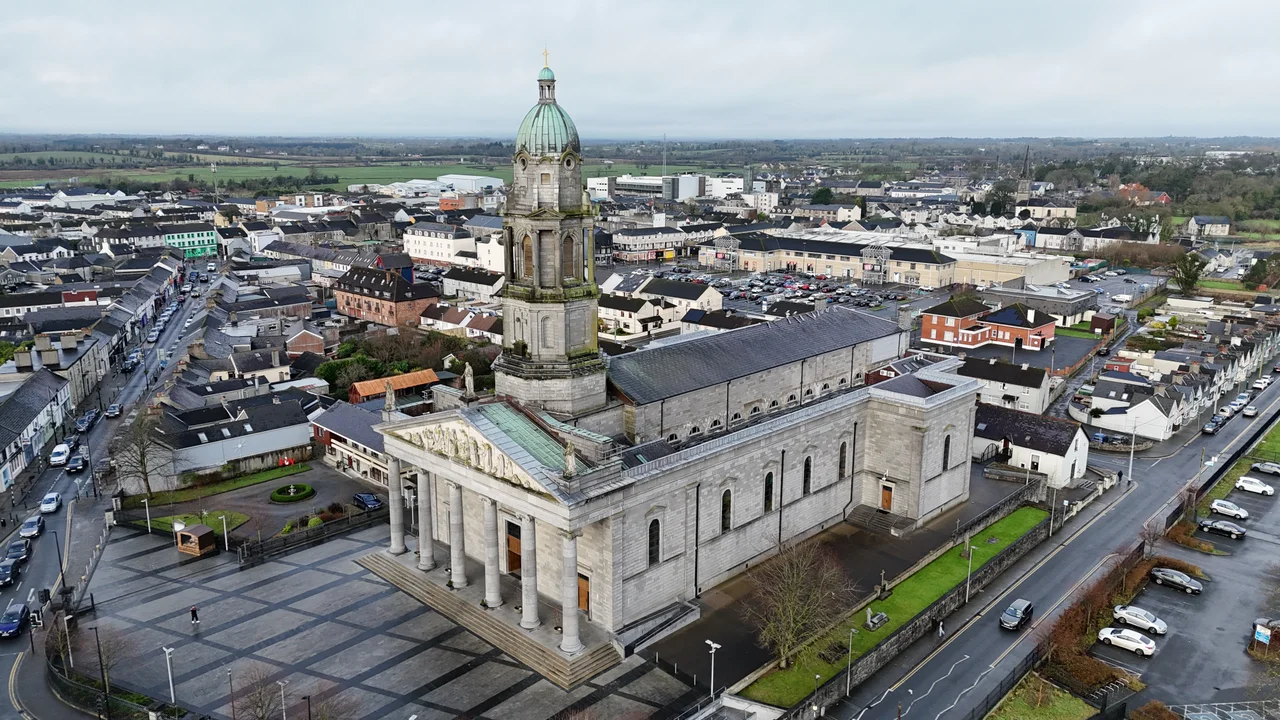

St Mel's Cathedral
It was the coldest Christmas in living memory in Longford. The first Mass of Christmas Day 2009 had ended just after midnight and the cathedral had emptied to the smell of incense and candle smoke. Sometime before dawn, hidden behind a fitted unit in the sacristy, an old chimney flue began to glow. By 5 a.m. the back of the building was on fire. Firefighters arrived to find their pipes frozen solid - the temperature outside was minus seven. By morning, one of the great Catholic cathedrals of nineteenth-century Ireland, the soaring landmark that Longford had grown up around for over a hundred and fifty years, was, as the chief fire officer put it, just a shell - burned out from end to end. And yet the story of St Mel's is not the story of its burning. It is the story of what happened next.
Twenty-Four Limestone Columns
Construction had begun in 1840 in the lean years before the Famine and continued in the desperate ones during and after. The cathedral was built between 1840 and 1856, with later additions: a belfry designed by John Bourke in 1860 and a Greek-revival portico by George Ashlin added in 1889. It was finally consecrated on 19 May 1893, more than half a century after the first stone was laid. Twenty-four limestone columns, quarried at nearby Newtowncashel on the shores of Lough Ree, rose to support the roof. Inside the diocese, people called it the flagship cathedral of the Irish midlands. Outside, even those who never set foot in it knew its silhouette - so much so that the cathedral appears on the crest of League of Ireland football club Longford Town and on the crests of every Longford GAA team. The bell-tower was the town's compass point. For three generations, you knew where Longford was because you could see St Mel's.
Christmas Morning, 2009
Bishop Colm O'Reilly arrived in the dark and watched the roof go. By daylight the damage was being estimated at thirty million euro. St Mel's Crosier - a relic over a thousand years old, named for the sixth-century saint who had given the diocese his name - was inside, and it was lost. So were the organ, the pews, the stained glass, the plaster saints, the choir loft, the marble of the altar. Two days later the gardai confirmed the fire was not arson. A long forensic investigation eventually traced the cause to an old chimney flue at the rear of the building that had broken out through inspection hatches hidden behind fitted units in the sacristy. The fire had been waiting in the walls. To his forty-one parishes the bishop wrote a letter that has been quoted ever since: 'I am now writing the kind of letter that I never dreamt I would need to write... I write to bring some solace to the many who are quite truly heart-broken.'
Hope from the Ashes
Mass moved into the sports hall and chapel of St Mel's College up the road. On 18 September 2011 - nearly two years after the fire - the cathedral ruins were opened to the public for one day. Thousands queued in the rain to walk through the roofless shell of the building that had baptised them, married them, buried their parents. The decision was already made: it would be rebuilt. The work took five years and cost thirty million euro. The new altar was consecrated in March 2014. On Christmas Eve 2014, exactly five Christmases after the fire, the cathedral reopened with the first Mass said inside its walls since 2009. The restoration is a quietly extraordinary thing. A Carrara marble altar was sculpted by Tom Glendon. A silver tabernacle was made by Imogen Stuart and Vicki Donovan. A new organ of 2,307 pipes was built by Fratelli Ruffatti in Padua - the Italian commission survived a public debate in 2012 over whether an Irish builder should have been chosen. And new stained-glass windows were designed by Kim En Joong, a Korean-born Dominican priest and abstract painter, whose colour now floods a building that nearly ended in ash.
What a Cathedral Means
Walk into St Mel's now and the building is older than it was on Christmas Eve 2009, and also entirely new. The plasterwork looks the same. The columns are the same Newtowncashel limestone. The proportions are exact. But the air smells of fresh paint and new wood, and the light is shaped by glass that did not exist a decade ago. In a small country town of about ten thousand people, the rebuilding of St Mel's is a monument to a certain stubbornness - to the conviction that a building is not just stone and wood but the place where a community holds its own memory. The fire was the worst thing that had happened to the cathedral. The rebuilding was the best thing that had happened to Longford in a generation. The silhouette is back on the football crest. The bells ring on Sunday morning. The flue, this time, is sealed.
From the Air
Located at 53.727 degrees north, 7.796 degrees west, in the centre of Longford town in the Irish midlands. The cathedral's pale neoclassical bulk and tall portico make it easily picked out from low altitude. Best viewed at 2,000-4,000 feet. Nearest airports: Ireland West Knock (EIKN) about 65 km northwest, Dublin (EIDW) about 110 km southeast. The N4 motorway runs just south of the town.
Nearby Stories
- Athlone Castle 2.7 km away
- Cavan 3.3 km away
- Castlepollard Mother & Baby Home 6.1 km away
- Castlerea 8.4 km away
- Shannon-Erne Waterway 12 km away
- Ballymote Castle 15 km away
- Loughrea 28 km away
- Portarlington, County Laois 33 km away