.jpg)
Castlerea
Sergeant James King of the Royal Irish Constabulary was shot on St Patrick Street in Castlerea on 11 July 1921, and died of his wounds a short time later. The Truce that ended the Irish War of Independence was declared the same day. King became the last casualty of that war - a small distinction, but one written into the historical record of this quiet Roscommon town. Castlerea has a way of generating that kind of footnote. It is small - 2,348 people at the 2022 census - but its sons and daughters have a habit of turning up in unexpected places: Ireland's first President, Oscar Wilde's surgeon father, world-champion boxers, journalists, oil executives, a sumo wrestler. The town is the kind of place where, statistically, a lot more should not have happened than has.
Distillery, Brewery, Demesne
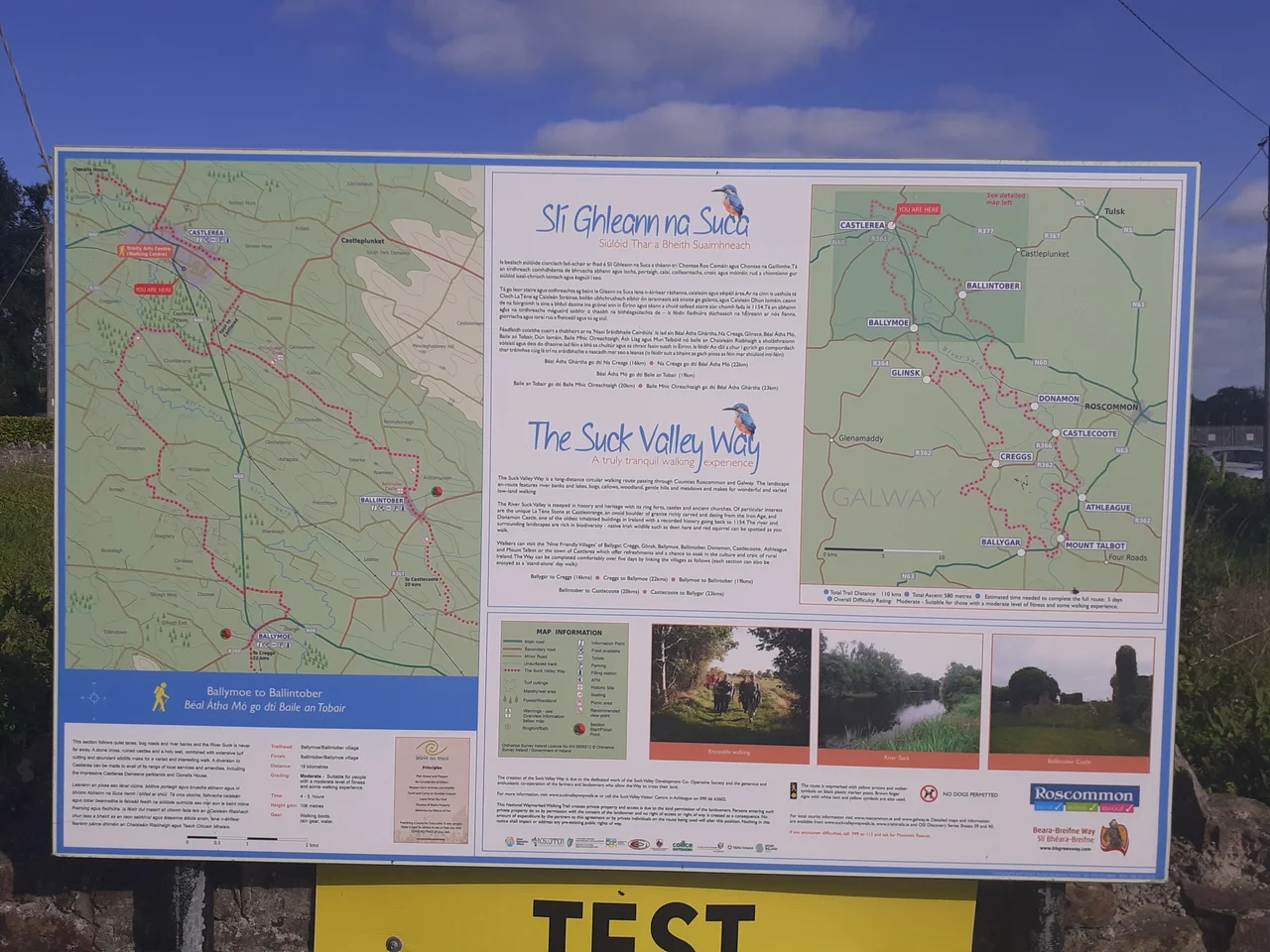
Castlerea developed in the eighteenth and nineteenth centuries under the Sandford family, who built it up around three industries: a distillery that at its height produced more than 20,000 imperial gallons of whiskey a year, a brewery, and a tannery. The Sandfords continued to dominate local life through the nineteenth century until their estate was broken up and redistributed by the Irish Land Commission and the Congested Districts Board. What survived their departure was the demesne - the great wooded park accessible off Main Street - which is now a public amenity of mature trees, walking paths and picnic spaces. Some of the trees were planted by visiting dignitaries, including former US ambassador to Ireland Jean Kennedy Smith. The town is also the trailhead for two long-distance walking routes: the 105-kilometre Suck Valley Way, which begins and ends in Castlerea, and the Lung Lough Gara Way. The Beara-Breifne Way passes through too.
Douglas Hyde and the Gaelic League
Longford House in Castlerea was the birthplace of Douglas Hyde, who would become one of the most consequential cultural figures in modern Irish history. He founded the Gaelic League, the organisation that drove the revival of the Irish language at a time when it was disappearing rapidly from daily speech. He wrote poetry in Irish, collected folk tales, and gave the language a kind of intellectual respectability it had been losing for centuries. When the new Irish state needed a first President under its 1937 constitution, Hyde was the cross-party choice. The cultural movement he led - emphasising Irish music, sport and dance alongside the language - shaped the new state's sense of itself. None of this would have surprised the area he grew up in, which still claims him with quiet pride. Castlerea names him on plaques and in pub conversations; Longford House survives as a registered protected structure.
Sir William Wilde, and Oscar's Father
Sir William Wilde was born in Castlerea in 1815. He became one of the foremost eye and ear surgeons of nineteenth-century Europe, an antiquarian who catalogued Irish archaeology, and a folklorist who collected ancient legends. He was knighted for his census work on Irish public health. He was also the father of Oscar Wilde. The connections from Castlerea ripple outward in unlikely directions. Dr Matthew Young, born here in the eighteenth century, became a bishop, a natural philosopher and a mathematician. Aidan Heavey left Castlerea for England in 1993 and built Tullow Oil into one of Africa's largest independent oil and gas companies. John Gunning, the sports journalist, ended up in Japan covering sumo. Luke 'Ming' Flanagan, the cannabis-legalisation campaigner turned TD turned MEP, comes from Castlerea. John Waters, the columnist and author of Jiving at the Crossroads, was raised on Main Street.
The O'Rourke Sisters
In a small enterprise hub in the Castlerea business park, alongside the gym and a few small companies, is Castlerea Boxing Club. Out of that club have come two of the most successful Irish boxers of their generation. Aoife O'Rourke won European gold in 2019 and World gold in 2025, competing at the Tokyo Olympics in 2020 and Paris in 2024 - a double Olympian. Her sister Lisa O'Rourke won World gold in 2022. The two of them have between them collected a stack of international medals that would be remarkable for a city, let alone a town of 2,348. When they came home after their respective victories, the streets filled. The club is a reminder that Irish boxing's strength is built in small rural rooms with second-hand bags and committed coaches, not in metropolitan centres.
Garda Colm Horkan
On 17 June 2020, Detective Garda Colm Horkan was on patrol in Castlerea when he stopped to question a man behaving suspiciously. The man, aged 43, snatched Horkan's firearm and fired fifteen rounds, killing him. Horkan became the 89th member of An Garda Siochana to be killed in the line of duty since the force was founded in 1922. The town shut down for his funeral. The man who killed him was later convicted and committed to the Central Mental Hospital. A century after the last casualty of the War of Independence died on St Patrick Street, the town mourned another police officer, another life. Castlerea is small enough that everyone knew someone who knew Colm. The community has commemorated him steadily ever since.
From the Air
Located at 53.77 degrees north, 8.50 degrees west, in west County Roscommon on the N60 between Roscommon town and Mayo. Castlerea railway station, on the Westport-Dublin line, opened in 1860 and is still active. Ireland West Airport (EIKN) lies about 40 km to the north-west; Knock Shrine is about 25 km north. The wooded demesne south-west of the town is visible from low altitudes.
Nearby Stories
- Ballyglass 5.5 km away
- Scramoge Ambush 7.2 km away
- Aughnanure Castle 8.9 km away
- Athlone Castle 9.6 km away
- Drumshanbo 10 km away
- Ballymote Castle 15 km away
- Ballina Railway Station 16 km away
- Ahascragh 19 km away