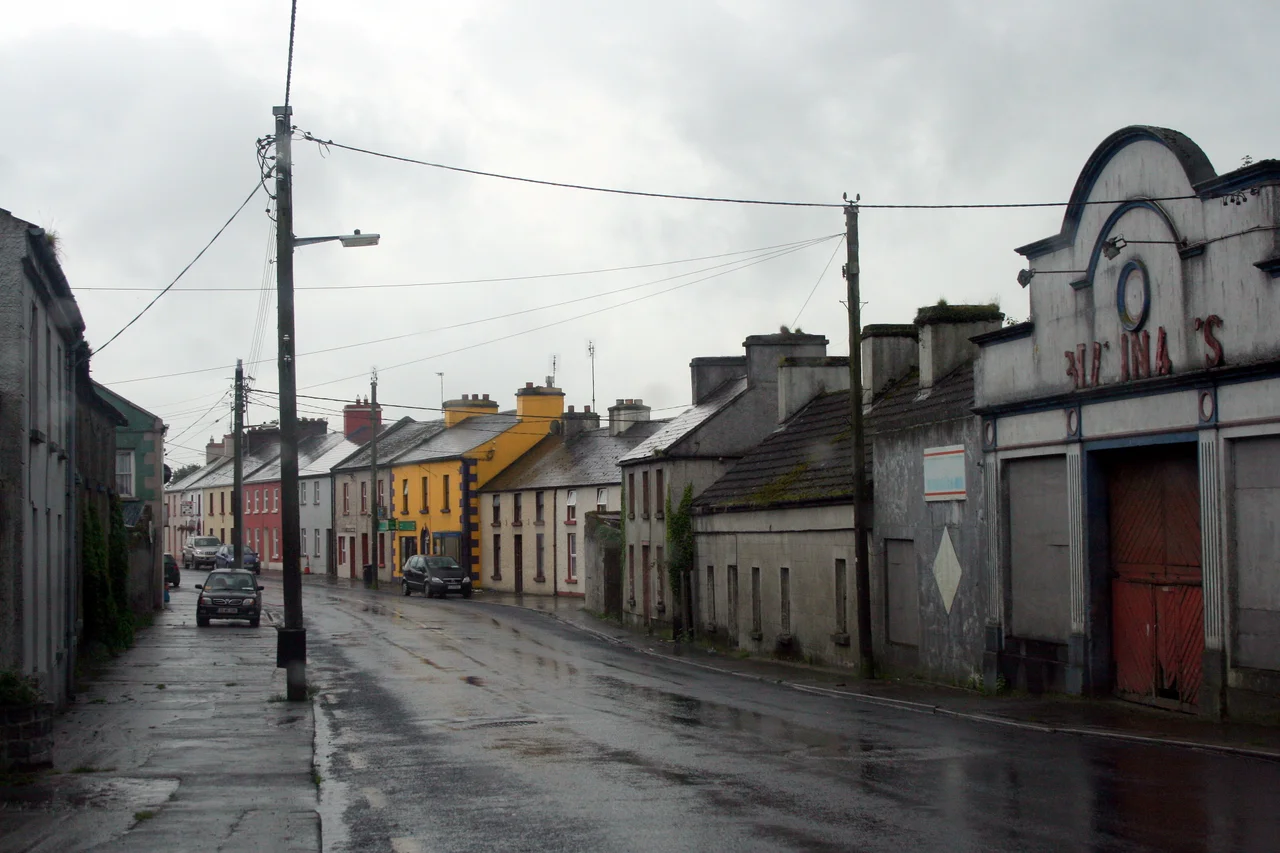

Ahascragh
Áth Eascrach—'the ford of the gravel ridge'—is the Irish original. The ford is across the Ahascragh River, also called the Bunowen, a tributary of the River Suck. The gravel ridge is glacial: the kame and esker country of east Galway, where the last ice age left long sinuous mounds of sorted material that the local roads still follow. Modern Ahascragh is a single street and a handful of side lanes, population 186 at the 2022 census, eleven kilometres north-west of Ballinasloe. From this address, in the past two centuries, came one of Ireland's most internationally famous milliners, two former Tánaistí, and a saint whose death was recorded in the Annals of the Four Masters in 788 A.D.
Saint Cuan and the Battle
The patron saint of Ahascragh is Saint Cuan, whose death the Annals of the Four Masters mark in 788. The Annals are also where you find the next significant event: in 1307, English forces clashed with the local O'Kelly chieftains in the Battle of Ahascragh. The O'Kellys—Uí Maine, one of the great medieval Gaelic dynasties of Connacht—held this country for centuries. Their hereditary stronghold, Clonbrock Castle near the village, is a late fifteenth-century tower house that still stands in fragmentary form, a reminder of the architecture Irish chieftains used when battle was a regular feature of estate management. The Annals record the battle. The Annals do not record who won.
Two Anglo-Irish Estates
The plantations transferred Ahascragh's productive land from the O'Kellys to two Anglo-Irish families. The Mahons settled at Castlegar from the late seventeenth century, intermarrying with the Brownes of Westport and gaining a baronetcy in 1819. By the 1870s the Castlegar estate covered over 32 square kilometres of County Galway. The Dillons, who acquired their lands from the O'Kellys in the late sixteenth century, built their seat at Clonbrock in the 1780s. Luke Dillon, 2nd Baron Clonbrock, was listed as a resident proprietor in 1824. By the 1870s the Clonbrock estate ran to over 110 square kilometres. Both estates are gone now. Castlegar passed out of Mahon hands in 1979. Clonbrock House, sold by the Dillon family in the 1970s, burned in 1986—the ruins still stand in the parkland, a Georgian shell roofed only with sky.
The Workmen of Clonbrock
Some of the most arresting photographs in the National Library of Ireland collection were taken at Clonbrock in the 1870s by the Dillon family themselves—amateur photographers using the new wet-plate technology to record their estate workers. The portraits show gardeners, masons, ploughmen, and labourers caught against the estate's outbuildings, their working clothes detailed, their faces direct. They are among the earliest extensive photographic records of rural Irish working people. The Dillons documented the people who built and maintained their world; what survives is a portrait of a class that almost never had its picture taken. The Clonbrock photographs are a small consolation for the silence around so many similar lives.
The Hat-Maker and the Politicians
Philip Treacy was born and raised on Church Street in Ahascragh in 1967. He went on to become one of the most celebrated milliners of his generation, designing hats for Madonna, Lady Gaga, and the British royal family. The hats worn by the Princesses Beatrice and Eugenie at the 2011 wedding of Prince William and Catherine Middleton were his work. Treacy's signature pieces—architectural, sculptural, sometimes startlingly avant-garde—are in permanent collections at the Victoria and Albert Museum. Eamon Gilmore, born 1955 in the nearby village of Caltra within the parish of Ahascragh, served as Tánaiste from 2011 to 2014 as Labour Party leader. Mary Harney, born 1953 to a Fianna Fáil farming family from the same area, was Tánaiste from 1997 to 2006 as Progressive Democrats leader. From a village of 186 people came two deputy heads of government and a hat in the V&A.
Don't Feed the Gondolas
In the late 1990s, RTÉ aired a satirical comedy show called Don't Feed the Gondolas, presented by Sean Moncrieff. Each episode ended with a sketch satirising small-village Ireland through the fictional 'Head of the Parish Co-mit-tea' Monica Loolly, a Mrs-Doyle-style stereotype of rural respectability. The village they chose for the satire was Ahascragh. The villagers were good-humoured about it. Small Irish places have a long memory and a longer sense of humour, and being chosen as the comic stand-in for every rural community in Ireland is, in its way, a kind of fame. The actor Seán 'ac Donncha, headmaster of the Ahascragh national school until his death in 1996, was one of Ireland's great traditional singers. The school is still there. So is the singing. The Bunowen river still holds wild brown trout, the Eglish National School still teaches around forty children, and Ahascragh is still slightly smaller than the press notices for its famous sons would suggest.
From the Air
Ahascragh is at 53.40°N, 8.33°W in east County Galway, on the R358 regional road about 11 km north-west of Ballinasloe. Cruise at 2,000–4,000 feet and the village reveals itself as a small linear settlement along the road, with the Bunowen River curling around the eastern side. The ruined Clonbrock House sits within tree cover 3 km south-east. Nearest airports are Shannon (EINN) about 75 km south and Galway (EICM) to the west. The River Suck runs north-south 8 km east; the wider east Galway lowlands extend in every direction.
Nearby Stories
- Gort 2.7 km away
- Roscommon 5.6 km away
- Milltown, County Galway 7.4 km away
- Lorrha 9.7 km away
- Durrow Abbey 15 km away
- Marine Institute Ireland 17 km away
- Clonfin Ambush 19 km away
- Ballyfin 21 km away