
Roscommon
Lady Betty was sentenced to hang. Then the gaol of Roscommon found itself without an executioner, and the law required one, and they made her an offer: hang others, and live. She agreed. For decades she pulled the lever in the yard at the north end of the market square - the only female executioner in Irish history, walking out from the gaol Richard Cassells had designed in 1745, doing the work that had been her own sentence. The building she worked in lasted into the 1980s when a developer demolished it down to the facade. The town it served is a thousand years older than her story and a hundred times stranger.
St Coman's Wood
The name comes from Comman mac Faelchon, who built a monastery here in the 5th century. The woods around it became Ros Comain - St Coman's Wood - and Anglicisation eventually flattened the Irish into Roscommon. The Annals of the Four Masters, of Inisfallen, of Loch Ce, and of Ulster all record the abbots and bishops of Ros Comain across nine centuries: Aedhan died in 777, Forbhasach in 774, Aed in 782, Siadhail bishop and abbot in 813. Joseph son of Nechtain rested in 830. The lineage is dense. The 2022 census put the town's population at 6,555 - small, but never small in importance. A gold lunula and two gold discs from 2300 to 1800 BC were dug up here in 1945, confirming what the abbots already knew: this had been holy ground for a very long time.
Felim's Abbey
Roscommon Abbey - more accurately a Dominican friary - was founded around 1253 by Felim O'Connor, King of Connacht. He was buried in it himself in 1265. His effigy in the chancel, carved decades later, shows a king in long English-style robe and mantle holding a fleur-de-lis sceptre - an Irish ruler dressed like the English monarchs his sons would fight. Below his slab, eight 15th-century carved gallowglasses stand in armoured niches: Scottish mercenaries in coats of mail, bascinets on their heads, swords in their hands, except one bearing an axe-like sparth. These were the men the O'Connors hired by the shipload to fight the Anglo-Norman lords. The abbey burned in 1270, was struck by lightning in 1308, was robbed by Lord Audley, was suppressed at the Reformation. Its medieval lancet windows are still there. So is Felim, lying in stone where he was put 760 years ago.
Roscommon Castle
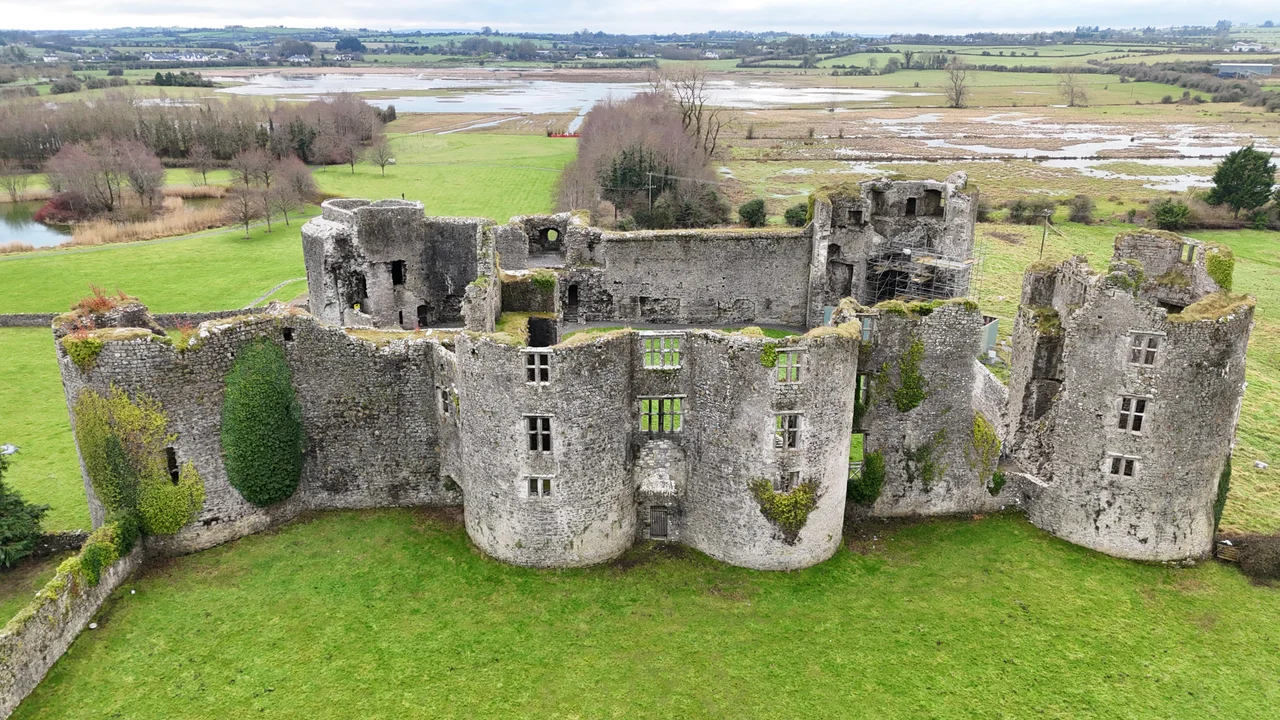
Built in 1269 by Robert de Ufford, Justiciar of Ireland, on lands he had seized from the Augustinian Priory, Roscommon Castle is one of the great early Anglo-Norman fortifications in Connacht: quadrangular, four corner D-shaped towers, twin towers at the gateway, the whole thing enclosed by a tall curtain wall and surrounded by a moat. It changed hands constantly. King Aodh O Conchobhair besieged it in 1272. The English garrisoned it again by 1280. The O'Connors took it back by 1340 and held it for two centuries. In 1569 Sir Henry Sidney, Lord Deputy, seized it for Elizabeth. Sir Nicholas Malbie remodelled the interior with large mullioned windows in 1580. Confederate Catholics under Preston captured it in 1645. Cromwellian Ironsides blew it up in 1652. It burned for the last time in 1690 and gradually decayed. It stands today, vast and roofless, on a low hill outside the town - a national monument in stone.
The Workhouse and the Famine
Roscommon suffered as badly as any town in Ireland during An Gorta Mor. The workhouse was built in 1840 to hold 700 paupers; during the worst famine years it tried to hold 1,600. In January 1847 a notice went up outside the door: no new applicants could be admitted. There was no more space, no more food, no more medicine. People who had walked miles to seek help were turned away. Many of those who got inside died inside and were buried in Bully's Acre nearby - a mass grave with no individual markers. Roscommon's population dropped 31.5 per cent in the famine years, among the highest losses recorded in any Irish county. The workhouse building is still there, now the Sacred Heart Home. Outside it stands an Irish Famine Memorial, raised in 1999 by the people of Roscommon to remember the thousands who never came out.
The Skyline
Sacred Heart Catholic Church dominates the town today: 52 metres of spire, built of local cut stone, opened in 1903 and completed in 1925. Over the main door is an Italian-made mosaic of two bishops of Elphin. Inside, until May 2016, was a replica of the Cross of Cong - the original made at Fuerty between 1120 and 1123 - until thieves took the replica and disappeared. Harrison Hall on the market square was originally a courthouse and market house, became a Catholic church, then a dance hall, then a cinema, then a theatre, and is now a branch of the Bank of Ireland. The Roscommon County Museum is housed in a Presbyterian church built in 1863 by Welsh stonemasons who put a Star of David window over the door. Doors lead to abbeys, abbeys lead to kings, kings lead to graves. The town has been making layers for fifteen hundred years and is still making them.
From the Air
Roscommon lies at 53.63°N, 8.18°W, in the centre of Ireland, at the meeting of the N60, N61, and N63 roads. Recommended viewing altitude 2,500-4,000 ft to take in the town's heritage cluster: the ruined castle on its hillside northwest, the abbey on the south outskirts, and the Sacred Heart Church spire dominating the skyline. The town sits on rolling lowland; Lough Ree (Shannon) lies 30 km east. Nearest airport: Ireland West Airport Knock (EIKN), 50 km northwest. The county is famous for racing - Roscommon Racecourse is 1.6 km from the centre.
Nearby Stories
- Boyle Abbey 2.5 km away
- Holywell ambush 5 km away
- Ahascragh 6.3 km away
- Aclare 11 km away
- Clonfin Ambush 12 km away
- Killeshandra 14 km away
- Kilbeggan Distillery 17 km away
- Annaghdown 20 km away