
Marine Institute Ireland
Ireland is an island nation that for most of its history treated the sea as somebody else's problem. That changed slowly. In 1974 a National Science Council report called Ireland, Science and the Sea pointed out the obvious - that a country with one of the longer coastlines in Europe might benefit from actually studying the water around it. It took seventeen years for the recommendation to become law. The Marine Institute Act of 1991 created the agency that today runs three purpose-built research vessels, monitors fish health, maps the seabed, and keeps a deepwater submersible called Holland 1 in a hangar on the Galway Bay peninsula at Rinville.
From Abbotstown to the Bay
The institute's first chair was Dr Maire Mulcahy, a zoologist and ecologist; the founding chief executive was Dr Peter Heffernan. They started small in 1991 and grew through 1995 with four programme managers covering marine environment, food, technology, and leisure and tourism. The institute absorbed the Irish Marine Data Centre and the existing research facilities at Abbotstown in County Dublin, along with the Salmon Research Agency at Newport in Mayo. The first purpose-built Irish research vessel - RV Celtic Voyager, 31 metres - arrived in 1998. The bigger 65-metre deepwater vessel RV Celtic Explorer followed in 2002. In 2006 the institute moved its headquarters out of Dublin entirely, to a new purpose-built laboratory complex on a peninsula at Rinville near Oranmore. Holland 1 - a deepwater Remotely Operated Vehicle capable of working at three kilometres depth - was delivered in 2008.
The Headquarters
The building at Rinville has won several architectural awards. It sits on a peninsula southwest of Oranmore, looking out across the inner reaches of Galway Bay - the same waters where the Marine Institute's vessels tie up between cruises. The complex houses research laboratories, an auditorium, a marine science library, and an office building shaped in a crescent. About two hundred staff work there: specialists in fisheries assessment, marine environmental science, technology, aquaculture and catchment management, ocean energy, functional foods, and increasingly marine climate change. Additional facilities operate at Furnace near Newport in County Mayo - the aquaculture and catchment management lab - plus offices and laboratories in Ireland's fishing ports. The Irish Maritime Development Office, focused on shipping services, runs out of Dublin.
Celtic Voyager, Explorer, Tom Crean
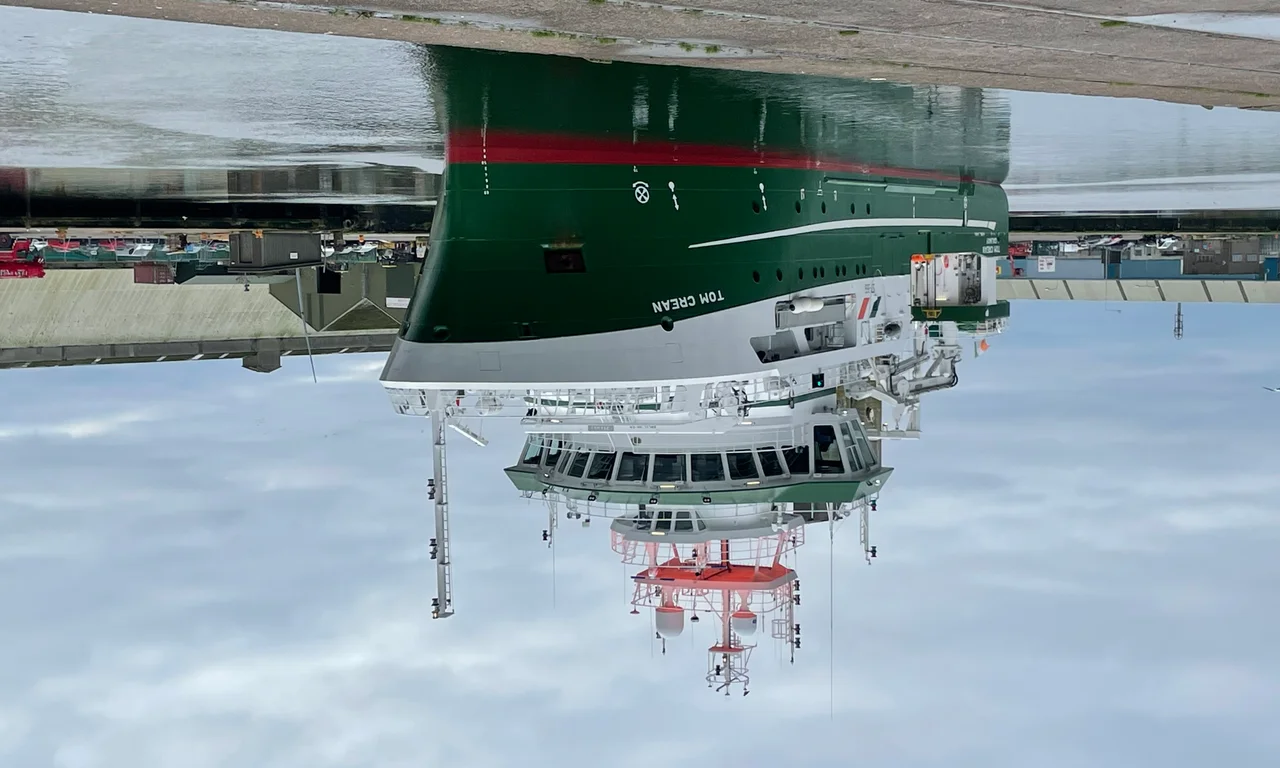
Three research vessels carry the work to sea. RV Celtic Voyager, smallest and oldest at 31 metres, was Ireland's first purpose-built marine research ship - a workhorse for coastal surveys. RV Celtic Explorer at 65 metres handles deepwater science across the North Atlantic continental shelf. The newest, RV Tom Crean, launched in 2022 after a two-year build in Vigo, Spain. The ship is named for the Antarctic explorer who served on Robert Falcon Scott's Discovery and Terra Nova expeditions and on Ernest Shackleton's Endurance - a Kerry man who became one of the few people to set foot on Antarctica three times in the heroic age. The Tom Crean and Celtic Explorer between them carry out the bulk of Ireland's fisheries surveys, seabed mapping, oceanographic monitoring, and seismic work for the broader European research community.
Fish, Food, and Stock Books
Marine Environment and Food Safety Services - MEFS - runs the institute's role as Ireland's National Reference Laboratory for fish, mollusc, and crustacean diseases. The Fish Health Unit tests samples from across Irish aquaculture, the legal requirement for any country that wants to trade salmon or oysters to the European Union. The Fisheries Ecosystems Advisory Services unit - FEAS - assesses fish stocks in Irish waters and publishes the annual Stock Book that informs Ireland's negotiations at the EU's December fisheries council, the meeting where quotas are fought over for the year ahead. Ocean Science and Information Services runs the research vessel fleet, the Irish Marine Data Buoy Observation Network of five buoys around the coast, and the seabed-mapping work for the INFOMAR project - the Integrated Mapping for the Sustainable Development of Ireland's Marine Resource.
Why the Sea Matters
The institute's mandate is unromantically practical: support government decision-making, enable sustainable industry, protect the marine environment. The Stock Book determines how much mackerel an Irish boat may catch this year, how the prawn fishery in the Irish Sea is managed, how the salmon farms in Mayo are monitored for sea lice. The seabed maps determine where wind farms may be built. The data buoys feed the storm warnings that keep fishermen alive in winter. Holland 1, the deepwater ROV, has been used to map cold-water coral reefs off Ireland's continental shelf - structures the existence of which was barely known when the Marine Institute was created in 1991. The peninsula at Rinville faces west across the bay, and on most working days at least one of the research vessels is somewhere out there in the Atlantic, sampling something.
From the Air
The Marine Institute headquarters sits at 53.25 N, 8.98 W on Rinville (Renville) peninsula, southwest of Oranmore on the south shore of Galway Bay. Galway Airport (EICM) lies about 13 km north-east; Shannon (EINN) is 55 km south. From altitude the institute reads as a modern complex with a distinctive crescent-shaped office building on the tip of a small peninsula reaching into the bay. The research vessels are often tied up at the adjacent quay - the Celtic Explorer in particular is visible as a substantial blue-and-white hull. The peninsula sits inside Galway Bay's relatively sheltered inner reaches; Atlantic weather is moderated but mist is common.
Nearby Stories
- Connemara Railway 3.8 km away
- Ennis 7.2 km away
- Headford 10 km away
- Inishmaan 12 km away
- Ballygar 12 km away
- Ardgraigue Bog 13 km away
- Nenagh 17 km away
- Kilkee 27 km away