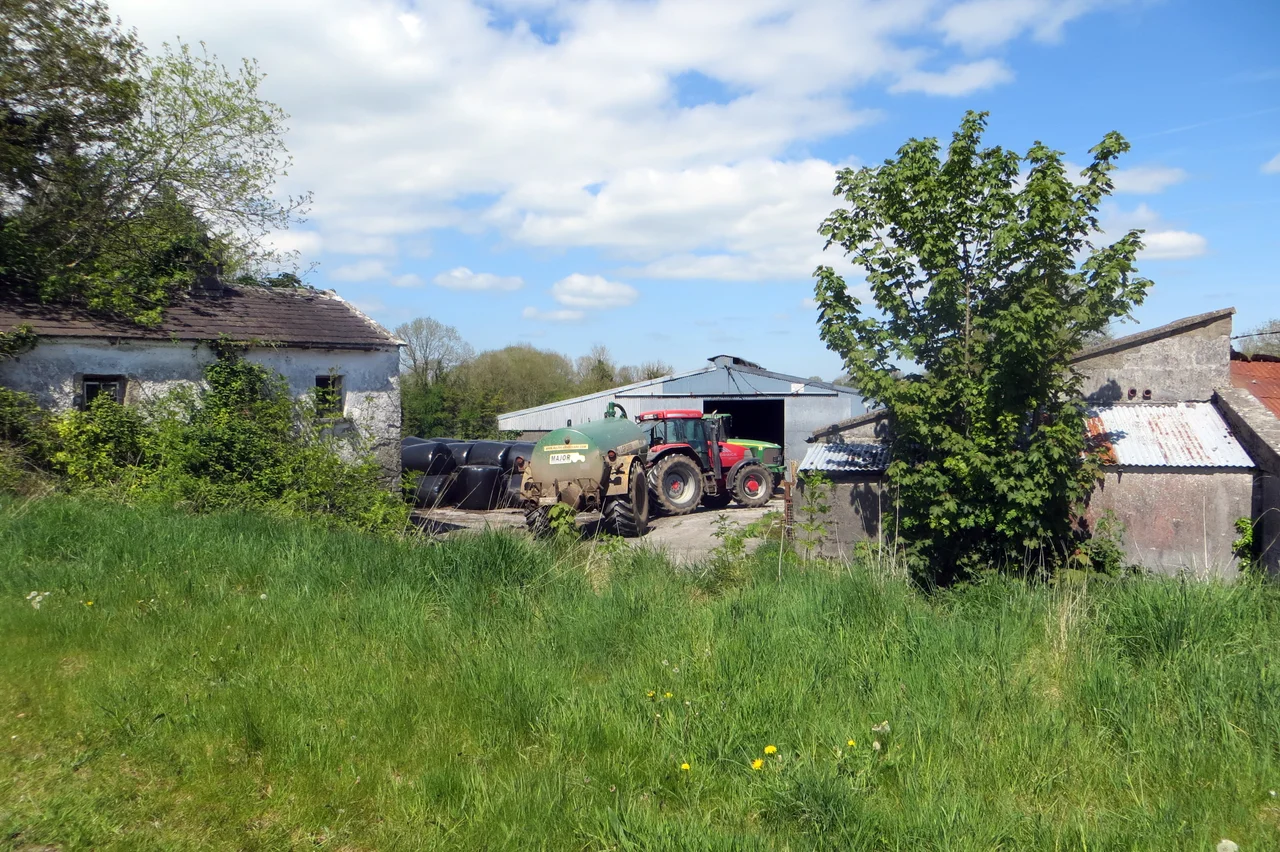

Ballyglass
There is a building in Ballyglass called the Garda Barracks. It was built as a hotel. The hotel was built to serve passengers who would arrive at the new train station. The train station was never built. This is a village largely defined by what never quite happened, and yet the most extraordinary thing in its catchment area is something nobody planned at all: a small wooden house, uncovered by archaeologists in 1970, that has been sitting under a megalithic tomb for roughly five thousand years.
Older Than Almost Anything
In 1970, archaeologists excavating a court cairn near Ballyglass were working their way toward the center-court tomb when they hit timber. Not modern timber, but the post-holes and floor outline of a rectangular wooden house. Carbon dating placed the structure at roughly 3000 BCE, slightly older than the tomb built on top of it. That made it Neolithic. It also made it one of the only Neolithic houses ever discovered in all of Ireland and Great Britain. Most early farmers across these islands lived in structures that left almost no archaeological trace. Their floors rotted, their posts collapsed, their fires went cold and the ground reabsorbed them. Somehow, this one house in Mayo survived to be found, and only because someone covered it with stone and made it the foundation of a tomb.
The Train That Never Came
Most of rural Ireland was reshaped, however briefly, by the railway boom of the nineteenth century. Towns that got a station prospered. Towns that did not, did not. Ballyglass was promised a station on a line that would run through central Mayo. Investors moved. A hotel was built to house the travelling salesmen and tourists who would soon arrive. Then the plans changed. The line ran somewhere else. The hotel that was meant to anchor a thriving railway town was eventually given over to the Garda Síochána as a police station instead. A century later it was closed and sold at auction in 2021. The same pattern shows up across the village: The Old Ground, now a public house, started as a warehouse. The court house used to stand where Murphy's guest house is today. The buildings keep adapting, even when the original plans dissolve.
A Field of Forts
Step away from the village center and the land tells a longer story than any building can. The catchment area around Ballyglass is dense with Raths and ringforts, the circular earthen enclosures that early medieval Irish families used as defended farmsteads. There are Bronze Age burial sites, scattered standing stones, and fulachta fiadh, the ancient cooking pits that show up wherever Iron Age communities boiled meat with hot stones. None of it is marketed. Most of it has no signpost. The fields are working fields, and the monuments sit in them the way they have for thousands of years, fenced around by farmers who simply farm around them. To know they are there, you have to look at the Ordnance Survey maps. The land does not advertise its age.
Mary Robinson Opened the Pitch
Ballyglass Football Club was founded in 1975. It is the kind of soccer club, distinct from the more dominant GAA, that exists in nearly every Irish village, fielding a senior side and youth teams and surviving largely on volunteer labour. The grounds were officially opened in 1989 by Mary Robinson, then a barrister, soon to be the first woman ever elected President of Ireland. The club has since won the Mayo Association Football League title twice, a modest record made notable mainly by the fact that a future head of state once cut its opening ribbon. In 2008, the Minister of State for Children, Barry Andrews, returned to the village to turn the first sod for a new playschool behind the old Mountpleasant National School, vacated since 1986. The village kept asking politicians to come, and the politicians kept coming.
The Quiet Centre
Ten miles from Castlebar, closer to Claremorris and Ballinrobe, Ballyglass has one shop, two pubs, a primary school, a playschool, a community center, a tennis court, a soccer pitch, a football team, a post office, and a part-time dispensary. The list reads like an inventory of essential rural infrastructure, the basics required to keep a community functioning when everything around it is contracting. The Neolithic house under the cairn is a few kilometers away. The hotel-that-became-a-barracks-that-was-sold-at-auction is at the heart of the village. Five thousand years of human settlement compressed into a village so small that most people drive through it without realising they have arrived.
From the Air
Ballyglass sits at 53.75°N, 9.18°W in central County Mayo, about 10 miles east of Castlebar. The Partry Mountains rise to the south-southwest, Lough Mask further south. Best viewed from 3,000-5,000 ft AGL. Ireland West Airport Knock (EIKN) is approximately 25 nm east; Galway (EICM) about 55 nm south-southeast. The village itself is small; the Neolithic site lies in surrounding farmland.
Nearby Stories
- Toombeola 1.6 km away
- Aughnanure Castle 3.7 km away
- Inishbiggle 5.2 km away
- Uggool Beach 7.4 km away
- Ballyhaunis 7.4 km away
- Crossmolina 15 km away
- Ballymote Castle 22 km away
- Ahascragh 31 km away