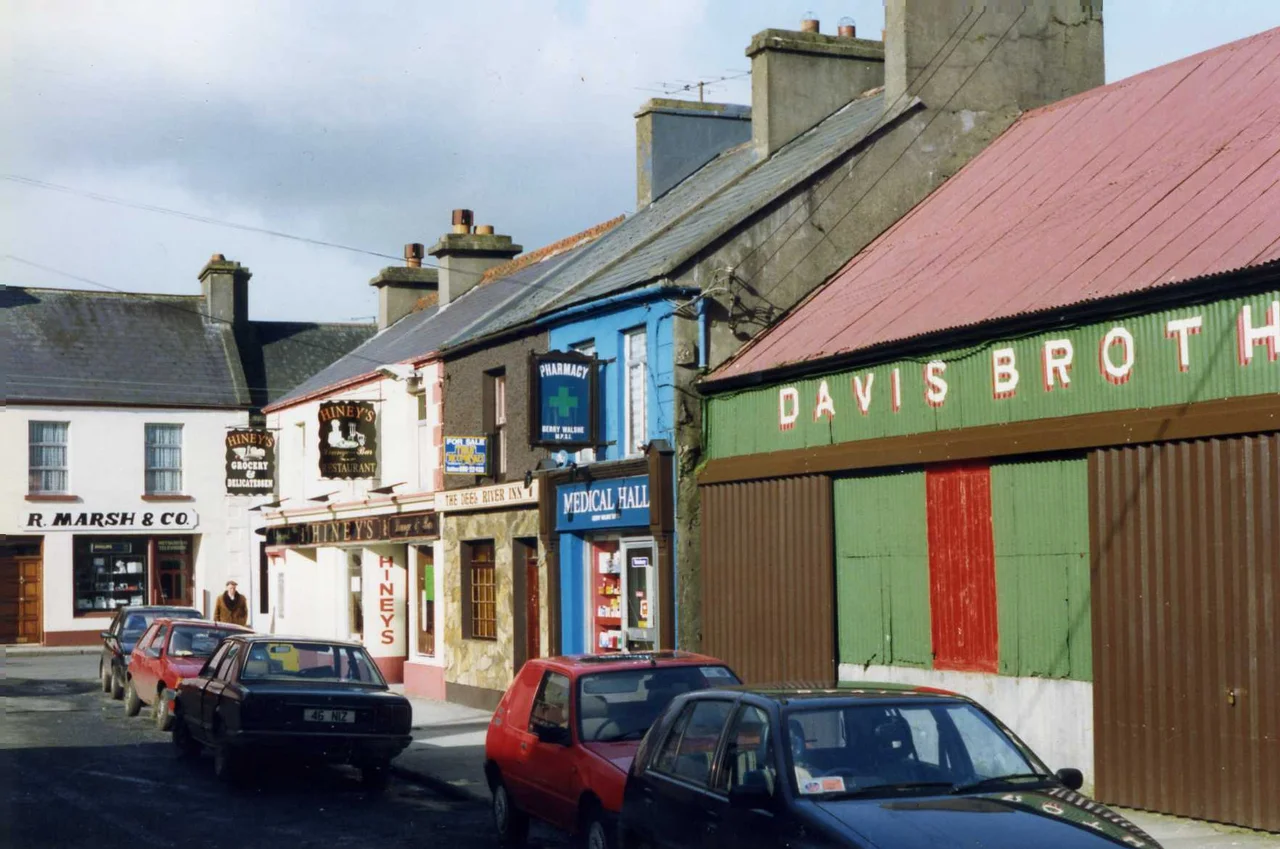

Crossmolina
In June 1843, the body of a young woman was found drowned in the river at Crossmolina. An apron was tied around her feet. Her knees were bound together with a shirt. A piece of ribbon was tied around one of her arms in a way that suggested both arms had been bound, and that she had managed to free one before she died. The deceased, the local press reported, 'appeared to have been a young woman of considerable beauty'. She was never identified, and no one was ever charged. The mystery of the drowned woman of Crossmolina is one of dozens of stories this small Mayo town has carried for centuries without ever quite resolving. Crossmolina has a way of generating remarkable people and unsolved questions in roughly equal measure.
St. Tiernan's Bog
Crossmolina takes its name from Crois Mhaoilíona, the Cross of Maoilíona, an early Christian figure whose marker once stood near the town. The settlement itself is much older. Errew Abbey, on a small peninsula jutting into Lough Conn just south of the town, was founded by Saint Tiernan in the sixth century. The ruins that survive there now date from the thirteenth century, after the abbey was rebuilt by Augustinian canons. Cromwell's troops finally finished the medieval abbey off in the 1650s. Lough Conn itself is Ireland's seventh-largest lake, covering about 14,000 acres, famous among anglers for its char and its wild brown trout. It has never been artificially stocked. The wild fish are the descendants of the same fish Saint Tiernan would have seen in the sixth century, give or take some glacial reshuffling.
The Priest at Enniscoe Gate
In February 1839, the parish priest of Crossmolina, Father John Barrett, was murdered at Enniscoe Gate, about a mile and a half from the town. He had been walking home late at night from Crossmolina to his residence. Local belief at the time was that he had been killed because he denounced from the pulpit the activities of a local secret society called the Steel Boys. The Steel Boys were one of many agrarian secret societies that flourished in rural Ireland in the early nineteenth century, alongside the Ribbonmen and the Threshers, all of them resisting landlord power through a mixture of intimidation, sabotage, and selective violence. They did not appreciate being denounced by their parish priest. The murder went unsolved. The grim pattern repeated across the area for decades, with magistrates, informers, and parish priests all targeted depending on which secret society was active at the time, and which had been recently betrayed.
Hunger by Name
By 1846, the Great Famine had reached its full devastation in Crossmolina. The local coroner, Mr. Atkinson, and the local doctor, Dr. McNair, did something that most rural Irish authorities did not do during the famine: they recorded the names of the people who died of starvation, and reported them to the press. At an inquest in December 1846, Michael Walsh, John Munnelly, Michael McGevir and Anthony Mally were found to have died from starvation in Crossmolina. James Fleming, aged 60, and his son Edward Fleming, aged 13, died of hunger in March 1847 in Corrabeg. Bernard Rogan died in the town in December 1846, having travelled from Limerick begging. Michael Moran died the same month after six weeks of begging for food. In February 1847, Mary Minn and Patrick Gorman were recorded as starvation deaths, along with sixteen more in surrounding villages. In March 1847, the body of Bridget McDermott was found dead in the town. The population of the Crossmolina area fell from 12,221 in 1841 to 7,236 by 1851. The named dead are a fraction. The unnamed make up the rest of the missing six thousand.
Patrick Nally
In May 1883, six local men were arrested in the so-called Crossmolina Conspiracy: Thomas Daly, Thomas Macaulay, James King, Richard Halloran, Patrick Nunelly, and Patrick Nally. The charge was conspiracy to murder local landlords and their agents. A search of their houses turned up two rifles, a revolver, and explosives. Patrick Nally was a member of the Supreme Council of the Irish Republican Brotherhood, the underground Fenian organisation working for an independent Irish republic. He was convicted, sentenced to ten years, and died of typhoid in prison in November 1891 before serving out his term. He never saw what his work helped create. In 1952, the Gaelic Athletic Association erected a stand at Croke Park named the Nally Stand in his memory. He had been instrumental in the founding of the GAA, helping organise athletics meetings in the early 1880s that became the framework for what is now the largest sporting body in Ireland.
Two Crashes in the Bog
Ireland was officially neutral during the Second World War, but the bogs of North Mayo saw their share of the war anyway. On 13 March 1942, a Bristol Blenheim bomber crashed in Killeen, just outside Crossmolina, during a training flight from the Isle of Man. The crew had lost their bearings after a wireless failure and ran out of fuel. Two crew members were seriously injured but survived. The less injured were repatriated to Northern Ireland the next day. Seven months later, on 25 October 1942, an RAF Boston Douglas light bomber from Newfoundland tried an emergency landing in Pulladoohy near Crossmolina, mistook the bog for a flat field, and flipped upside down. The Norwegian pilot, Captain Nils Rasmussen, was killed and given a military funeral at Kilmurray Cemetery. Local Defence Force members and the Irish Army assisted the survivors, who were quietly sent on to Northern Ireland a few days later. Both crashes happened in the same kind of soft wet peat that has eaten so much else over the centuries. The crews who survived owed their lives to the bog being too soft for the planes to break up properly. The pilot who died owed his death to the same softness.
From the Air
Crossmolina sits at 54.10°N, 9.32°W in North County Mayo, about 9 km west of Ballina on the N59 road. The town is on the River Deel just north of Lough Conn. The Nephin Mountains rise to the south. Best viewed from 3,000-5,000 ft AGL. Ireland West Airport Knock (EIKN) is approximately 35 nm south-southeast. The lough is the most prominent visual landmark. The town centre with its two churches (St Tiernan's Catholic and St Mary's Church of Ireland) is the focal point.
Nearby Stories
- Ballyhaunis 2.9 km away
- Ballintubber Abbey 4.2 km away
- Doohoma 6.9 km away
- Lissadell House 14 km away
- Caher Island 15 km away
- Ballymote Castle 18 km away
- Ballygilgan 50 km away
- Action of 7 May 1794 63 km away