
Ballygilgan
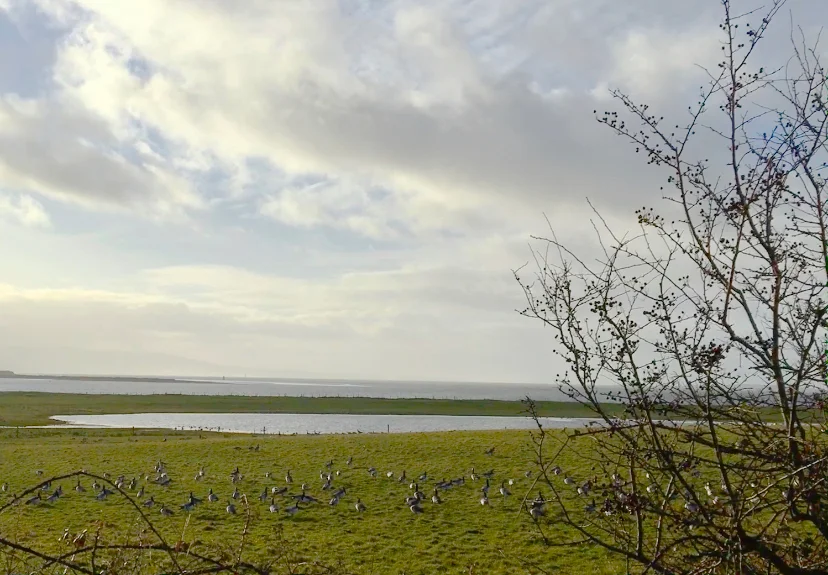
Every October, the sky above the Maugherow Peninsula in north Sligo fills with the harsh barking calls of barnacle geese arriving from Greenland. Around three thousand of them - Ireland's biggest mainland flock - descend on a 73-acre nature reserve near the Lissadell estate called Ballygilgan, or more affectionately, the Goose Field. They will spend the winter here, grazing the pasture and resting on the seasonal freshwater pond, until April carries them back across the Atlantic to breed on Greenland's cliffs. Without this small patch of protected land, this flock might no longer exist in Ireland at all.
Saving the Flock
The Irish government legally protected Ballygilgan as a national nature reserve in 1986, specifically to preserve the overwintering barnacle geese whose numbers had been falling alarmingly through the 1970s. The cause was familiar - habitat loss, disturbance, hunting on the migration route - and the response was simple: set aside the land they actually used, and keep them safe on it. The strategy worked. The flock now numbers consistently around 3,000 birds, Ireland's largest mainland gathering of the species, managed by the National Parks & Wildlife Service. It is one of those quiet conservation successes that doesn't generate headlines because the result is the absence of disaster.
Black-and-White Travellers
Barnacle geese are unmistakable up close - a sharp black-and-white plumage, white face, black neck and breast, grey wings. They are mid-sized geese, smaller than the more familiar greylag. The Irish population breeds in the high Arctic, on the cliffs and steep coasts of east Greenland, where the goslings famously launch themselves off ledges hundreds of feet above the ground within days of hatching, bouncing down the slopes to reach the feeding grounds below. By autumn the survivors fly south, across the Atlantic, to spend the dark months on the comparatively gentle pastures of western Ireland and Scotland. Ballygilgan is one of a handful of sites where they reliably congregate. They arrive in October. They leave in April. The cycle has been running for thousands of years.
Not Just the Geese
The geese are the main attraction but they are very far from the only birds at Ballygilgan. Through the winter the wet pastures and the seasonal pond host teal and wigeon ducks, pintails, shovelers, redshanks, greenshanks, bar-tailed godwits, golden plovers, lapwings, and dunlins. At the eastern end of the reserve, oats and linseed have been planted in a small cereal patch specifically to feed the smaller seed-eaters - chaffinches, bramblings, greenfinches, goldfinches, buntings. The whole reserve functions as a small refuelling station for the migrating bird life of the north Atlantic flyway. In summer, with the geese gone, the pasture is grazed by sheep and cattle to keep the sward at the height the returning birds will need.
Beside Lissadell
The reserve sits beside the Lissadell estate, which carries its own freight of Irish history - it was the childhood home of the revolutionary Constance Markievicz and her sister, the poet and suffragist Eva Gore-Booth, both of whom W. B. Yeats memorialised in his poem "In Memory of Eva Gore-Booth and Con Markievicz." The Goose Field and the great house share the same north Sligo light, the same Atlantic weather, the same view across to Benbulbin in the south and out to the open ocean in the west. It is a quiet corner of the country, easy to drive past without realising what you've passed. The geese know it's there. They have known for a very long time.
From the Air
Ballygilgan Nature Reserve sits at 54.341°N, 8.549°W on the Maugherow Peninsula in north County Sligo, beside the Lissadell estate and 15 km north of Sligo town. From the air, the 73-acre reserve appears as a distinct pattern of grazed pasture and a seasonal freshwater pond, with the Atlantic coast just to the west. Donegal Airport (EIDL) is 40 km north; Sligo Airport (EISG) is 17 km south. Benbulbin (526 m) rises 6 km southeast. Best viewed at 1,000-2,000 ft AGL; please maintain higher altitudes (1,500 ft AGL minimum) during the October-April overwintering season to avoid disturbing the geese.
Nearby Stories
- Roman Catholic Diocese of Killala 3.2 km away
- County Leitrim 6.2 km away
- Glencolmcille 8.3 km away
- Ballymote 8.5 km away
- Caves of the Tullybrack and Belmore Hills 15 km away
- Ballycastle, County Mayo 20 km away
- Castlederg 32 km away
- RMS Empress of Britain (1930) 80 km away