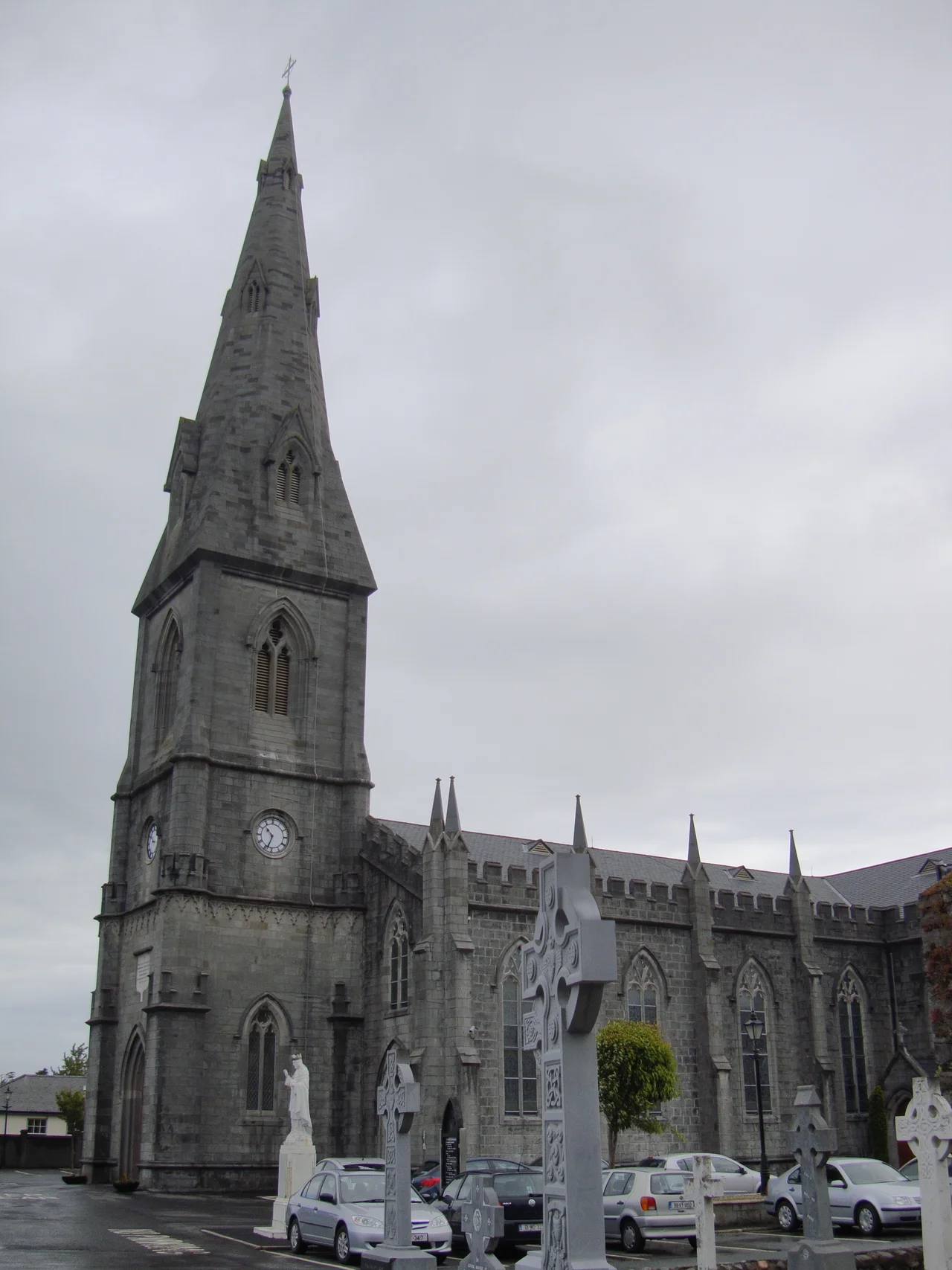

Roman Catholic Diocese of Killala
As of 2024, the Diocese of Killala has no bishop. The seat is what the Catholic Church calls 'Sede Vacante', the chair is empty, while Rome considers who should fill it. This is not unusual in the technical sense; vacancies happen routinely when one bishop retires before another is appointed. But it is unusual in scale and in symbolism. Killala is one of the smallest Catholic dioceses in Ireland, covering only the northernmost parts of County Mayo and County Sligo, and its current vacancy comes at a moment when the rural parishes that make up most of the diocese are emptying out faster than the church can find priests to serve them. The diocese was founded in 1111 AD by the Synod of Rathbreasail. It is older than the country it sits in. Whether it will outlive the population decline that has hollowed out its parishes since the Great Famine remains, in a quite literal sense, an open question.
Synod of Rathbreasail
In 1111, a synod of Irish bishops met at Rathbreasail and reorganised the entire Irish church into territorial dioceses, replacing the older monastic system in which abbots had held most of the ecclesiastical authority. Killala was one of the dioceses created that day. Its boundaries were revised and confirmed at the Synod of Kells in 1152. The first bishop of Killala recorded in Roman documents was Donatus O'Bechdha, whose possession of the diocese was confirmed in a rescript dated 30 March 1198 by Pope Innocent III. That document is unusually valuable for historians because it transferred ancient churches, monasteries and church properties to the bishop's authority, and in doing so recorded place names that would otherwise be lost. Insula Gedig, for example, was Iniskea, an island in Blacksod Bay. Inisgluairibrandani was Inisglora of Brendan, where the original monastery was reportedly founded by Saint Brendan the Navigator himself.
Bishop Kirwan in a Mouse-Infested Room
Francis Kirwan was appointed Bishop of Killala in 1645. He is the only bishop of Killala for whom a contemporary biography survives, written by his own nephew. The biography is therefore the best window we have onto life in this diocese in the mid-seventeenth century. Kirwan was one of four Irish bishops representing the Church at the Confederation of Kilkenny, the short-lived Catholic government that ruled most of Ireland during the 1640s. He introduced a small catechism and tried to set up a craft school. Then Cromwell's army arrived. Kirwan lost his residence in Killala and went into hiding in a mouse-infested room where he said Mass on a chest because there was no altar. He eventually returned in disguise to his native Galway. In June 1654 he was taken into custody with thirty priests, held for fourteen months, and then deported to Nantes in France. He never saw Mayo again.
Bellew and the Cathedral
By the late eighteenth century, the Penal Laws against Catholics had eased enough that bishops could function more or less openly, even if many laws remained on the books. Bishop Bellew, who served from 1779 to 1812, moved the ecclesiastical centre of the diocese from Killala itself to the growing town of Ballina. When the French landed at Killala in 1798 to support the Irish rebellion, Bellew kept a low profile despite the fact that his own brother had joined the French forces and been killed. Bellew was deeply involved in two of the great issues of his era: the founding of Maynooth College, where Irish Catholic priests would finally be trained at home rather than abroad, and the campaign for Catholic Emancipation, which would eventually pass in 1829. Construction of a new cathedral in Ballina began in 1827 to replace the old thatched chapel built around 1740. The first Mass in the new building was said in autumn 1831. The interior was left unfinished for years; the Great Famine put a halt to further work in 1846 when all church resources had to be redirected to feeding the starving. The cathedral was not finally completed until 1892.
Famine, Schooners, and Forgotten Burials
Killala Diocese was at the epicentre of the worst suffering of the Great Famine. In 1847, a Mayo road inspector reported that he had personally arranged the burial of 140 bodies he had found lying by the wayside. In the same year, fourteen schooners left Westport quay laden with wheat and oats, exported under armed guard to British markets while the people who had grown the grain were dying within sight of the harbour. The Sligo Champion of 26 February 1847 reported the horror in plain terms: 'Every hour the calamity is increasing, hundreds of unfortunate creatures have, within the last week, died of starvation. They were hurried to the grave coffinless and shroudless, so great is the mortality that the ancient customs are forgotten'. By 1851 a million had perished in Ireland and another million had escaped to America, Britain, and Australia. The diocese never recovered its pre-famine numbers. The cathedral that had been started in 1827 was finally finished, four decades later, in a country that had lost a third of its people.
Developing the West Together
The decline did not stop with the famine. In the 65 years up to 1991, Connacht and Donegal lost a fifth of their population, with the rate of net emigration from the west doubling between 1986 and 1991 even as the Irish birth rate halved. There were villages in the diocese where the total population between the ages of 20 and 35 was less than five people. In 1991 the western Catholic bishops launched a campaign called 'Developing the West Together'. Over 500 people attended a conference in Ballina. Over 200 attended in Belmullet. The process produced an EU-funded study of the West of Ireland called the Report on Crusade for Survival, eventually leading the Irish government to establish the Western Development Commission on 1 February 1999. The Commission still exists. The population decline has slowed, but it has not reversed. The diocese now sits without a bishop, in a region that the Catholic Church helped survive but could not quite save.
From the Air
The Diocese of Killala covers the northernmost parts of County Mayo and County Sligo, with its administrative centre and cathedral in Ballina. St Muredach's Cathedral sits at 54.11°N, 9.15°W on the east bank of the River Moy in Ballina. Best viewed from 3,000-5,000 ft AGL over Ballina. Ireland West Airport Knock (EIKN) is approximately 30 nm south-southeast; Sligo (EISG) about 25 nm northeast. The diocese stretches from Achill Island in the southwest across to Killala Bay and into Sligo.
Nearby Stories
- Ballyhaunis 2.9 km away
- Ballintubber Abbey 4.2 km away
- Doohoma 6.9 km away
- Lissadell House 14 km away
- Caher Island 15 km away
- Ballymote Castle 18 km away
- Ballygilgan 50 km away
- Action of 7 May 1794 63 km away