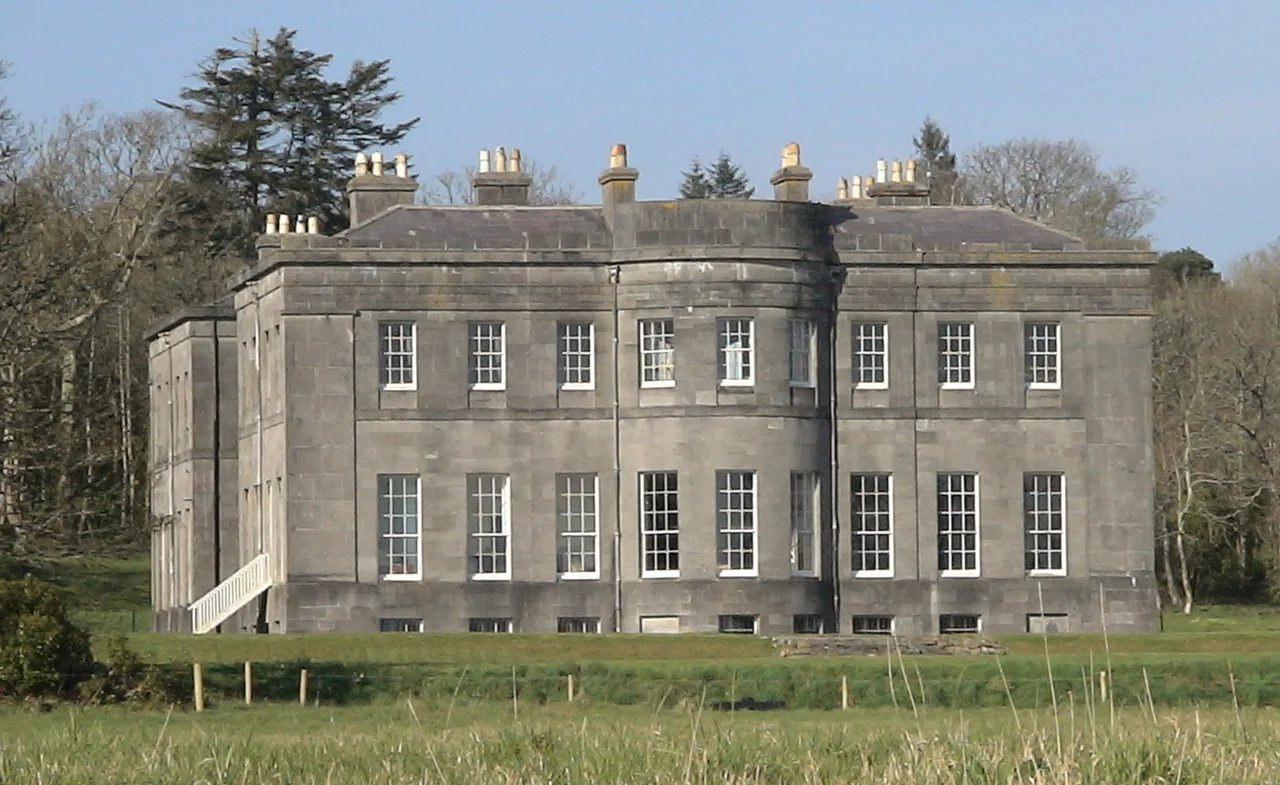

Lissadell House
'The light of evening, Lissadell, great windows open to the south, two girls in silk kimonos, both beautiful, one a gazelle.' W.B. Yeats wrote those lines for the Gore-Booth sisters he had known when they were young: Constance, who would marry a Polish count and pick up a rifle in 1916, and Eva, who would become a poet and a suffragist in Manchester. They grew up here, in a Greek Revival mansion on the south shore of the Maugherow Peninsula, with the windows facing south over Drumcliff Bay and Benbulben rising in the distance.
Austere in the Extreme
The house was built between 1830 and 1835 for Sir Robert Gore-Booth, 4th Baronet, by the London architect Francis Goodwin. Critics called it 'austere in the extreme,' a description the Gore-Booths seemed to take as praise. Nine bays wide, two storeys over a basement, built of Ballysadare limestone with finely jointed ashlar walling, it was the last Greek Revival country house ever built in Ireland. Goodwin designed the entrance front with a three-bay pedimented central projection, originally open east and west as a porte-cochere. The interior held Williams and Gibton furniture made specifically for the house, designed to harmonize with the architecture. Lissadell was also the first country house in Ireland to have its own independent gas supply piped in. The name comes from Lios an Doill Ui Dalaigh, the O'Daly's Court of the Blind, possibly referring to a thirteenth-century poetry school that operated on this ground long before the Gore-Booths arrived.
Two Girls in Silk Kimonos
Constance Gore-Booth was born in 1868. Eva followed two years later. Their childhood at Lissadell included hunting and riding through 32,000 acres of estate, summers when Yeats visited, the warmth and ease of Anglo-Irish aristocracy in its last comfortable decades. Constance went to Paris to study art. There she met and married the Polish-Ukrainian Count Casimir Markievicz, becoming Countess Markievicz. She became radicalized in Dublin, joined the Irish Citizen Army, and fought in the 1916 Easter Rising as second-in-command at St. Stephen's Green. She was sentenced to death, then commuted because she was a woman. In 1918 she became the first woman ever elected to the British House of Commons, though as a Sinn Fein member she refused to take her seat. Eva moved to Manchester, where she campaigned for women's suffrage and workers' rights alongside Esther Roper, her lifelong partner. Yeats's elegy for them, written after their deaths, returned again and again to that image: the great windows of Lissadell, the silk kimonos, the two beautiful young women who would each, in different ways, walk out of that drawing room and try to remake the world.
Yeats's Bitter Postscript
Yeats's poem 'In Memory of Eva Gore-Booth and Con Markievicz' is not entirely tender. He saw Constance's revolutionary politics as a waste of beauty. 'The older is condemned to death,' he wrote, 'pardoned, drags out lonely years, conspiring among the ignorant.' Eva, he thought, had grown 'withered old and skeleton-gaunt' in her Manchester slum work. The poem is one of his greatest, and also one of his most reactionary. The sisters became symbols. Lissadell became, through Yeats's lines, one of the most famous houses in Ireland, the place where a particular Anglo-Irish world had still been intact for one luminous evening before history came in through the great south-facing windows.
The Long Argument
The estate's history includes its harder chapters. Before the Great Famine, Sir Robert Gore-Booth cleared the settlement of Ballygilgan as part of estate 'improvement,' through what was called 'assisted emigration.' Whether those people went willingly is still argued. In the 1950s and 60s, an internal family dispute called the Lissadell Affair became a national scandal, with allegations of mismanagement and illegal timber felling. In 2003, Sir Josslyn Gore-Booth put the house up for sale. The Irish state, citing a 28 million euro estimated cost to refurbish it as a visitor attraction, declined to buy. Constance Cassidy and Edward Walsh, Dublin barristers, bought it instead and began restoring the house. Then they restricted public access through the estate, which triggered a legal war with Sligo County Council that lasted from 2008 to 2013. The Supreme Court eventually ruled in the owners' favor. The legal costs ran to roughly seven million euro.
What the House Holds
Constance Markievicz died in 1927. Eva had died the year before. Yeats wrote his elegy in 1927, looking back at a childhood scene that was already half a century gone. The house still stands, with its south-facing windows and its limestone facade and its memory of two sisters in silk. Leonard Cohen played a concert in the grounds in 2010. Westlife played one too. Visitors who pay admission can tour the rooms where Constance and Eva grew up before each went out, in her own direction, into the storm of the twentieth century. Benbulben is still visible from the long lawn, the same mountain Yeats made his epitaph in the churchyard at Drumcliff, eight kilometres to the south.
From the Air
Located at 54.35°N, 8.58°W on the Maugherow Peninsula, overlooking Drumcliff Bay. Best viewed at 1,500-3,000 feet to catch the house's south-facing facade and the bay below, with Benbulben visible to the southeast. Nearest airport is Sligo (EISG), 15 km south; Donegal (EIDL) is 40 km north. The peninsula juts northwest into the Atlantic; the house sits in mature trees on the southern shore.
Nearby Stories
- Roman Catholic Diocese of Killala 3.2 km away
- County Leitrim 6.2 km away
- Glencolmcille 8.3 km away
- Ballymote 8.5 km away
- Caves of the Tullybrack and Belmore Hills 15 km away
- Ballycastle, County Mayo 20 km away
- Castlederg 32 km away
- RMS Empress of Britain (1930) 80 km away