
Cavan
The phrase 'the life of Reilly' did not come from nowhere. It came from here. Cavan town was founded around 1300 by an Irish clan chief called Giolla Iosa Ruadh O'Reilly, Lord of East Breifne, and his descendants ran their lordship so prosperously, with such a productive marketplace and such powerful patronage, that the O'Reilly name slipped into English idiom as shorthand for living well. The medieval marketplace they built drew merchants from Dublin and Drogheda. The O'Reillys also, less famously, allowed counterfeit English and Scottish coins to be minted in their territory. A life of Reilly, it turns out, was complicated.
The O'Reilly Centuries
Cavan grew up around an O'Reilly castle on Tullymongan Hill, with a Dominican friary at its centre. The Dominicans were expelled in 1393 and replaced by Conventual Franciscans, but the friary tower still anchors the old graveyard on Abbey Street, and the medieval town's footprint is still visible in the kinks of Abbey Street, Bridge Street and Main Street. Bearded Owen O'Reilly expanded the marketplace in the fifteenth century, and the clan's wealth made Cavan one of the more important Gaelic trading centres in Ulster. During the Elizabethan persecution of Catholics, Archbishop Dermot O'Hurley, later one of the 24 Irish Catholic Martyrs, secretly visited fellow priests in Cavan from his hiding place in Slane Castle. He was eventually captured, tortured, and executed in Dublin in 1584.
Burned and Rebuilt
In February 1690, during the war that followed the Glorious Revolution, Williamite forces from Enniskillen marched on Cavan. Their commander, Colonel William Wolseley, attacked the Jacobite fort at Tullymongan that overlooked the town. The battle was sharp and the consequences harsh. Much of the town burned. The Jacobite general William Nugent was killed. The O'Reilly era was effectively over. Power passed to the Maxwell family, descendants of a Church of Ireland Bishop of Kilmore, who in time became Barons Farnham. Around 1780, the third Baron commissioned the architect James Wyatt to design Farnham House at Farnham, a few kilometres northwest of town. The house was later extended by Francis Johnston in 1810. It is now a Radisson Blu hotel, the kind of full circle that border-county Ireland specialises in.
The Orphanage Fire
Cavan's worst day came on 23 February 1943, when fire broke out at St Joseph's Orphanage. Thirty-five children and an elderly woman died. The public inquiry that followed found no formal culpability among the nuns who ran the home, but the questions never went away. Why were the children not evacuated faster? Why did the death toll climb so high in a building with so many exits? The secretary of the Commission of Enquiry was Brian O'Nolan, better known to Irish readers as the satirical writer Flann O'Brien, and his presence at the inquiry has been parsed by historians ever since. The Cavan Orphanage Fire remains one of the most painful episodes in the town's modern history. The children's deaths are still memorialised quietly within the community.
Gulliver and the Aquarium
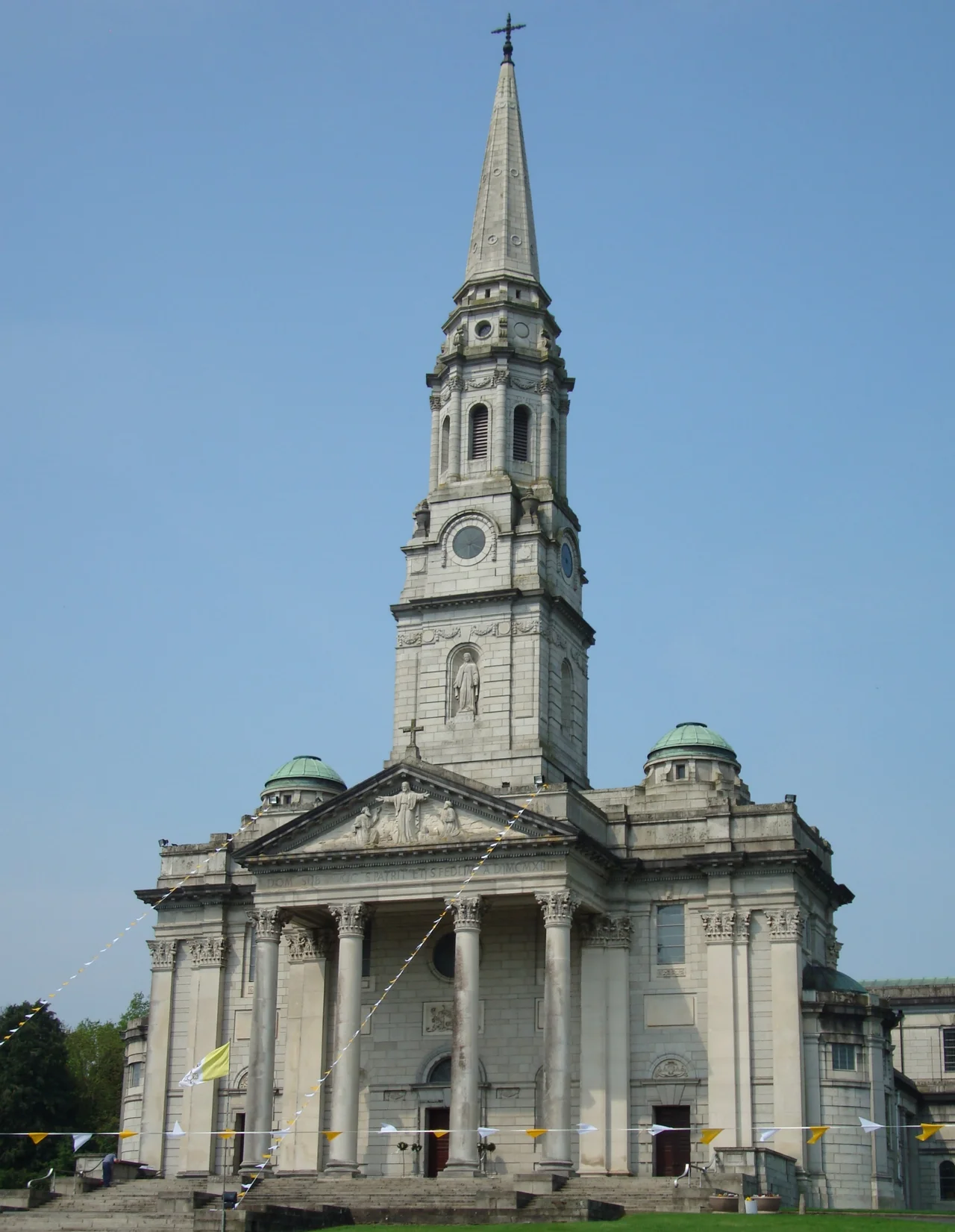
Cavan has long claimed Jonathan Swift, who wrote Gulliver's Travels while staying at his friend Thomas Sheridan's house at Quilca, a short ride south of the town. The connection is real and the town has leaned into it. The Cavan Central Library, opened in 2006 beside the Courthouse, includes an aquarium at its entrance, two large paintings by PJ Lynch commemorating Swift, and bog oak sculptures by local artist Joey Burns that trace Cavan's history through carved figures pulled from the bog. The Cathedral of Saints Patrick and Felim, begun in 1938, completes the town's spiritual axis, while the nearby Kilmore Cathedral five kilometres southwest contains a 12th-century Hiberno-Romanesque doorway that arrived from somewhere even older, possibly Holy Trinity priory on an island in Lough Oughter.
The Fleadh and the Lakelands
In 2010, 2011 and 2012, Cavan hosted Fleadh Cheoil na hEireann, the great Irish music festival run by Comhaltas Ceoltoiri Eireann. The 2010 Fleadh was the 50th and the first to be carbon-neutral, the first hosted in Cavan since 1954. Up to 250,000 visitors flooded the streets. About 10,000 musicians competed. The festival generates an estimated 20 to 25 million euros for its host town's economy, but in Cavan it did something more than that: it announced the town's return as a cultural centre after decades of being mostly a place people drove through on the way to somewhere else. The lakelands south and west of Cavan, anchored by Lough Oughter and Killykeen, are now positioned for ecotourism. The N3 motorway has put Dublin within easy reach. The old O'Reilly market town has grown rapidly in the last twenty years, with the kind of suburban expansion that would have astonished anyone counting hearths in 1660.
From the Air
Cavan town sits at 53.99°N, 7.36°W in the rolling drumlin country of Ulster, near the border with County Fermanagh in Northern Ireland. The N3 (Dublin-Donegal) and N55 (to Athlone) meet on the eastern bypass, and the Cathedral spires are visible landmarks from the air. Nearest commercial airports are Dublin (EIDW) about 110 km southeast and Belfast International (EGAA) about 130 km northeast. The town has no railway. The surrounding drumlin landscape, with its hundreds of small ovoid hills, was sculpted by Ice Age ice sheets and is dramatic from cruise altitude in low sun. Lough Oughter to the west is studded with small wooded islands. Best viewing altitude 2,000-4,000 ft.
Nearby Stories
- Oldcastle, County Meath 3.7 km away
- Roman Catholic Archdiocese of Armagh 3.8 km away
- Shannon-Erne Waterway 4.9 km away
- Boho, County Fermanagh 5.4 km away
- St Mel's Cathedral 8 km away
- Attack on UDR Clogher Barracks 9.3 km away
- Slane Festival 12 km away
- Ring of Gullion 18 km away