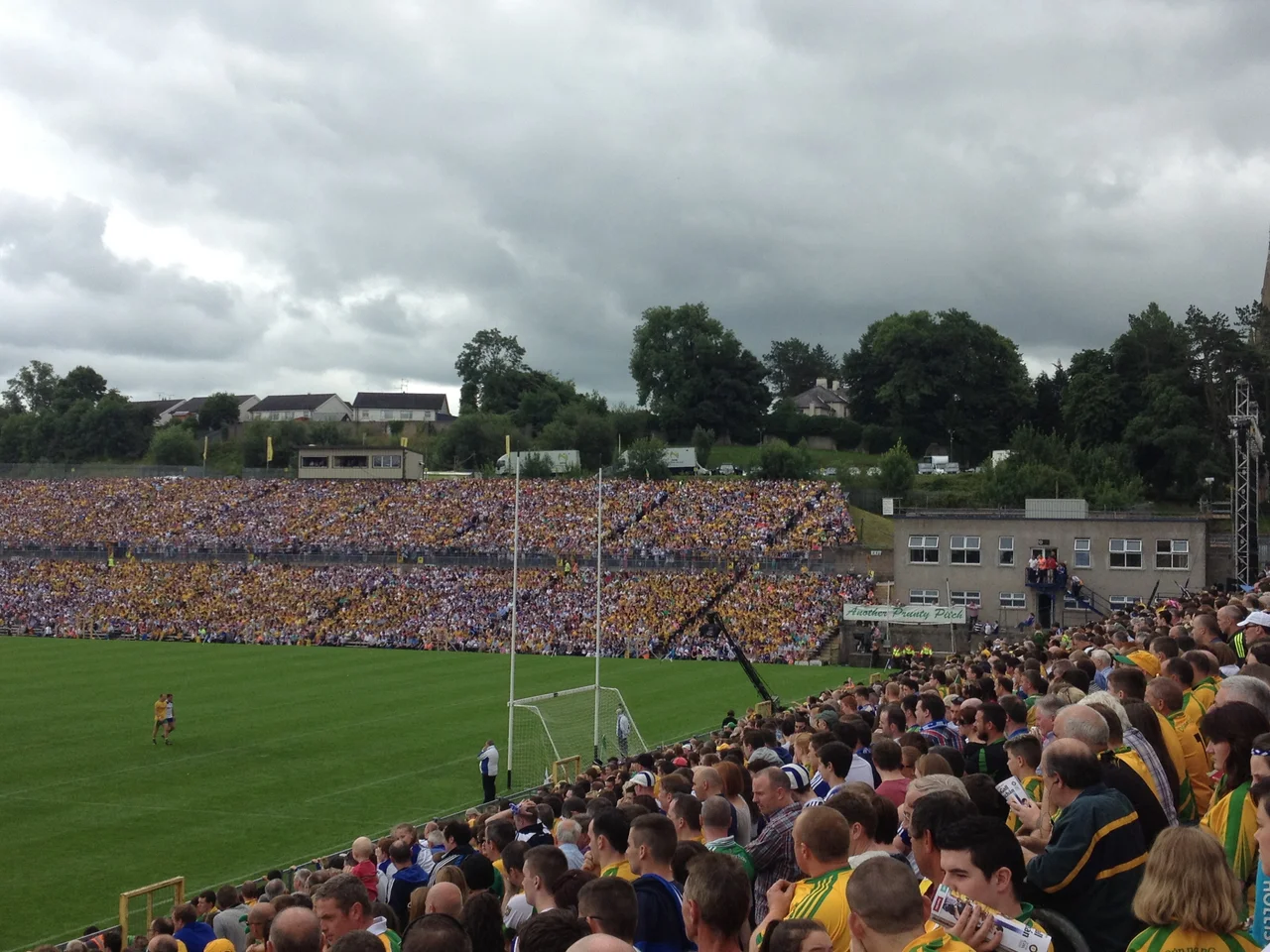

Clones, County Monaghan
When the boxer Barry McGuigan was at his peak in the mid 1980s, fighting his way to the world featherweight title, the cameras kept finding him back in Clones, the small County Monaghan town where he had grown up. He came in to defend his title in 1985 wearing his blue Republic of Ireland trunks with the United Nations dove of peace on them, an Irishman from a town six miles from a border that had cut his life in two. The nickname stuck: the Clones Cyclone. Clones is a town that wears its history without much fuss. A sixth-century saint, a ninth-century round tower, a tenth-century high cross in the market square, a sixteenth-century lace tradition, a railway that vanished overnight, a writer whose novel got Neil Jordan to film here. Population in 2022: 1,885. It is a town the Partition of Ireland nearly broke, that survived anyway.
St Tighernach's Hill
Clones, in Irish Cluain Eois, means roughly 'the meadow of Eois.' Local etymology has been debated for a century: Seosamh O Dufaigh argued the word was a cognate of the Welsh awch, meaning a point or a tip; Bearnard O'Dubhthaigh disputed the derivation. Folklore prefers an older form, Cluin Innish, suggesting the original monastic site was surrounded by water. St Tighernach, anglicised in some sources as St Tierney, founded the abbey and the town in the sixth century on land granted by an Irish king. He had received the benediction of St Maccartin and the bishopric of Clogher. The remains of the monastic complex are still scattered across the town: the Augustinian abbey ruins on Abbey Street, the truncated round tower in the old graveyard, the high cross in the Diamond, and the stone sarcophagus said to contain his relics.
Castle, Cathedral, Cross
The Plantation Castle on the higher ground of the town was built before 1640 by the Simpson family, three stories of stone with a kitchen, brew house, stable, and bawn. In 1641, two hundred Jacobites assembled in the town and the local Protestant inhabitants barricaded themselves inside the castle. From the walls they sallied out repeatedly, muskets in hand, harassing the Jacobite forces until both sides negotiated a surrender: the defenders were given safe conduct in exchange for handing over the castle. They returned to homes that had been looted in their absence. Behind the Church of Ireland church on the same hill rises the Norman motte and bailey, a stepped earthwork constructed in 1211 and used by the Normans to launch an attack on County Tyrone. The attack failed and the fortification was destroyed in 1212. Locals have reported 'extensive subterraneous passages' under the motte as far back as 1865.
What Partition Took Away
The Partition of Ireland in 1921 cut Clones off from most of its economic hinterland. The town sits in County Monaghan, in the Republic, with County Fermanagh in Northern Ireland surrounding it on three sides. Before partition, the town had been a railway junction of unusual importance for a place of its size. Lines connected Clones to Dundalk from 1855, to Enniskillen from 1859, to Cavan from 1862, and to Armagh from 1863. All became part of the Great Northern Railway in 1876. After 1921, Clones railway station became a border post, with customs inspections breaking the journey. Road competition and the inefficiencies of two-country operation gradually broke the railway. In 1954 the Republic and Northern Ireland jointly nationalised the GNR; in 1957 Northern Ireland forced the closure of the lines from Armagh and Enniskillen to Clones. With those lines gone, the remaining services on the Cavan and Dundalk lines became uneconomic. The Great Northern withdrew them too. By the late 1950s, the town had no passenger trains at all. The Clones Affray of 1922, when a confrontation between Free State and Northern Irish forces nearly sparked a wider conflict, had been the early warning. The slow railway death was the actual settlement.
Lace, Film, and the Cyclone
Clones lace, an Irish crochet adaptation of Venetian needlepoint, became a major cottage industry in the famine years of the 1840s under the encouragement of Cassandra Hand, the wife of the local Anglican rector. Examples from the early twentieth century are now displayed in the Clones Lace Museum, housed inside the 1839 Ulster Canal Store house on Cara Street alongside a bistro and visitor centre. The novelist Patrick McCabe, born in Clones in 1955, set The Butcher Boy in a thinly disguised version of the town. Parts of Neil Jordan's 1997 film of the novel were shot here. McCabe is now honorary patron of the Clones Film Festival, held annually during the October bank holiday. And Barry McGuigan, born in Clones in 1961, brought the world featherweight title back to the town in 1985 after his epic decision over Eusebio Pedroza at Loftus Road. He turned the tap of grief about partition into something the entire island could share. Barry McGuigan Park opened on the edge of town in 2015.
Other Sons of the Town
Beyond McCabe and McGuigan, Clones has produced an oddly international roster. John George Bowes was Mayor of Toronto from 1851 to 1853. John Joseph Lynch, born in Clones in 1816, became the first Archbishop of Toronto in 1860 and served until his death in 1888. Thomas Bracken, who emigrated as a child, wrote the lyrics of 'God Defend New Zealand,' one of New Zealand's two national anthems. Brigadier General Joseph Finegan, born here in 1814, became a Confederate commander in the American Civil War and won the Battle of Olustee in Florida in 1864. Alexander Pearce, executed in Van Diemen's Land in 1824 for cannibalism after escaping his penal sentence, also came from this town. James Cecil Parke, born around the corner in 1881, won an Olympic silver medal in tennis at the 1908 London Games. A small Monaghan town has, in different centuries, exported itself in unexpected directions.
From the Air
Clones sits at 54.181°N, 7.233°W in western County Monaghan, just inside the Republic of Ireland and roughly 8 miles south of the border with Northern Ireland. From the air the town is a small grid-plan settlement on slightly raised ground, with the stubby silhouette of the round tower visible above the rooftops. The international border runs north and east, separating Monaghan from Fermanagh and Tyrone. St Angelo Airport (EGAB), 4 miles north of Enniskillen, is 15 nautical miles north. Belfast International (EGAA) lies 80 nautical miles east; Dublin (EIDW) is 80 nautical miles southeast. The terrain is gentle drumlin country, almost universally rolling green fields punctuated by small lakes.
Nearby Stories
- Coalisland Canal 2.8 km away
- Ballygawley Bus Bombing 2.9 km away
- Cuilcagh 5.9 km away
- County Cavan 6.1 km away
- Pettigo 8.9 km away
- Monastery of Mohill-Manchan 9.8 km away
- Roman Catholic Archdiocese of Armagh 13 km away
- County Louth 17 km away