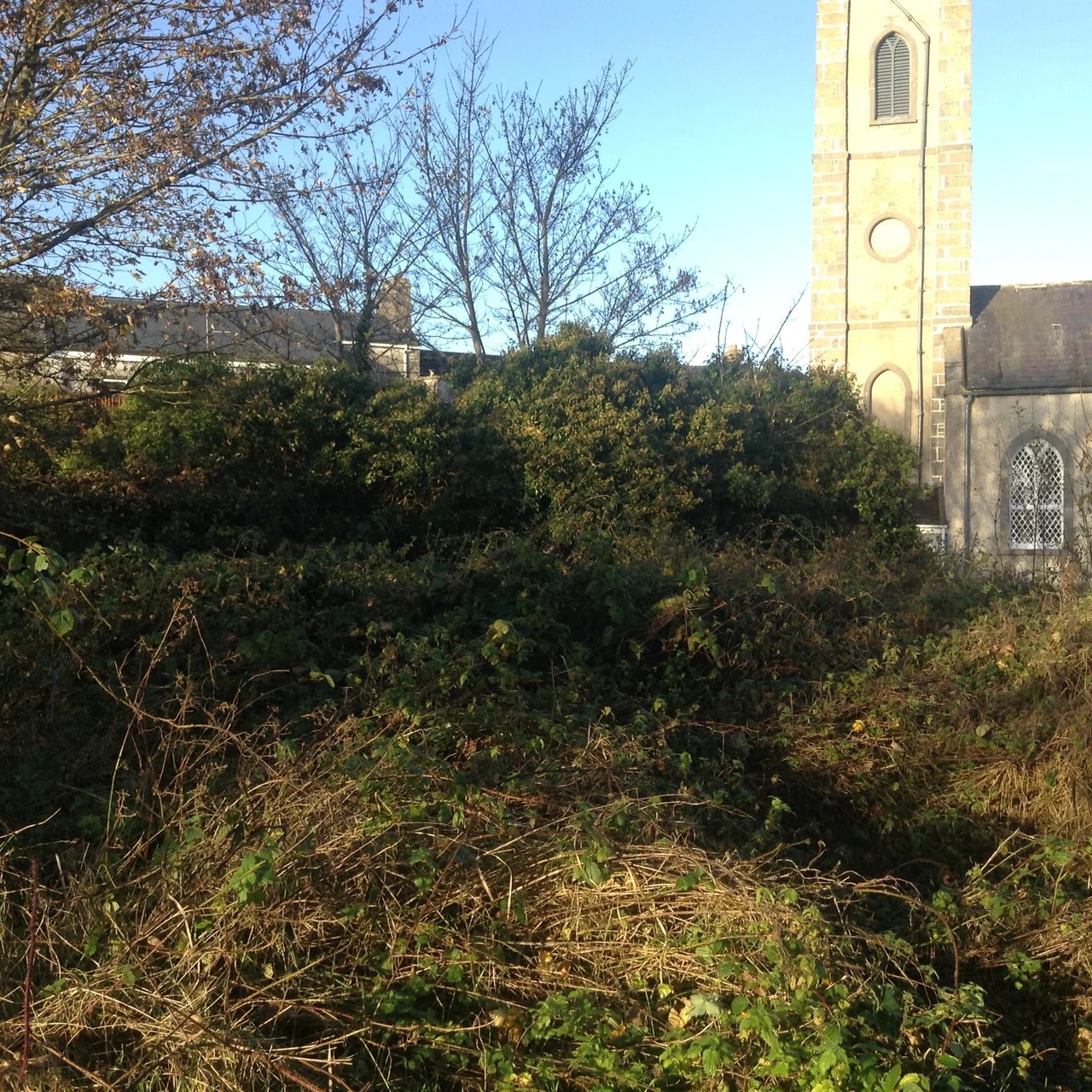

Monastery of Mohill-Manchan
In 538 AD, according to the Irish annals, a man named Manchan died at a place called Maethail in what is now south Leitrim. He had founded a small Christian church here in the sixth century - one of hundreds of monastic foundations that sprang up across Ireland during what later historians called the Age of Saints. Around it grew a community of monks, a school, a mill, a guesthouse for travellers, a Christian burial ground, monastic cells, a house of tears for grief and lamentation, and a round tower. For more than a thousand years it survived as a Christian institution. Today almost nothing of it remains - the base of a round tower next to the old folks' home in modern Mohill town, a roofless old school-house under thick ivy, and the south and east walls of a family vault in the graveyard that used to be a sanctuary. But the saint's name still names the town. Maethail Manchain - Mohill of Manchan.
Manchan and the Túath
Manchan of Mohill is a sixth-century figure about whom almost nothing certain is known. The annals record his death at Maethail in 538 AD. His remains were apparently preserved here as relics, and in 1166 - more than six hundred years after his death - the Annals of the Four Masters record an extraordinary moment: 'The shrine of Manchan of Maethail was covered by Ruaidri Ua Conchobhair, and an embroidering of gold was carried over it by him, in as good a style as a relic was ever covered in Ireland.' This is Rory O'Connor, who in 1166 was the last High King of Ireland - whose reign would be ended within five years by the Norman invasion - personally commissioning a gold reliquary for the bones of a sixth-century saint of a small Leitrim monastery. The shrine was that important. The monastic settlement spread across the river to cover the surrounding townlands of Tullybradan, Lisdadanan, Coolabaun, Cappagh, Gortfadda, Drumcroy, and Drumkilla. It was governed in the uniquely Irish style by a bishop, an abbot, and an erenagh - a hereditary lay administrator. It was bound to the tuath of the Muintir Eolais, the local Gaelic kingdom, and its life followed the ascetic discipline characteristic of early Irish Christianity.
Becoming a Priory
Around 1216, in the wave of church reform that followed the Norman invasion, the old Irish monastery was reorganised as a priory of the Canons Regular of Saint Augustine, dedicated to the Virgin Mary. The new community followed the Rule of Saint Augustine and the conventional Continental forms of monastic life. The Priory of St Mary's of Mohill-Manchan belonged to the diocese of Ardagh. In 1418 it was described as 'conventual, with cure' - meaning it was a proper monastic community with pastoral responsibility for souls - and as a dependency of the great priory at Abbeyshrule. It was sufficiently respected that canons from Clonmacnoise, the most prestigious monastery in the midlands, transferred here. The Annals of the Four Masters record an interesting detail about its privilege: in 1430 Mohill Priory still held the ancient right of sanctuary, the right to shelter a fugitive fleeing his enemies. That same year a small piece of local violence is recorded: Brian, son of Tiernan Og O'Rourke, was killed by the sons of Melaghlin Mac Rannall at Maethail-Mhanchain; Donough Mac Tiernan was driven into the monastery; he came out under Mac Rannall's guarantee; peace was made; an eric, the traditional Gaelic blood-price, was paid.
The Saxons at Maethail
From the 1540s onwards, Henry VIII's dissolution of the monasteries was being enforced across Ireland, and the end of the sixteenth century was, as one source dryly puts it, 'a bad time for priests and papists.' In March 1590 a final military blow fell. The annals record: 'An immense army was sent by the governor to Muinter-Eolais, in the beginning of March; and they captured ten hundred cows. And they were that night in Maethail.' Mohill Priory was forfeited to the English crown. Its lands were divided between Edward Barrett and Terence O'Byrne of Muintir Eolais; Barrett's share later passed to an Englishman called John Crofton, the founding ancestor of the Crofton family who would dominate the area for the next two centuries. The priory was briefly revived during the Confederate Catholic period of the 1640s, when Canon Antony Mag Raghnaill - in English, Reynolds - was appointed prior on 21 August 1648. The revival lasted less than a decade. Cromwell's army arrived in 1649 and suppressed the priory for the final time. Under the Penal Laws that followed, Catholic clergy were expelled and risked execution. In 1666 four Reynolds priests appear among forty-nine Catholic clergy from hiding places in the Roscommon woods who signed a letter in support of the Pope. In 1713 an elderly Father Connor Reynolds, exiled in Spain since 1681, was captured hiding in a trunk on a fishing boat at Dungarvan and imprisoned at Waterford.
What Remains
St Mary's Church of Ireland was built on the priory ruins in the eighteenth century, a Protestant church on the foundations of the Catholic monastery. The Hyde family vault in its graveyard - the Hydes were a prominent local Anglo-Irish family who later produced Douglas Hyde, founder of the Gaelic League and first President of Ireland - incorporates the surviving south and east walls of the old priory sanctuary. The Croftons, when they built their tower house at Rinn Lough on the lands they had received from the dissolution, reused small dressed stones that match those of Mohill priory - moving the building, literally, stone by stone. In Mohill town today the most visible survival is the base of the priory round tower, just behind the modern nursing home, mossy and unmarked. The shrine that Rory O'Connor covered in gold in 1166 disappeared centuries ago. The saint's bones are presumably long since dust. But the town is still called Mohill, after Manchan; and on the older Ordnance Survey maps it appears as Maethail Manchain, in Manchan's spelling - a sixth-century missionary whose name has outlasted his monastery by fifteen hundred years.
From the Air
Located at 53.923 degrees north, 7.866 degrees west, in the small town of Mohill in south County Leitrim. The town sits between Lough Rynn (to the southwest) and several other small lakes, all useful as landmarks. The N4 motorway runs through. Best viewed at 2,000-3,500 feet. Nearest airports: Ireland West Knock (EIKN) about 100 km west, Dublin (EIDW) about 145 km southeast.
Nearby Stories
- Markree Castle 4 km away
- Glangevlin 5.9 km away
- Ballaghaderreen Branch Line 7.6 km away
- Glenamaddy 7.6 km away
- County Cavan 9.8 km away
- Cathedral of Christ the King, Mullingar 9.9 km away
- Clones, County Monaghan 11 km away
- Moydrum Castle 21 km away