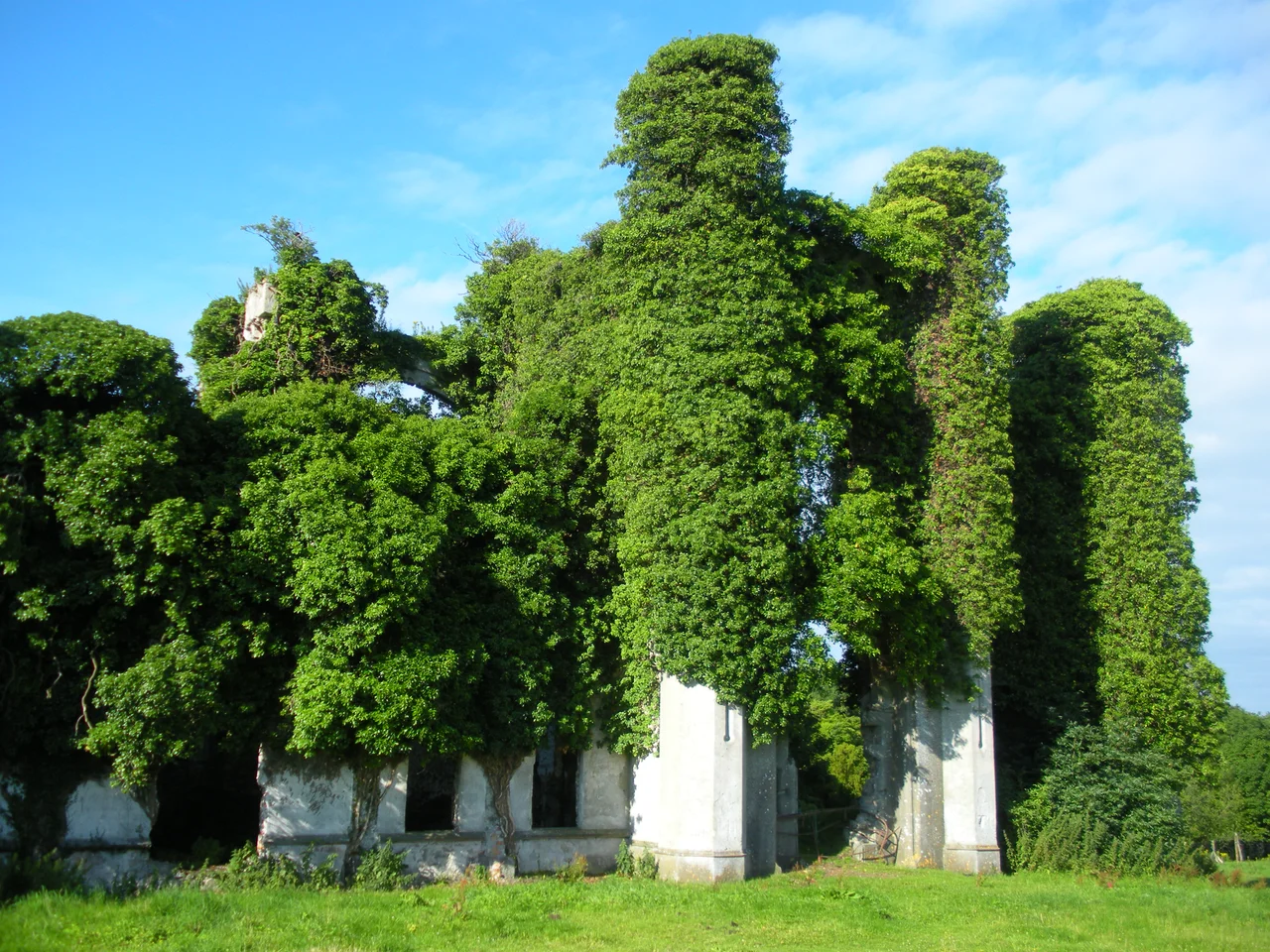

Moydrum Castle
Anton Corbijn arrived at Moydrum in 1984 with an infrared filter and the four members of U2. He posed them in front of the ruin, the brickwork dark behind them, the leaves around them ghosting pale because of the film. The result became the cover of The Unforgettable Fire - one of the most recognizable images in 1980s rock. Most people who bought the album did not know what they were looking at. The shell behind the band was a burned-out castle, gutted to its walls on the night of 3 July 1921, by neighbors who decided that the man who lived there was the wrong man to leave standing.
How the Handcocks Came to Moydrum
The land was won in the seventeenth century, when the English Crown handed Westmeath estates to families who had been useful to Cromwell. The Handcocks came from Devon. By 1812 William Handcock had become the 1st Baron Castlemaine - a peerage promised to him in exchange for his vote in favor of the Act of Union. He had originally opposed it, but the title changed his mind. In 1814, on the lands his ancestors had purchased in 1684, he built his gothic-revival castle. Samuel Lewis's 1837 Topographical Dictionary of Ireland called it "a handsome castellated mansion, beautifully situated in an extensive demesne, on one side of which is a small lake." By the 1880s the barony comprised 11,444 acres. The Castlemaines were prominent at Lough Ree Yacht Club, and in 1920 Major G.S. Handcock chaired the committee that designed the Shannon One-Design dinghy, still sailed today.
The Night the Castle Burned
On 20 June 1921, Major-General Thomas Stanton Lambert was killed near Moydrum by an IRA flying column that had hoped to take him alive and exchange him for the captured General Sean Mac Eoin. In reprisal, the Black and Tans burned several farmsteads in south Westmeath. The local IRA decided on a counter-reprisal. They picked the castle for its symbolism: this was the seat of a member of the House of Lords, the visible center of British landlord power in the area. On the night of 3 July, they knocked at the door. Lord Castlemaine was abroad. His wife, his daughter, and several servants were home. The IRA gave them a short time to gather what valuables they could carry, ordered them out, and set the castle alight. By morning it was a roofless shell. The family never came back.
The Photograph
Sixty-three years later, Anton Corbijn brought U2 to the ruin to shoot a sleeve. He used the same vantage point, the same polarizing filter, and the same infrared film as a 1980 photograph by Simon Marsden, from a book called In Ruins: The Once Great Houses of Ireland. The composition was nearly identical, with only the band members added; U2 eventually had to pay Marsden compensation. The sepia tone came in post-production. The infrared chemistry made the late summer leaves shimmer like snow and the blue Westmeath sky read as deep black behind the broken stone. The album, U2's fourth, opens with "A Sort of Homecoming." The cover is exactly that - a homecoming to a country in which the homes had been emptied. After release, fans started showing up at Moydrum. Locals were unprepared. Some of the ivy on the walls today grew in over years of pilgrims taking selfies in front of a building most of them could not have named.
What the Land Did
After the burning, the Castlemaine lands were broken up by the Irish Land Commission, divided, and sold on to local farmers. The barony of 11,444 acres became hundreds of smaller holdings, the great estate dissolved into the working countryside of independent Ireland. The castle itself stayed in private hands as a roofless ruin, slowly disappearing into the ivy. Today it remains on private land east of Athlone; the only way most people see it is the way Corbijn shot it, framed by trees, in a black-and-white photograph older than they are. Nearby Mount Temple - where Elizabeth Temple rode up the motte - and the village of Baylin are part of the same parish. They all share the long Westmeath story of conquest, settlement, and the moment when the conquered, finally, took their country back.
From the Air
Moydrum Castle sits at 53.43N, 7.86W, just east of Athlone in County Westmeath, in flat agricultural land studded with small lakes left behind by retreating glaciers. The Shannon River curves north of the site, and Lough Ree opens out to the north-northwest. Dublin (EIDW) lies 90 km east; Shannon (EINN) is 100 km southwest. The castle ruin is not visible from cruising altitude - it is a single shell in a stand of trees - but the nearby town of Athlone, marking the historic center of Ireland and the bridge over the Shannon, is unmistakable as a small urban concentration on the riverbend.
Nearby Stories
- Saighir 7.8 km away
- Portlaoise 8.2 km away
- Castlepollard Mother & Baby Home 8.9 km away
- Mountbellew 14 km away
- St Mel's Cathedral 15 km away
- Castlerea 18 km away
- Mullingar 19 km away
- Gort 25 km away