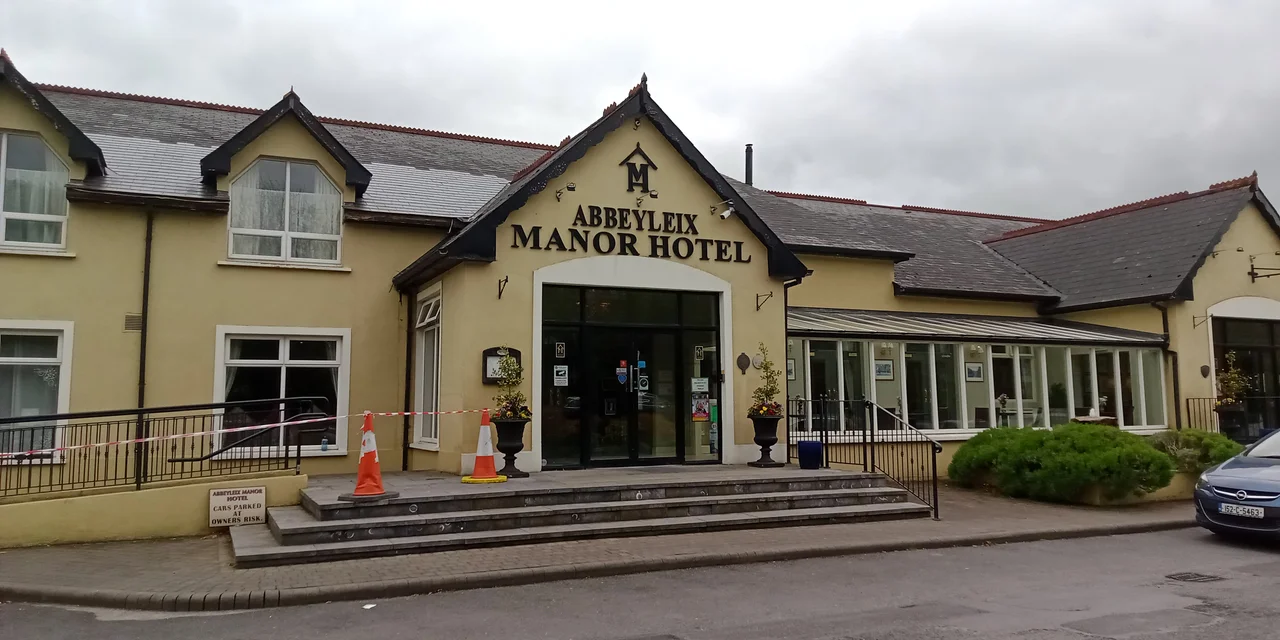

Abbeyleix
In 1790, John Vesey, 2nd Viscount de Vesci, looked at his tenants' town on the flood-prone bank of the River Nore, decided it was unhealthy, and ordered it demolished. He drew up plans for a new town on higher ground. He moved the residents up. He levelled the old place. The result is Abbeyleix - one of the oldest planned estate towns in Ireland, a grid of stone houses and lime-lined streets that has changed remarkably little in the two and a half centuries since the Viscount drew them. There is a memorial in the town center to John Vesey, paid for by public subscription. It features a water trough for horses.
The Abbey of Leix
The name combines abbey and Leix - the older spelling of Laois, the territory of the O'More clan. Around AD 600, tradition says, a Cistercian foundation was begun here, known later as Clonkyne Leix or De Lege Dei. The historical record is thin until 1183, when Conor O'More refounded the abbey, dedicated it to the Blessed Virgin, and brought in monks from Baltinglass in County Wicklow. For most of the medieval period, the abbey was the center of a small settlement near the River Nore. The monastery was suppressed at the Reformation. By the 1580s the lands had passed to English settlers. The old town that grew up around the abbey ruin gradually became the lower town that the de Vescis tore down in 1790. There is no surviving abbey building today - only the name.
The Carpets on the Titanic
In 1904, Yvo de Vesci, the 5th Viscount, established a carpet factory in Abbeyleix. It was part of an attempt to bring industry to the local economy - the kind of well-intentioned Anglo-Irish patronage that produced creameries, lace schools, and woollen mills across late-Victorian Ireland. The Abbeyleix factory made hand-knotted carpets to specification, and in the years before World War I, it supplied carpets for the new generation of White Star Line passenger liners. RMS Olympic, launched in 1911, was carpeted in Abbeyleix work. So was her sister ship, RMS Titanic, launched the following year. The carpets that lay in the first-class cabins of the Titanic, that absorbed the last footsteps of the wealthy as they decided whether to leave for the lifeboats, were knotted by hand in this Laois town. The factory eventually closed, but the Heritage House on Main Street still displays original Abbeyleix carpets among its exhibits.
Famous People Who Passed Through
Francis Bacon, the painter who would become one of the twentieth century's most disturbing portraitists, was born in Abbeyleix in 1909. His father was a horse trainer at the de Vesci estate. The Bacon family lived in the town only briefly before moving on, but Abbeyleix gave him his birth certificate and his first months. Other figures from this small Laois town reach into surprisingly distant corners. The American sculptor Launt Thompson, born in Abbeyleix in 1833, emigrated as a child and ended up carving Civil War generals in New York studios. Sir Edward Massey, born here in 1619, fought as a Parliamentary general in the English Civil War. Paul Nunn, the British mountaineer who died on Haramosh II in 1995, was an Abbeyleix man. Sarah "Venie" Barr, a political activist born in 1875, was a local woman who became a national figure in the early days of independent Ireland.
The Bog and the Walk
Outside town, the Abbeyleix Bog Project manages Killamuck Bog - a raised bog of national ecological importance. Wooden boardwalks loop through wet sphagnum moss, past stands of cotton grass and bog asphodel. Bog cotton waves white in summer. In autumn the heather flowers purple. The project runs guided walks for school groups and visitors learning what an undisturbed Irish bog looks like, after centuries of bog drainage for fuel. Closer to the town center, the Lords Walk Loop traces the 2.4-kilometer route the de Vesci family used to walk from Abbeyleix House to church and railway station. The estate itself - 1,050 acres of Georgian parkland, eighteenth-century formal gardens, and the Abbeyleix House at its heart - sold in 2021 for twenty million euro to Irish entrepreneur John Collison, co-founder of Stripe. The estate is private. But the town the de Vescis built is open, and the streets they laid out two hundred and thirty years ago are still the streets a visitor walks today.
From the Air
Abbeyleix sits at 52.91N, 7.35W in central County Laois, fourteen kilometers south of the county town of Portlaoise, on the River Nore. The Slieve Bloom Mountains rise to the northwest; the rolling country between Portlaoise and Kilkenny stretches south and east. Dublin (EIDW) is 90 km northeast; Shannon (EINN) 100 km west. The town sits just off the M8 motorway between Dublin and Cork; the Abbeyleix bypass opened in 2010, ending the legendary half-hour traffic jams that defined the old N8. From cruising altitude, look for the Abbeyleix demesne - 1,050 acres of mature woodland and parkland just west of the town - as a distinct dark patch of old trees in surrounding farmland.
Nearby Stories
- Civil Defence Ireland 5.2 km away
- Cantwell's Castle 5.8 km away
- Straffan 6.8 km away
- Thurles 8.2 km away
- 2008 Irish Pork Crisis 12 km away
- Fenian Rising 16 km away
- County Wicklow 18 km away
- Murder of Ashling Murphy 18 km away