
Murder of Ashling Murphy
Ashling Murphy was twenty-three years old. She had been a qualified primary school teacher for less than four months when she was killed. She was the youngest of three children. She played the fiddle - had played since childhood, well enough to tour with the national orchestra of Comhaltas Ceoltori Eireann, well enough to give private lessons at the family home near Blue Ball. She played camogie for Kilcormac-Killoughey GAA. She was engaged to be married to Ryan Casey, her partner of five years. On 12 January 2022, she finished work, drove to the Daingean Road car park in Tullamore, and went out for a run along the Grand Canal. She did not come home.
The Family Around the Table
Music ran through the Murphy household. Her father had played with The Fureys and with a local band called Best Foot Forward. Her mother. Her brother. Her sister. The fiddle case was pink. She and her sister could read each other's mind when they played together. "Music is not and will never be the same without Ashling," her sister told the court two years later. "Our love for Irish music was intertwined with a special bond." Ashling had been teaching first-class pupils at Scoil Naomh Colmcille, a primary school in Durrow, just over the county line from her home village. She had been hired full-time in September 2021. The children loved her. After her death, her former pupils stood outside St. Brigid's Church in Mountbolus holding photographs of their teacher, each child carrying a single red rose.
The Afternoon
She finished work at 2:30pm. CCTV caught her walking to her red Seat Cordoba at 2:37pm. She drove the eight kilometers to Tullamore, parked near the canal, and set off on foot at 2:51pm wearing her Kilcormac-Killoughey camogie top under a navy jacket, a pink woolen hat with a brown bobble, blue Nike runners, and a gold necklace bearing her own name. Her Fitbit recorded everything. She walked east along the canal towpath, crossed Digby Bridge at 3:16pm, and turned back westward toward her car. Sometime in the next ten minutes, her attacker dragged her off the path into a steep, briar-filled ditch and stabbed her. Her heart rate climbed, then collapsed. Her Fitbit stopped recording a heartbeat at 3:31pm. Two joggers - both primary-school teachers, Jenna Stack and Aoife Marron - heard the rustling, looked through the hedge, and ran for help. Neither had a phone with her. By the time they reached the cyclists at Digby Bridge, Ashling was already dying.
What Ireland Did
Within forty-eight hours, vigils began. Tens of thousands of people stood in candlelight at the canal, in Eyre Square in Galway, on Patrick Street in Cork, on College Green in Dublin. Vigils were held in Belfast, in Limerick, Waterford, Kilkenny, Drogheda, Sligo, Derry, Omagh, and Armagh. In London. In New York. In Toronto, Vancouver, Melbourne, Brisbane, Dubai, Glasgow, Edinburgh. People who had never met Ashling Murphy or anyone who knew her stood quietly in the dark with candles for a young teacher who had been killed in the middle of an afternoon, on a footpath, doing nothing more dangerous than going for a walk. President Michael D. Higgins attended her funeral. So did Taoiseach Micheal Martin. The Minister for Justice, Helen McEntee, said the country would adopt a zero-tolerance approach to violence against women. A €363 million, five-year government strategy on gender-based violence, already in draft, was accelerated through Cabinet.
The Funeral and the Music
Her wake was held at the family home near Blue Ball on 16 and 17 January. Her Requiem Mass was at 11am on 18 January at St. Brigid's Church in Mountbolus. Schools across Ireland observed a minute of silence at exactly that hour. Her former pupils formed a guard of honour outside the church. So did the Kilcormac-Killoughey senior camogie team. Her godparents brought items to the altar to symbolize her life: a musical instrument, a camogie stick and her GAA jersey, a family photograph, a schoolbook. At the graveside, friends and fellow musicians played the traditional tunes she had played with them in pubs and at festivals all her short adult life. Her father and his Best Foot Forward bandmates played her favourite song, "When You Were Sweet Sixteen." Bishop Tom Deenihan of Meath called her death "a depraved act of violence." The cousins read the prayers. The country watched.
Justice and Aftermath
On 14 January 2022, Jozef Puska, a 31-year-old Slovak man living in Mucklagh near Tullamore, confessed at St. James's Hospital in Dublin. He had cycled to the canal that day on a black and green Falcon Storm mountain bike that police later recovered at the scene. His DNA was under Ashling's fingernails - the prosecution argued she had fought him as he attacked her. He was convicted of murder on 9 November 2023, after a three-week trial, the jury deliberating just two hours. He was sentenced to life imprisonment on 17 November 2023. No motive was ever established. He had never met Ashling Murphy before he killed her. In June 2025, his two brothers and three women - his wife and his brothers' wives - were convicted of withholding information or destroying evidence; they had burned his bloodstained clothes in the fireplace of their shared house in Mucklagh, where the extended family had been living with fourteen children, on the days after the murder.
Memory and Light
The Murphy family established the Ashling Murphy Memorial Fund in January 2023 - a registered charity supporting traditional Irish music, arts, and culture for young people. Mary Immaculate College and the Irish National Teachers' Organisation jointly created a scholarship in her name, awarded each year to a first-year B.Ed student excelling in traditional Irish music. Comhaltas Ceoltori Eireann created three more scholarships. Offaly Camogie renamed its Division 1 cup the Ashling Murphy Memorial Cup. A permanent memorial now stands on the canal bank at Cappincur, at the place she died. Each year, on the anniversary of her death, people walk the towpath together. There is a Mass. There is music. "As a parent, you want your child to go out into this world and live a full and meaningful life," her mother wrote in the victim impact statement read at sentencing, "yet, being acutely aware of how fragile their safety is, wanting to protect them. I couldn't protect my darling Ashling, and now she is gone forever."
From the Air
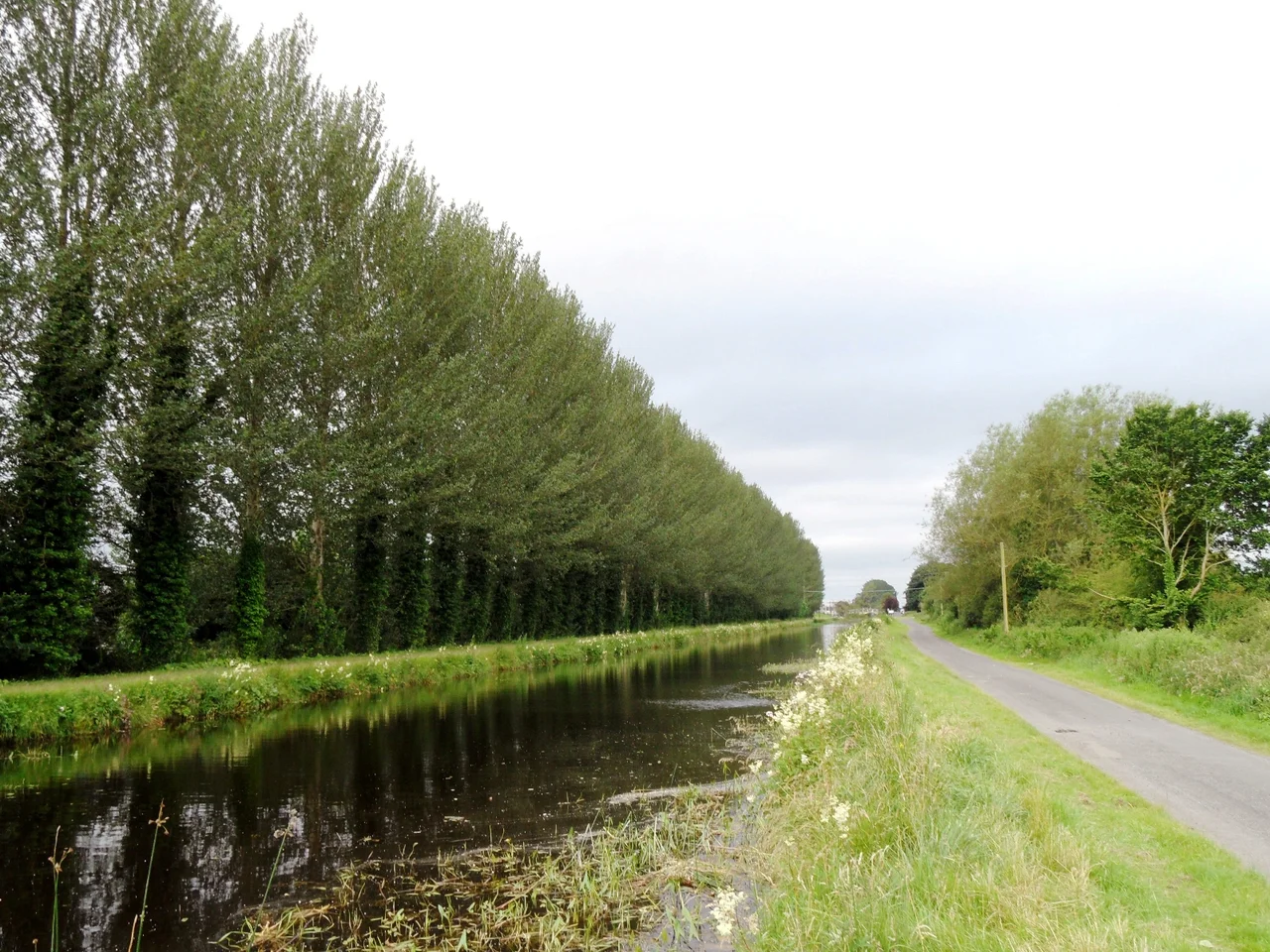
The Grand Canal at Tullamore runs through County Offaly at approximately 53.28N, 7.48W, in the Irish midlands. The canal connects Dublin to the River Shannon, passing through Tullamore on its way west to Shannon Harbour. The memorial to Ashling Murphy sits on the canal bank at Cappincur, just east of Tullamore town. Dublin (EIDW) is 100 km east; Shannon (EINN) 70 km southwest. From cruising altitude, the Grand Canal appears as a long, straight ribbon of water cutting across the flat midland landscape - distinctive because it is more linear than any natural Irish waterway. The towpath beside it is still used by walkers, runners, and cyclists. The site is treated, by local convention, with quiet respect.
Nearby Stories
- Lorrha 2.1 km away
- Roscommon 6.8 km away
- Grand Canal (Ireland) 8.4 km away
- Ballyfin 10 km away
- Clonard Abbey 11 km away
- Abbey of Kells 16 km away
- Clonfin Ambush 17 km away
- County Wicklow 42 km away