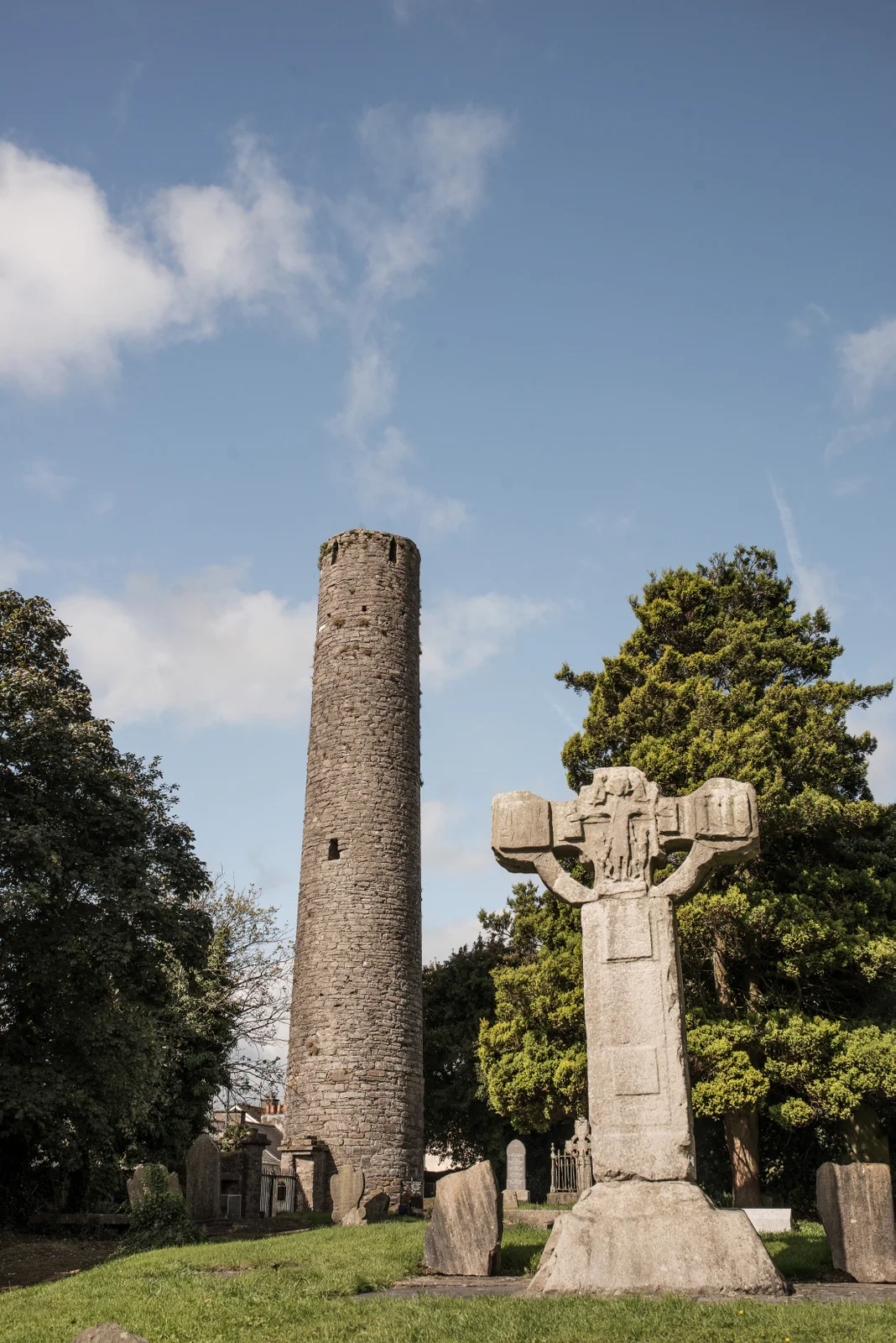

Abbey of Kells
In 1006, somebody stole the Book of Kells. The Annals of Ulster record that the great gospel book - the chief relic of the western world, the annalist called it - was lifted from the stone church of Kells. Two months later it was found buried beneath a sod of turf, missing only its jewelled cover. The thief had pried off the gold and gems and left the parchment behind. That violent removal probably explains why the opening and closing pages of the book are missing today. Everything else survives, eleven hundred years after the monks of Kells inked it.
The Monks Who Fled Iona
The abbey traces itself back to St Columba, who is said to have founded a monastery here around 554 on land granted by the High King Diarmait mac Cerbaill. But the abbey that mattered came later, built in fear. In 795, Vikings began raiding the Columban monastery on the Hebridean island of Iona, off the west coast of Scotland. Iona was a wealthy, exposed target. After successive raids - one in 806 killed 68 monks - the Iona community decided to build a refuge in Ireland. They chose the old hillfort site at Kells, 59 kilometres northwest of Dublin, and from 807 to 814 they constructed a new monastery. Cellach, abbot of Iona, retired to Kells in 814. For decades, the community ran both houses - Iona still primary, Kells a backup. Only in 878, after another devastating Viking raid, did the monks finally move Columba's reliquary shrine permanently to Kells. The Book of Kells almost certainly came with it.
The Book Itself
Historians still argue about where the Book of Kells was made. One theory has it started at Iona and finished at Kells. Another has it created entirely at Kells over generations of monastic scribes. Wherever it was begun, what survives is 340 vellum leaves of the four Gospels in Latin, painted with such ferocious intricacy that you can find new details after a hundred viewings. The carpet pages and Chi-Rho monogram crawl with knotwork, beasts, and tiny human figures hidden inside the geometry. The pigments came from across the known world - lapis lazuli from Afghanistan for the deep blues, kermes red from Mediterranean insects, orpiment yellow from arsenic sulphide ore. Monks ground these stones and creatures into the paint that has lasted twelve centuries. The Book has been called the most beautiful book ever made. It survived the Vikings, who sacked the abbey repeatedly through the tenth century. It survived its own theft in 1006. It survived the dissolution of the monastery in the twelfth century, when the abbey became a parish church but the book stayed. It almost did not survive Cromwell.
Cromwell's Cavalry
When Oliver Cromwell's army occupied Kells in the 1650s, his cavalry were billeted in the very church where the Book of Kells had spent six and a half centuries. Someone in the local clergy - it is not entirely clear who - made the decision to get the book out. It was sent to Dublin for safekeeping. In 1661, after the Restoration, the Book of Kells was formally acquired by Trinity College Dublin, where it has remained ever since. You can see it there now in the old library, two volumes opened each day to a different page under careful glass. The abbey at Kells lost its greatest treasure to the precaution that saved it. The town has never quite recovered from being the place where the Book of Kells used to be.
What Still Stands
The monastic site at Kells preserves a small museum of what early medieval Irish Christianity built and left behind. The Round Tower, ten metres higher than the surrounding rooftops, rises about 28 metres from the original street level - it has five windows at the top instead of the usual four, said to overlook the five roads that lead into the town. The towers were both bell-houses and refuges; in a Viking raid the monks could climb in, draw up the ladder, and ride it out. Nearby stands St Columb's House, a tiny tenth-century oratory with a steeply pitched stone roof so massive that the interior had to be vaulted with stone to bear its weight. Around the site are several high crosses from the ninth and tenth centuries, carved with biblical scenes - Daniel in the lions' den, Adam and Eve, the Crucifixion. The Market Cross, originally at the abbey's eastern gate, stands now in front of the old courthouse. Local tradition says Cromwellian soldiers damaged it and that participants in the 1798 rebellion were hanged from it. It is no longer used for either purpose. The town named Kells still circulates around the stump of the cross and the round tower at its centre, and the road signs out of town still point to the five medieval routes that radiated from a monastery.
From the Air
The Abbey of Kells site is at 53.73 degrees north, 6.88 degrees west, in the town of Kells, County Meath, 59 kilometres northwest of Dublin. Nearest airport is Dublin (EIDW) about 45 miles southeast. From 2,000-4,000 feet in clear weather, the round tower at the centre of Kells stands out among the modern rooftops, and the converging pattern of five roads is still visible from above. The Boyne valley lies to the south, with Trim Castle further along. Meath weather is reliably damp Irish midlands - clearest visibility tends to come in spring mornings.
Nearby Stories
- Mornington 4.4 km away
- Ballymun 6 km away
- Kilbeggan Distillery 11 km away
- Killeshandra 11 km away
- Carlingford 13 km away
- Tristernagh Abbey 13 km away
- Cootehill 15 km away
- Maynooth University 18 km away