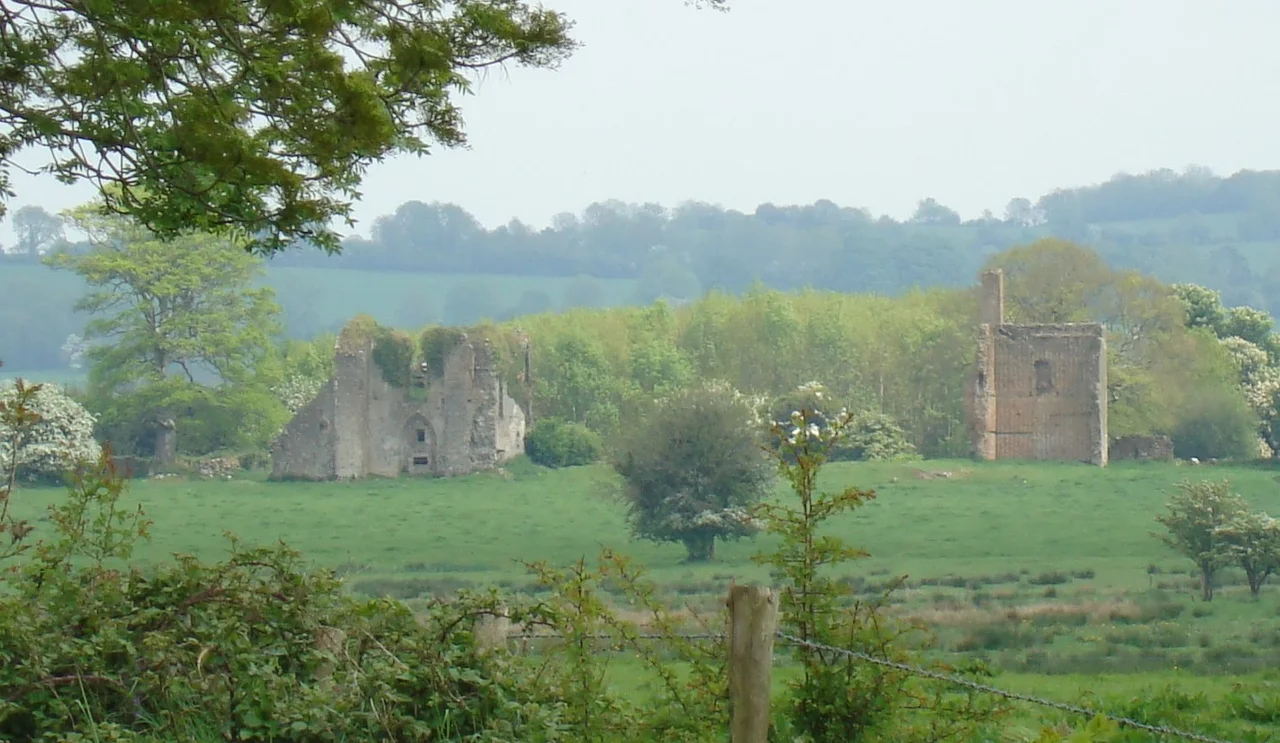

Tristernagh Abbey
In 1783, Sir Pigott William Piers - a Westmeath landlord, descended from one of the English families that had received confiscated abbey lands during the Reformation - decided to pull down what was left of Tristernagh Abbey. The medieval Augustinian priory on the shore of Lough Iron, founded by a Norman knight in 1190, had stood for nearly six hundred years through Reformation, Cromwellian sack, and Penal Laws. It had still been impressive ruins as recently as 1682 when Pigott's grandfather had described them with pride. Pigott Piers cleared the old monastic graveyard, knocked down the church walls, and used the carved stones to build himself a fashionable new Gothic Revival house. The topographer James Norris Brewer later called it 'an outrage' and wrote that 'the name of Tristernagh should never be mentioned without an expression of contempt towards that of Sir Pigott William Piers.' Locally it was widely believed that the disturbance of the graveyard had brought ruin on the family. Within forty years the new Gothic house was a wreck. It is said to have inspired Maria Edgeworth's Castle Rackrent.
The Place of Thorns
The name Tristernagh comes from the Irish triostarnach, which means 'place of thorns' - the kind of straight functional Irish place-name that the early Cistercians and Augustinians liked because it described the actual landscape they had to settle. The priory was founded around 1190 by Geoffrey de Costentin, a Norman knight who had been granted the land by Walter de Lacy, the great Lord of Meath. Dedicated to the Blessed Virgin Mary, it housed Augustinian canons under a prior, and stood beside an even older Irish church at nearby Kilbixy that was dedicated to a sixth-century female saint named Bigseach. Geoffrey de Costentin granted the Kilbixy church to Ralph de Petit, the Archdeacon of Meath, while keeping the new priory at Tristernagh as his family foundation. The first recorded prior, Henry, was probably a relative of the founder. Successive Bishops of Ardagh and Meath were benefactors. The priory grew into one of the substantial Augustinian houses of the midlands - not great like Mellifont or Boyle, but solid, locally important, and continually used for over three hundred years.
The Reformation and the Bells
In 1536 the abbey was ransacked by the commissioners of Henry VIII as part of the Dissolution of the Monasteries. The last prior, Edmund Nugent - who was also Bishop of Kilmore - was pensioned off with a payment of twenty-six pounds, thirteen shillings and sixpence; five canons received smaller pensions. The lands were granted by the crown to William Piers, the constable of Carrickfergus Castle, in the great Tudor redistribution of Irish church property. There was a tradition in Kilbixy parish - the kind of memory that long outlives the people who remember it - that at the moment of the Reformation the friars had taken the abbey bells from the bell-tower and thrown them into the dark waters of Lough Iron, where the English commissioners could not get to them. The bells were said to lie there still. The last prior formally surrendered to crown forces on 30 November 1539. About sixty years later, in 1599, there was a strange echo: after Hugh Roe O'Donnell's victory at the Battle of Curlew Pass, a Gaelic force of six hundred men under Sir Shane O'Doherty, lord of Inishowen, is said by local tradition to have camped in the priory grounds and been defeated and mostly killed under its walls. A thornbush and a hillock in Tristernagh demesne were still pointed out in 1837 as the site of the camp, and 'O'Doherty's Bush' was marked on the Ordnance Survey sheet for Kilbixy parish.
Sir Pigott and the Curse
The Piers family held Tristernagh through the seventeenth century. According to a memorial inscription in the nearby ruined church of Templecross, the abbey was repaired by William Piers' son Sir Henry Piers, who converted to Catholicism late in life. It is possible the monastery briefly returned to religious use during the Confederate Catholic period of the 1640s; a recorded dispute in 1646 between Bishop Thomas Dease and the Papal Nuncio Rinuccini over an appointment to Tristernagh suggests there was something there to appoint to. By 1682, Sir Henry Piers - grandfather of Sir Pigott - was describing the ruins as still very substantial. Then in 1783 came the demolition. Sir Pigott pulled down the medieval church, cleared the monastic burial ground, and incorporated the stones into a new Gothic Revival country house. The locals were horrified. The disturbance of consecrated ground was felt as sacrilege, and the family's subsequent misfortunes were widely attributed to it. The new house, called Tristernagh House, was famously badly built; by the early nineteenth century it was already in a state of severe dilapidation. Maria Edgeworth - whose own family seat at Edgeworthstown was nearby - is said to have drawn on the dilapidated Tristernagh House and the absurd Piers family for her 1800 novel Castle Rackrent, the first novel ever published in the modern Irish realist tradition.
What Remains, and the Baronetcy
Pigott's son built a new house about half a kilometre to the northwest. Nothing now remains of either the abbey or the eighteenth-century replacement on the original site. The location on the shore of Lough Iron is largely overgrown, with only a few fragments of masonry visible in the grass. The Piers baronetcy of Tristernagh Abbey - created in 1660 - still survives in the Baronetage of Ireland; the current baronet, in line of male descent from William Piers the Tudor constable, holds a title that the family has now possessed for longer than they possessed the abbey lands. The bells, if they were ever thrown in Lough Iron, have never been found. The lake is small, dark and reedy and most of its bottom is soft peat. The old saying that disturbing a graveyard brings down a curse is the kind of thing that medieval Ireland would have understood instinctively; eighteenth-century Westmeath, on the cusp of modernity, said it with embarrassment but kept on saying it. Sir Pigott William Piers died in 1798. His house was a ruin within a generation. His abbey is now a field. The thorn bush, by all accounts, is still there.
From the Air
Located at 53.599 degrees north, 7.479 degrees west, on the shore of Lough Iron about 3 km northeast of Ballynacargy village in central County Westmeath. The lake is small and roughly oval; the abbey site is on its northeast shore. Best viewed at 1,500-3,000 feet on calm clear days. The site itself is largely overgrown and may be hard to spot, but Lough Iron is a useful navigation reference. Nearest airports: Dublin (EIDW) about 70 km east-southeast, Ireland West Knock (EIKN) about 95 km west-northwest.
Nearby Stories
- County Offaly 4.1 km away
- Eyrecourt Castle 7.1 km away
- Clonard Abbey 8.5 km away
- Roscommon 14 km away
- Kildare Cathedral 14 km away
- Rathcroghan 14 km away
- Bailieborough Castle 16 km away
- Lough Rynn Castle 22 km away