
Rathcroghan
From the air it looks like ordinary Connacht pasture. From the ground, almost as ordinary - a few low grassy mounds, some ancient field banks, a deep notched hollow at the edge of a road. But underneath the soil here, scattered across six square kilometres of plain near the village of Tulsk in County Roscommon, lie more than 240 archaeological sites - sixty of them protected national monuments - representing six thousand years of continuous human activity. National Geographic has called Rathcroghan possibly Europe's largest unexcavated royal complex. Irish tradition calls it Cruachan, the capital of the ancient Connachta. The medieval Christian writers called it the Gate to Hell. To the storytellers of the Ulster Cycle, this was the seat of Queen Maeve - and the place where the war for the Brown Bull of Cooley began.
The Plain of Connacht
Standing on top of Rathcroghan Mound, the focal point of the complex, you see almost nothing dramatic - just the slow roll of grazing country in every direction, broken here and there by hedgerows and the smudges of small towns. That flatness is the point. This is Mag nAi, the great central plain of Connacht, and the people who built here built for ceremony, not defence. The mound itself is broad and almost perfectly circular, eighty-nine metres across and five and a half metres high, with gently sloping ramps to east and west giving formal access to a flat summit. Geophysical surveys have shown that what looks like a single grassy hump is actually built on top of an older monument made of two concentric stone ring-banks - and that the whole mound sits at the centre of a great enclosure 360 metres across, vanished from the surface but unmistakable in the magnetometer data. Rathcroghan is one of the six Royal Sites of Ireland, sharing the same architectural language as Tara, Emain Macha, and Dun Ailinne.
Queen Maeve's Country
Cruachan is the home of one of the most vividly drawn characters in Irish literature. Medb - Queen Maeve in English - rules Connacht here in the Ulster Cycle, married to King Ailill mac Mata, and it is from these halls that the great cattle-raid of the Tain Bo Cuailnge begins. The Tain opens with the famous 'pillow talk' between Medb and Ailill in their bedchamber at Cruachan, in which the queen, jealous of her husband's prize white-horned bull, resolves to steal the great brown bull of Ulster - a decision that launches a war and a literature. The Tain ends here too, at Rathnadarve, the 'Fort of the Bulls' just west of the main mound, where the two great bulls fight to the death. Many scholars now believe Medb was originally not a queen at all but the local sovereignty goddess of Connacht, and that to become king meant marrying the earth here - that the inauguration of kings most likely took place on the mound itself. Either way, the stories survive.
Oweynagat: The Cave of the Cats
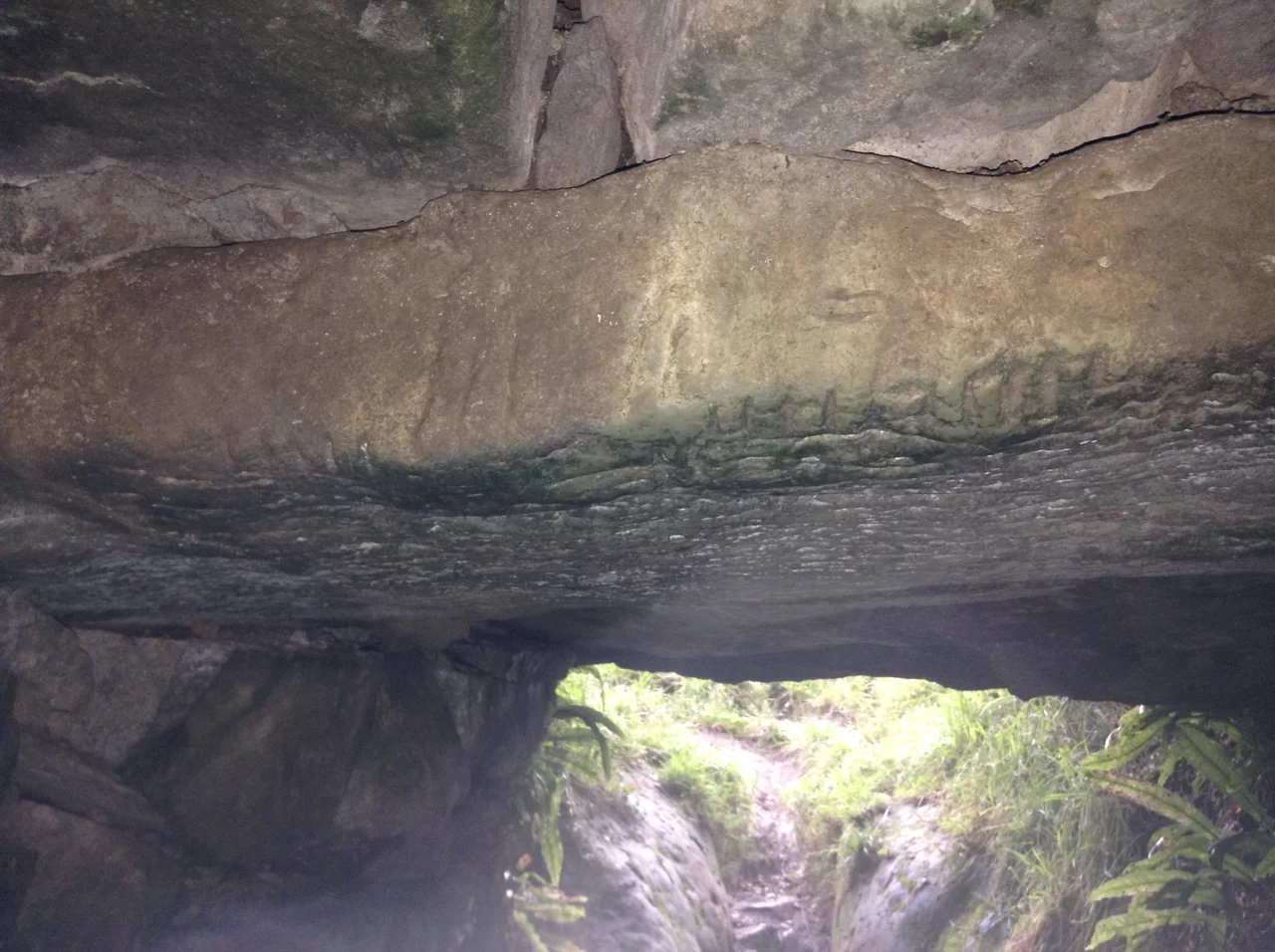
At the edge of the complex, beside the road, an unassuming hawthorn marks the entrance to Oweynagat - Uaimh na gCat, the Cave of the Cats. A narrow stone-lintelled passage drops underground into a natural limestone cave that runs back about thirty-seven metres beneath the field. National Geographic calls it the birthplace of Queen Medb. The medieval Triads of Ireland list it as one of the three darkest places in the country. Medieval Christian writers, never enthusiastic about pagan caves, called it Ireland's Gate to Hell - the entrance to the Otherworld from which the Morrigan, the shape-shifting goddess of war and fate, was said to emerge on Samhain night. One of the ogham inscriptions cut into the lintel just inside the entrance still reads, in the angular slashes of Ireland's earliest writing system: VRAICCI...MAQI MEDVVI - 'of Fraech, son of Medb.' Two thousand years on, the cave still smells of cold wet stone, and the date carved over the door is November 1, the old feast of Samhain - now Halloween, which some say was born here.
The Mound, the Mucklaghs, and Dathi's Stone
The complex repays slow walking. Rathmore, the 'Big Fort,' is a forty-metre convex mound that the geophysics shows is full of hearths and pits - possibly an Iron Age communal hall, the kind of timber building where high feasts were held. Reilig na Ri, the 'Burial Place of the Kings,' is a hundred-metre enclosure with the foundations of five rectangular houses inside it. The Mucklaghs are two parallel linear earthworks, each running for hundreds of metres - folklore says they were ploughed by a giant boar; archaeology shrugs. Dathi's Mound is supposed to hold the body of Dathi, the last pagan High King of Ireland, killed by lightning in the Alps in 429 AD - but excavation in 1981 dated the mound to between 200 BC and 200 AD, several centuries too early. The red sandstone pillar on top still stands. The first surveying of these monuments was begun in the mid-1700s, when Gabriel Beranger drew Rathcroghan Mound in watercolour; the Ordnance Survey of the 1830s gave the monuments the names they still carry. In 1999 the Cruachan Ai visitor centre opened in nearby Tulsk. In 2021 Ireland applied for UNESCO World Heritage status. Almost none of it has ever been dug.
From the Air
Located at 53.802 degrees north, 8.304 degrees west, on the gently rolling plain about 25 km northwest of Roscommon town, near the village of Tulsk on the N5. The site is a six-square-kilometre archaeological landscape rather than a single monument, so the best aerial reference is the slight rise of Rathcroghan Mound itself and the network of ancient field banks visible in low oblique light. Best viewed at 2,000-4,000 feet, ideally in low morning or evening sun when crop marks and earthworks show most clearly. Nearest airports: Ireland West Knock (EIKN) about 45 km west-northwest, Sligo (EISG) about 65 km north.
Nearby Stories
- Ireland West Airport 4.2 km away
- Swanlinbar 6.1 km away
- Creevelea Abbey 11 km away
- Ballygar 11 km away
- Tuam 12 km away
- Clonfin Ambush 16 km away
- Tristernagh Abbey 17 km away
- Easky 20 km away