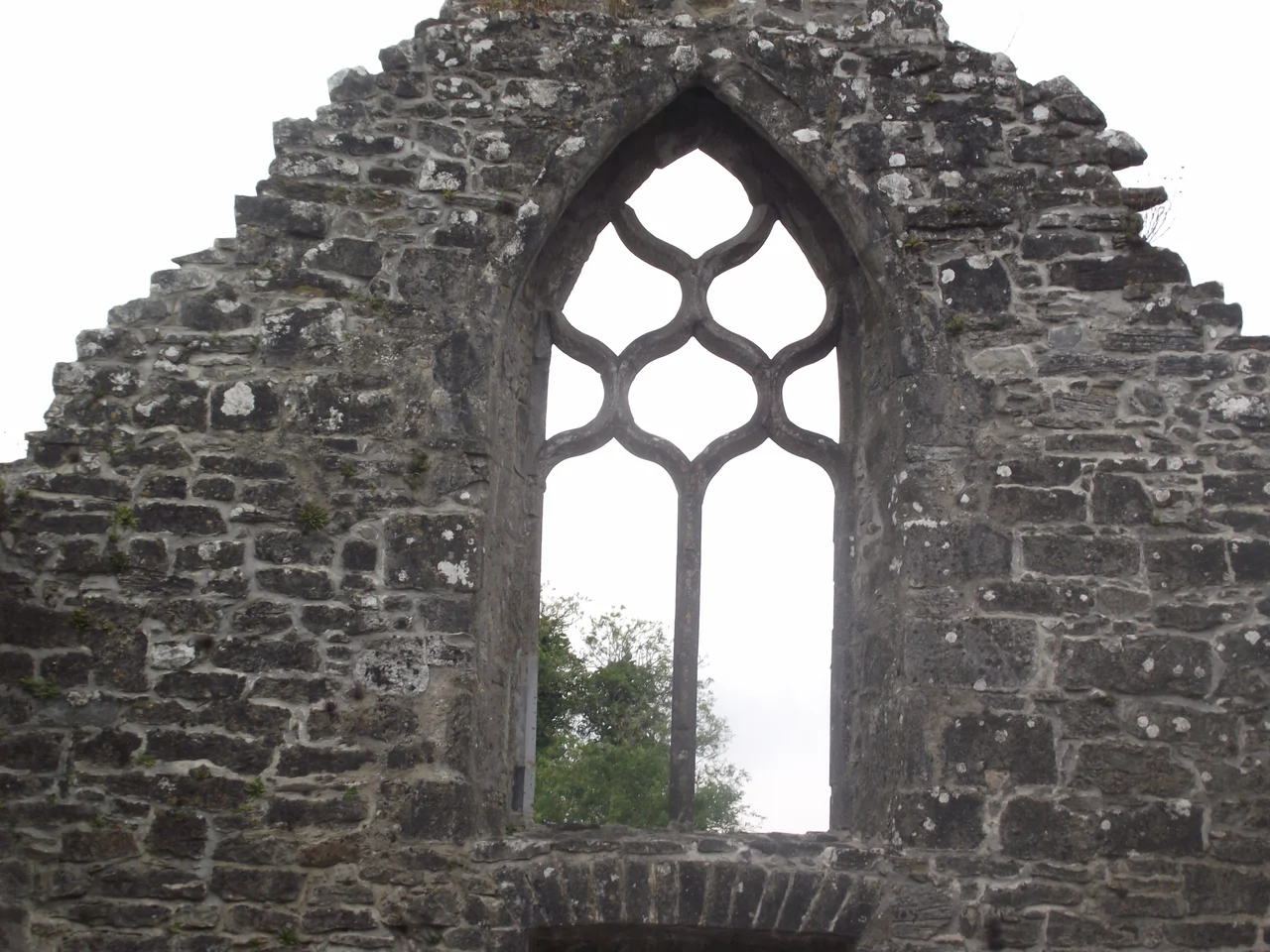

Creevelea Abbey
It is a quiet ruin beside a river in County Leitrim, and the cloister carving still shows Saint Francis preaching to the birds. But Creevelea Abbey has a stranger distinction than its peaceful setting suggests: it was the last Franciscan friary built in Ireland before Henry VIII's Dissolution of the Monasteries swept through the country. Founded in 1508 by Eoghan O'Rourke, Lord of West Breifne, and his wife Margaret O'Brian, the friary had perhaps thirty years of regular monastic life before it became, instead, a problem.
The Last Foundation
Eoghan O'Rourke and Margaret O'Brian, daughter of a King of Thomond, founded Creevelea as a daughter house of Donegal Abbey. The Franciscans arrived, built their church with nave, chancel, transept and choir, raised a bell tower, and laid out the cloister where the figure of Francis preaching to birds was carved into the stone. In 1536, the friary burned by accident and was rebuilt by Brian Ballach O'Rourke. The timing was unfortunate. By the 1540s, Henry VIII's commissioners were dissolving religious houses across Ireland, and any new Franciscan foundation was a small act of defiance against the Reformation. Creevelea was tolerated, then harassed, then officially dissolved around 1598. But the friars did not leave.
The Armada and the Stables
In 1590, an English soldier named Richard Bingham, Governor of Connacht, rode into Creevelea and stabled his horses inside the friary church. He was hunting Brian O'Rourke, the local Gaelic chieftain who had sheltered survivors of the Spanish Armada the previous year. Bingham's gesture, billeting cavalry inside a sacred space, was a deliberate desecration meant to humiliate the O'Rourkes and intimidate the Franciscans who depended on their patronage. It worked in the short term. It did not break the friary. Friars returned. Another house for them was built nearby in 1618, and Creevelea was reoccupied in 1642. Then came Oliver Cromwell. The New Model Army drove the Franciscans out during the Cromwellian conquest of Ireland in the 1650s, but after the Restoration the friars came back yet again, this time living in thatched cabins near the ruins.
Hedge School for a Classicist
What happened next is one of the surprising chapters of eighteenth-century Irish intellectual history. The surviving Franciscans, scattered across the surrounding country, ran an underground hedge school for local Catholic children, who were barred from formal education by the Penal Laws. Among the students in the early 1700s was Charles O'Conor of Bellanagare, a descendant of the local Gaelic nobility who would become one of Ireland's first great antiquarian scholars. O'Conor later described what he had been taught: Latin grammar through Corderius, then the writings of Ovid, Suetonius and Erasmus. He learned to play the Celtic harp, took up fencing, learned to dance. The popular assumption that Gaelic Ireland had missed Renaissance humanism turned out to be wrong, at least at Creevelea. The friars also continued to celebrate Mass at a Megalithic tomb in the nearby townland of Sranagarvanagh, which they used as a Mass rock. A walking trail now leads to the site.
Buried Kings
Two figures from West Breifne lie buried in the ruins. Sir Tadhg O'Rourke, who died in 1605, was the last man to hold the title King of West Breifne, a Gaelic kingship that had been in the family for centuries. Beside him lies Thaddeus Francis O'Rourke, who died in 1735, a Franciscan friar who became Bishop of Killala. Their tombs are among many stone monuments commemorating the local Gaelic nobility that were still visible in the cloister as of 1870. Another Franciscan associated with Creevelea is Patrick O'Hely, who did his novitiate and final vows here around 1560. He was later consecrated abroad as Bishop of Mayo, returned to Ireland during the Elizabethan persecution, was captured, tortured and hanged outside the walls of Kilmallock in 1579. He was beatified in 1992 by Pope John Paul II as one of the 24 officially recognised Irish Catholic Martyrs. His feast day is June 20.
What the Stones Remember
Today Creevelea is a national monument, preserved as a ruin and still in use as a graveyard. The bell tower was converted to living quarters in the 17th century, and at some point the church was covered with a thatched roof to keep the worst of the Leitrim weather off the families that camped inside. The Abbey Church remained in use as living quarters until 1837, more than three centuries after the friary was founded. Stand inside the chancel today and the trees lean in from above where the roof timbers used to be. The Bonet River runs past on the west, the way it has run since the Franciscans first chose this spot for its quiet. The friars are long gone. The carved Francis with his birds is weathered almost to abstraction. But the building they raised has refused, in its quiet stone way, to be entirely silenced.
From the Air
Creevelea Abbey sits at 54.23°N, 8.31°W on the west bank of the Bonet River, immediately west of Dromahair village in County Leitrim, in the rolling country between the Dartry Mountains and the river valleys that drain toward Lough Gill. Nearest commercial airport is Ireland West Airport Knock (EIKN) about 75 km southwest, or Sligo airfield (EISG) about 20 km west. The friary's bell tower and roofless church are visible against the river's broadleaf woodland from low altitude. Lough Gill is just to the southwest. Parke's Castle on the lough's north shore is a related O'Rourke heritage site, less than 5 km away. Best viewing altitude 1,000-2,000 ft for picking out the friary ruins against the surrounding pasture.
Nearby Stories
- Kesh Ambush 3.4 km away
- Florence Court 3.6 km away
- Ballyshannon 4 km away
- Ireland West Airport 6.4 km away
- Carrick-on-Shannon 11 km away
- Easky 13 km away
- Border Region 25 km away
- RMS Empress of Britain (1930) 109 km away