
Florence Court
In 1767, a local farmer named George Willis was walking on Cuilcagh Mountain in County Fermanagh when he noticed two unusual yew saplings. They were growing upright, like columns, rather than spreading like ordinary yew trees. Willis dug them up and replanted one at Florence Court, the house on the lower slopes of the mountain. The Irish Yew, Taxus baccata fastigiata, can only be reproduced by taking cuttings, not from seed. Every Irish Yew in the world today, the upright columnar trees that line graveyards and churchyards across Ireland, Britain, and the broader Anglosphere, descends from that single sapling. The other one died. Willis's tree still stands at Florence Court, roughly a mile southeast of the house, in the overgrown remains of John Cole's early eighteenth-century garden. It is the mother of an entire cultivated lineage, planted in cemeteries from California to New Zealand, surviving even when the house that named it nearly burned to the ground.
Named for a Woman from Devon
Florence Court takes its name from Florence Bourchier Wrey, who died in 1718. Florence was the daughter of Sir Bourchier Wrey, 4th Baronet, of Tawstock in Devon. Her grandmother was Florence Rolle, one of the earliest English women to bear the name. Florence Wrey married John Cole, an Irish landowner, who built the first house on this site some time after 1718, naming it for his late wife. An anonymous history of Fermanagh from that year described John Cole's house as very costly and sumptuous, but a 1739 description by Rev. William Henry called it but small, being only the left wing of a grand building, designed by Mr Cole, which he did not live to execute. The current Florence Court was built in at least two, possibly three, phases. Different rooms display different periods of plasterwork: baroque in the library and study at the front, rich rococo in the dining room, drawing room, and stair hall on the western side. The architects of the current house are unknown.
The Earls of Enniskillen
Florence Court was the seat of the Earls of Enniskillen from the eighteenth century until 1973. The 5th Earl, John Henry Michael Cole, transferred the house and fourteen acres around it to the National Trust in 1953, an act of foresight that probably saved the building. In 1955, a devastating fire destroyed the upper floors. Sir Albert Richardson, an English architect known for his sympathetic restoration work, led the National Trust's repair effort. The result returned most of the house to its former condition, although some rooms on the upper floors remain closed. The 5th Earl's only son and heir, Michael, Viscount Cole, died suddenly in 1956 at the age of 36. In 1961, just as the restoration was nearing completion, Hurricane Debbie devastated the estate's trees. In 1963, the 5th Earl and his wife died within three months of each other. It was the end of an era for the family.
The Last Earl in Residence
David Lowry Cole, the 6th Earl of Enniskillen, succeeded his uncle in 1963. David had spent much of his life in colonial Kenya, where he was elected to the Legislative Council in the early 1960s, just before Kenyan independence. He returned to Florence Court with his second wife, Nancy, a former United States Foreign Service diplomat, and lived there from 1964 until 1973. That year, in the early years of the Troubles, the Earl and Countess of Enniskillen left Northern Ireland, moving to Kinloch House in Perthshire in Scotland. David Enniskillen thus became the last Earl actually to live at Florence Court. His son Andrew Cole, the 7th Earl, succeeded him in 1989 and continues to live on an estate in Kenya. The Cole family connection to Africa, which began with David's youth in the colonial era, has now lasted longer than their continuous residence in Fermanagh did.
The Yew That Started a Lineage
The Irish Yew is one of the most distinctive trees in the cultivated world. Unlike ordinary yews, which spread sideways with horizontal branches, the Irish Yew grows upright, with branches that hold themselves vertical. The shape lends itself to formal landscape design, and especially to graveyards, where the dark green columnar form became an iconic feature of nineteenth and twentieth century Christian burial grounds across the English-speaking world. Every one of these trees is a clone, descended through cuttings from the single sapling George Willis transplanted in 1767. The other Cuilcagh sapling died young. The mother tree at Florence Court is still alive, perhaps 250 years old now, standing within the site of John Cole's original early eighteenth-century gardens. The rock garden opposite the yew also survives, though much overgrown. The formal eighteenth-century landscape it occupied is largely lost. The tree, against all odds, is not.
The Pleasure Garden and the Walled Garden
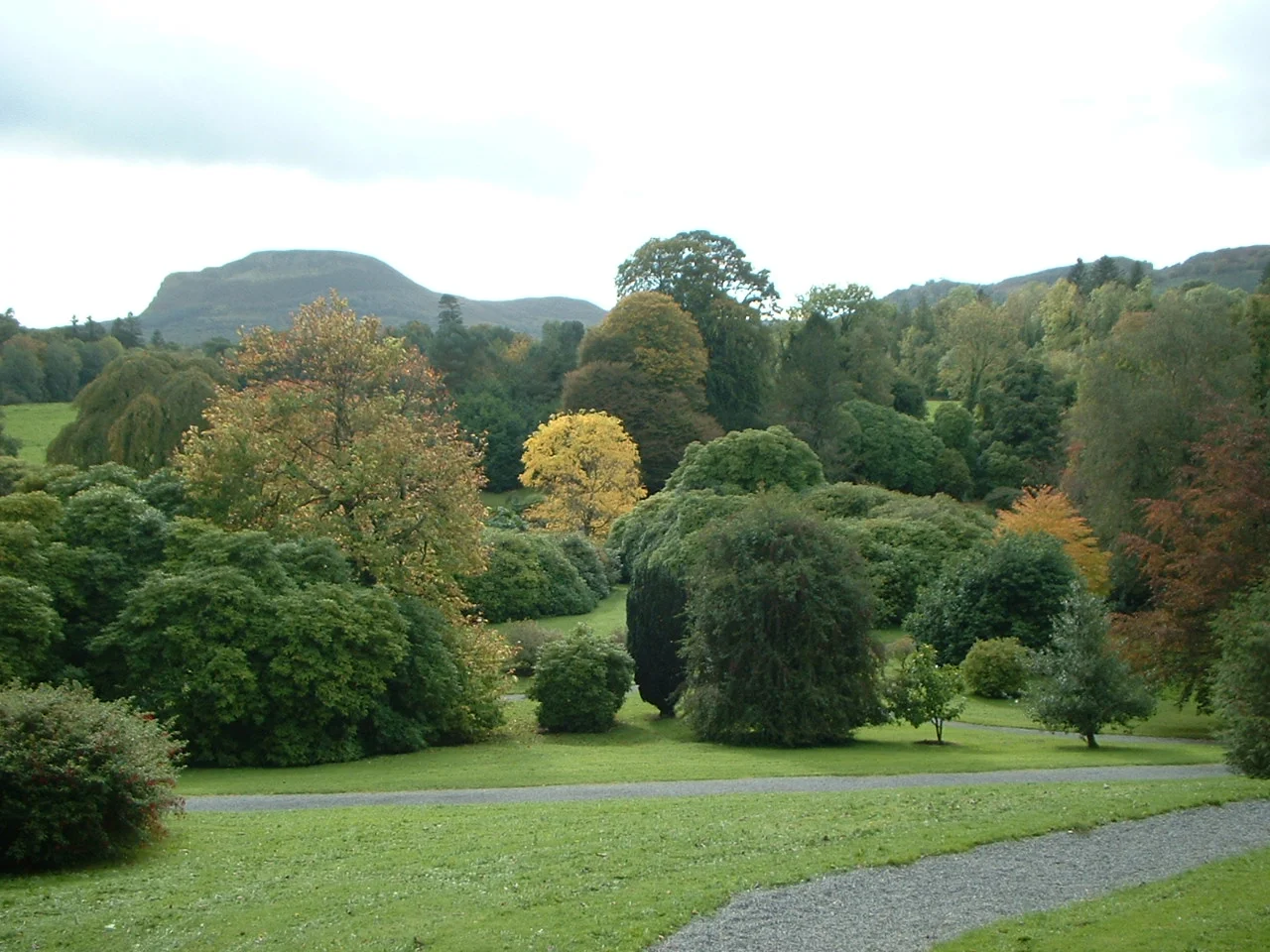
Florence Court's grounds were extensively landscaped during the eighteenth and nineteenth centuries. The Pleasure Garden, with panoramic views of Benaughlin and Cuilcagh mountains, was landscaped in the mid-nineteenth century and features Victorian specimen trees and displays of both temperate and semi-tropical plants, principally rhododendrons. The Summer House, also known as the Heather House, was rebuilt by the National Trust in the late 1980s based on nineteenth-century photographs of the original thatched eighteenth-century structure. In 2015, vandals burned it to the ground. The local community raised most of the funding for a 2016 reconstruction. The four-acre Walled Garden was laid out in the eighteenth century and extended in the 1870s by Charlotte, Countess of Enniskillen. It features a rose garden, two ponds, orchards of heirloom variety fruit trees, and a working vegetable garden. The 1870s Rose Cottage, formerly the head gardener's dwelling, was restored from a derelict condition in the 1990s and is now let as a holiday cottage.
Wodehouse on the Hillside
During the spring of 2012, the BBC filmed parts of its television adaptation of P. G. Wodehouse's Blandings stories at Florence Court. Most of the series was filmed at nearby Crom Castle, but Florence Court appeared in supporting scenes. The series, first broadcast on BBC One in January and February 2013, brought a brief surge of Wodehouse enthusiasts to the Fermanagh countryside, all hoping to catch a glimpse of where Lord Emsworth and his prize-winning pig had appeared on television. The house and gardens are now open to the public year-round under National Trust management, the most visited heritage site in County Fermanagh after the Marble Arch Caves. The 5th Earl who handed the property over in 1953 made the right call. Without him, the fire two years later might have destroyed Florence Court entirely. As it stands, the rococo plasterwork, the Irish furniture, the Walled Garden, and the mother of all Irish Yews are all still here, still being shown to visitors, still telling the story of a family that built a house in Fermanagh and named it for a woman in Devon.
From the Air
Located at 54.26 degrees north, 7.73 degrees west, eight miles southwest of Enniskillen in County Fermanagh, Northern Ireland. Recommended viewing altitude 2,000 to 3,500 feet above terrain. The house sits at the foot of Cuilcagh Mountain, with Benaughlin to the south. The estate's landscaped park, walled garden, and forest plantations are visible from the air. The famous Florence Court Yew lies roughly a mile southeast of the house. Nearest airports: St Angelo (EGAB) to the northeast, Donegal (EIDL) to the northwest, Belfast International (EGAA) to the east. Atlantic weather brings frequent rain and low cloud; the Cuilcagh uplands often have their own cloud cover.
Nearby Stories
- Carrick-on-Shannon 2 km away
- Bailieborough Castle 4.8 km away
- Ballyshannon 7.6 km away
- Manorhamilton 11 km away
- Kesh Ambush 11 km away
- Castlecaulfield 13 km away
- Border Region 13 km away
- Annaglogh Lead Mines 18 km away