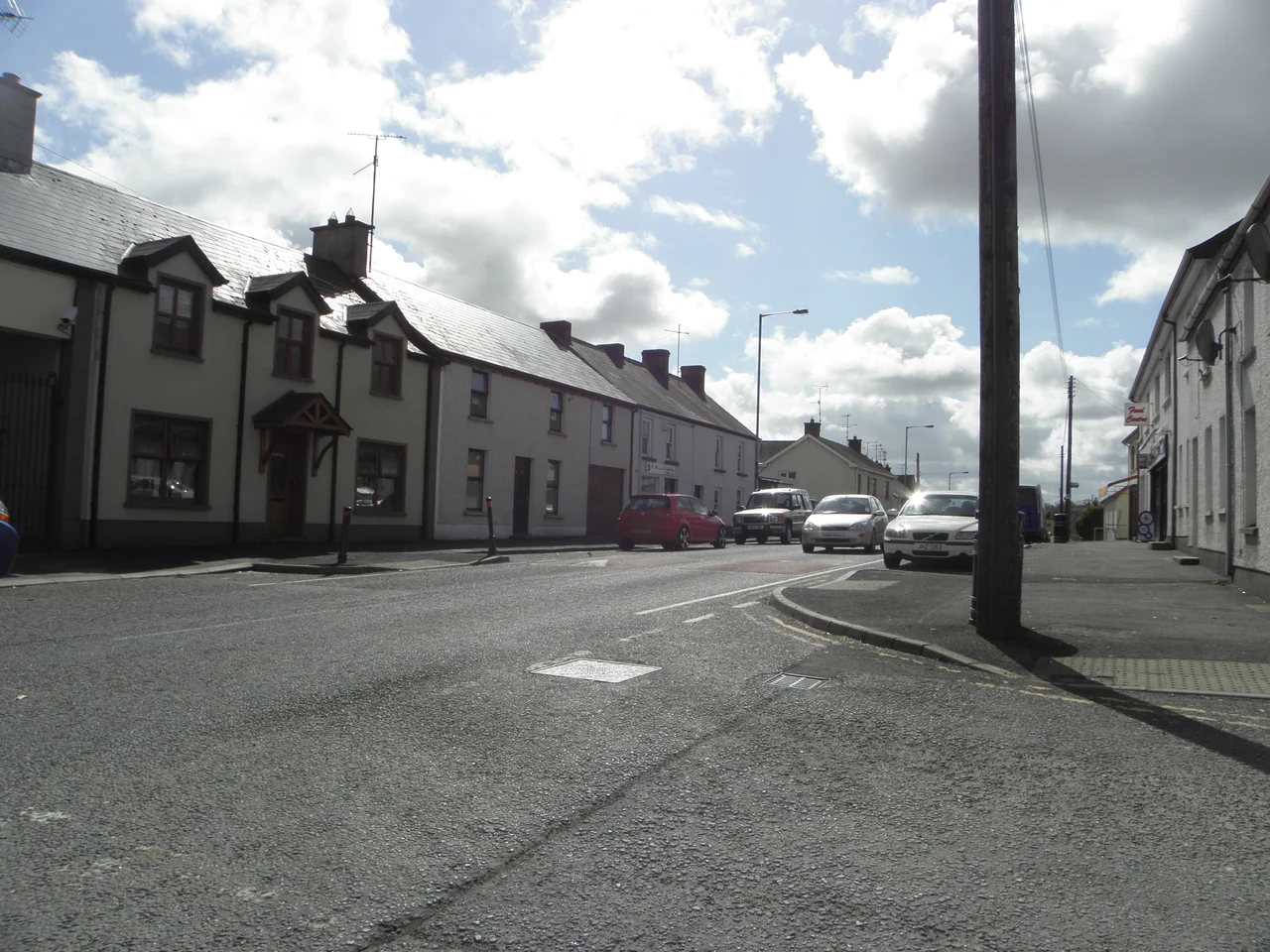

Castlecaulfield
In 1611, a Crown officer named Sir Toby Caulfeild began building a country house on land that had belonged for centuries to the O'Donnelly clan, marshals to the O'Neills of Tyrone. He called the new building Castle Caulfield, but it was not actually a castle. It was an Oxfordshire-style manor house with Tudor mullioned windows and a few defensive flourishes including murder holes above the gatehouse: a thoroughly English statement of confidence dropped into the Tyrone countryside. Thirty years later, the Irish Rebellion of 1641 broke out and the building was burned almost to a shell. Saint Oliver Plunkett later ordained Catholic priests in its grounds. John Wesley preached here several times in the late 1700s. And in the small churchyard a few yards away lies a remarkable piece of literary history. The village of Castlecaulfield, population a few hundred, has lived through more than most.
Ballydonnelly
Before it was Castlecaulfield it was Ballydonnelly, Baile Uí Dhonnaíle in Irish, the place of the O'Donnellys. The O'Donnellys served as marshals to the O'Neills of Tyrone for centuries; in Gaelic tradition the family was part of the Cenél nEoghain, kin of the O'Neills themselves, and the head of the family was responsible for fostering O'Neill children. They reached a peak of influence under Shane O'Neill in the 1560s, when Dean Terrence Danyell (Turlough O'Donnelly) of Armagh handled correspondence between Shane and Queen Elizabeth I. The earliest historical mention of Ballydonnelly is in the Annals of the Four Masters under the year 1531, which records that the place was assaulted by Niall Oge O'Neill, who demolished its castle and carried off the son of O'Neill as a prisoner. The O'Donnellys were displaced from Ballydonnelly during the Plantation of Ulster after the Nine Years' War. The land was granted to Sir Toby Caulfeild in 1610 as a Servitor portion.
Sir Toby's Manor
Sir Toby Caulfeild had served in the Crown forces during the Nine Years' War and was rewarded with the Manor of Aghloske, as Castlecaulfield was then called. He built the house between 1611 and 1619 in the style of an Oxfordshire country manor, which made it strikingly different from the more typical Plantation tower houses being built elsewhere in Ulster. It had Jacobean mullioned windows, tall chimneys, and a long range of rooms rather than a single defensive tower. The gatehouse did have murder holes in the ceiling, openings through which defenders could pour boiling liquid or fire on attackers below, and the Caulfeild Arms above the gate. But the building was a statement of confidence as much as defence. The Caulfeilds were saying, in stone, that they intended to stay. Their family eventually founded the village of Caulfeild in West Vancouver, Canada, in 1898.
The Fire Of 1641
On the night of 22 October 1641, the long-simmering grievances of dispossessed Irish landowners erupted into general rebellion across Ulster. Castle Caulfield was attacked and badly damaged by fire. After the rebellion was suppressed, the Caulfeild descendants used the building only in a limited capacity, finally abandoning it as a residence in the 18th century. Today the manor stands as a roofless ruin within the village, owned by the state and accessible to the public. The walls survive to nearly full height; you can walk through the doorway that once led to the great hall, see the murder-hole openings above what is left of the gatehouse, and trace the outline of the rooms. The shell is recognisably the building that Sir Toby designed: an English manor in the Tyrone countryside, still surrounded by trees, still reading on its own terms despite being open to the sky for nearly four hundred years.
Plunkett, Walker, And Wesley
Three figures of strikingly different traditions are associated with the village. Saint Oliver Plunkett, Catholic Archbishop of Armagh from 1669 to 1681, conducted ordinations of Catholic priests in the ruined grounds of Castle Caulfield under the protection of William Caulfeild, 1st Viscount Charlemont, in defiance of the penal laws. Plunkett was later martyred at Tyburn in 1681 and canonised in 1975. The Reverend George Walker, governor of Derry during its great siege of 1689, was rector of nearby Donaghmore Parish from 1674 until his death at the Battle of the Boyne in 1690. He is buried in Castlecaulfield's parish church of Saint Michael and All Angels. John Wesley, the founder of Methodism, visited Castlecaulfield several times between 1767 and 1789. His preaching here led directly to the founding of the local Methodist congregation in 1842. Three faiths, three figures, one small Tyrone village.
The Burial Of Sir John Moore
From 1818 to his death in 1823, the curate of Donaghmore Parish, based in Castlecaulfield, was a young clergyman named Charles Wolfe. He was 27 years old when he wrote, in 1816, a short poem titled The Burial of Sir John Moore after Corunna. It begins, "Not a drum was heard, not a funeral note, As his corse to the rampart we hurried..." The poem became one of the most anthologised works of 19th-century English verse, memorised by generations of schoolchildren, and Lord Byron called it perhaps the most perfect ode in English. Wolfe himself died of tuberculosis at 31. He is remembered at Castlecaulfield by a blue plaque near the entrance to St Michael's Church and a memorial inside it. He is buried in Cork, where he had gone for his health.
Seventeenth Summer
On 15 March 1921, an American author named Maureen Daly was born in Castlecaulfield. Her family emigrated to Wisconsin when she was a child, but she returned to Ireland sometimes. In 1942 she wrote a novel called Seventeenth Summer, an honest portrait of a young woman's first romance in a small American town. The novel is widely regarded as the founding work of the young-adult literary genre, and by 2005 it had sold over a million copies. Castlecaulfield itself has been a regular winner of Britain in Bloom and Ulster in Bloom in the village category, recognised most years between 2015 and 2018. The Horticultural Society received the Queen's Award for Voluntary Service in 2017. It is a tidy village around a ruined manor in a quiet corner of Tyrone, two miles west of Dungannon, and it has produced more literary, religious, and military reputation than its size would suggest.
From the Air
Castlecaulfield lies at 54.51°N, 6.84°W in central County Tyrone, about two miles west of Dungannon. From altitude the village shows as a small cluster of buildings in mature parkland; the ruined manor of Castle Caulfield is visible as a roofless stone shell at the village's eastern edge. Best viewed at 2,500-4,000 ft. Nearest airports: Belfast International (EGAA) about 25 nm northeast, Dublin (EIDW) about 75 nm south-southeast. Parkanaur Forest Park, formerly a Burges family estate, lies a mile north and is recognisable as a substantial wooded area.
Nearby Stories
- Artigarvan 1.3 km away
- Irish Open (golf) 1.6 km away
- Miami Showband killings 6.3 km away
- Crumlin, County Antrim 7.7 km away
- County Londonderry 8.5 km away
- Baronscourt 13 km away
- County Monaghan 14 km away
- Crom Castle 17 km away