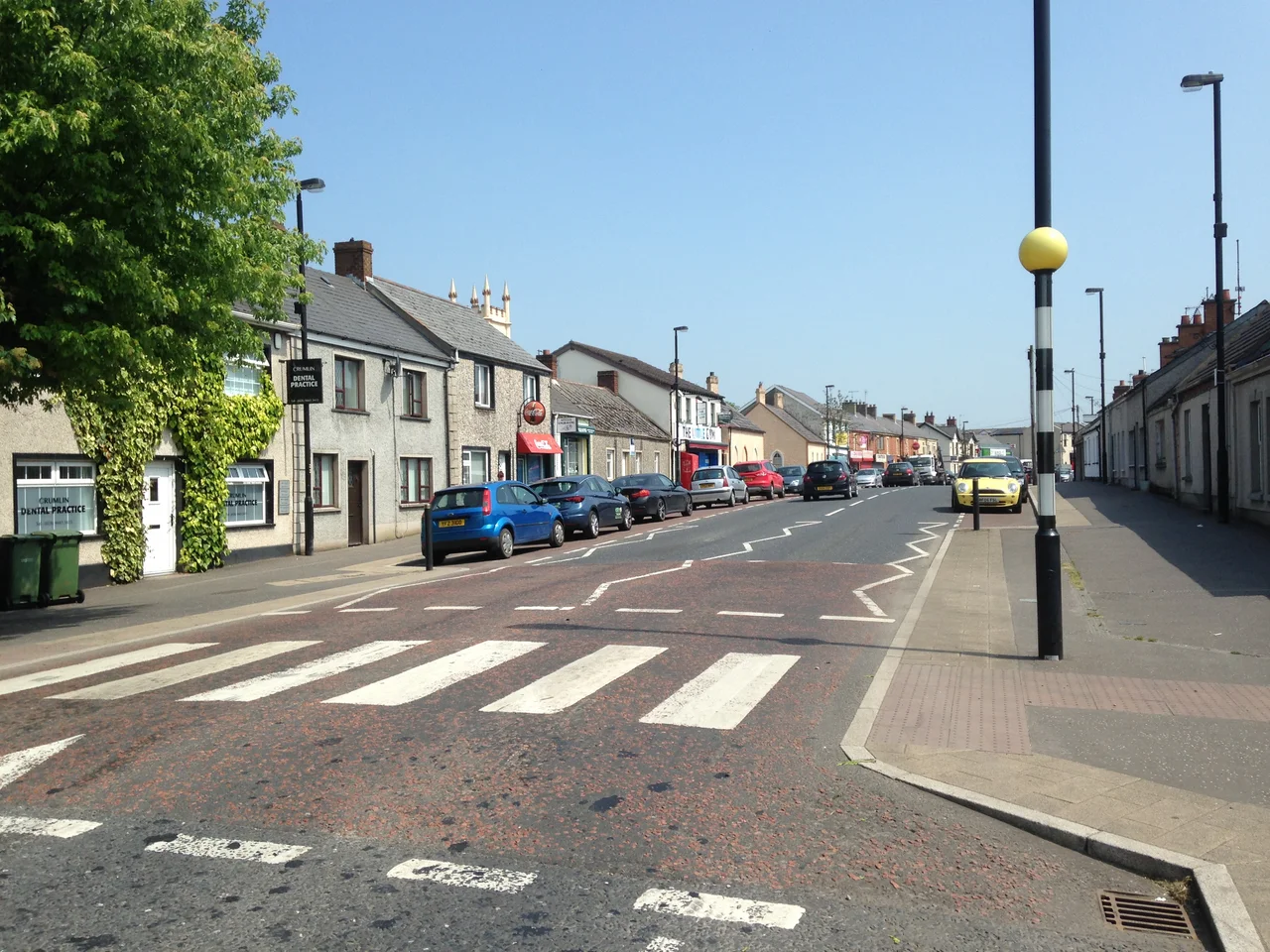

Crumlin, County Antrim
At about ten o'clock on the morning of 13 September 1902, the air above County Antrim made a noise people would still be describing decades later. Some thought it was a train running off the rails. Others guessed a boiler had exploded in the linen mill. A few said it sounded like a swarm of bees pressed up against the windows. None of them were right. A meteorite was tearing through the atmosphere at thirty thousand miles an hour, slowing as it burned, until the rock that survived the descent hit Andrew Walker's farmland near Crumlin. The Natural History Museum in London paid for it. It stayed in England for 121 years. In February 2023 it came home, on loan to the Ulster Museum in Belfast.
A Linen Town Beside the Lough
Crumlin sits twenty miles west of Belfast city centre and three miles from Belfast International Airport at Aldergrove, the international gateway to Northern Ireland. The town's old linen mill was built in 1809. According to a survey in 1808, the village then had 430 people, one school, and one post office - linen weaving and farm labour were the main employers. The mill prospered, the railway arrived in 1871, and a stone clock tower went up in 1897 as a memorial to a member of the Pakenham family. By the 2021 census, Crumlin had grown to 5,366 residents and the airport had brought a different kind of trade. Randox Laboratories headquarters and Lidl Northern Ireland both operate from the area, threading the old village into the global economy.
Naíscoil Ghleann Darach
Crumlin is one of the places where the Irish language is quietly being rebuilt. Naíscoil and Gaelscoil Ghleann Darach - the nursery and primary school operating through the medium of Irish - now educate about a hundred children with fifteen staff. The Gaelscoil is recognised by the Department of Education and operates alongside two voluntary groups, Cumann Gaeilge and Cairde Ghleann Darach, who organise classes, céilís, an annual Irish language fun day, and a bilingual pub quiz. Eighty percent of Crumlin's population identifies as Catholic by background according to the 2021 census, but the language work runs across the town. The same census recorded 25 percent of residents identifying as Northern Irish, with smaller numbers identifying as British or Irish - a community still working out what its identity sounds like.
The Twelfth in 2012
In July 2012, the Orange Order's Twelfth celebration was hosted in Crumlin for the first time in twelve years. The march had grown in scale - more bands, more participants, more flags than the village had seen since the previous hosting. Tension built in advance. The Parades Commission's determination appeared to side with residents opposed to the march, citing its size and the late notice given. Then organisers and residents sat down. They talked. The parade went off peacefully. Commentators afterwards called the agreement a possible blueprint for other contentious marches across Northern Ireland - a small County Antrim village having found a way through one of Northern Ireland's most divisive annual rituals. Trinity, the Orange Arch, still goes up on the main street each July. The march still passes. The compromise still holds.
The Meteorite, Returned
The Crumlin meteorite is a chondrite - a stony meteorite preserving material from the early solar system, more than four and a half billion years old. When it hit Andrew Walker's farm in 1902, the sonic boom was heard up to ten miles away. Two pieces were recovered, totalling about four kilograms. The Natural History Museum acquired them and they sat in London cabinets through two world wars. In 2023, after lobbying by the Ulster Museum and local enthusiasts, the meteorite was lent back to Northern Ireland for three years - a fragment of pre-solar dust returned to within a few miles of the field where it landed. Visitors at the Ulster Museum in Belfast can now see what fell that September morning, the way a few generations of Crumlin schoolchildren never could.
From the Air
Crumlin lies at 54.62N, 6.23W in County Antrim, three nm south of Belfast International Airport (EGAA). The proximity to a major international airport makes this controlled airspace - VFR transit requires coordination with EGAA approach. Aldergrove RAF base shares the airport. Lough Neagh, the largest lake in the British Isles, lies 4 nm to the west. Best ground-orientation reference: the clock tower at the top of the village, and the linen mill chimneys on the river. Belfast City (EGAC) lies 13 nm east-southeast.
Nearby Stories
- Northern Ireland 2.6 km away
- Mount Stewart 3 km away
- Ballyhornan 5.2 km away
- Ballymena 7.7 km away
- Miami Showband killings 12 km away
- County Londonderry 14 km away
- Annaglogh Lead Mines 15 km away
- Ballantrae Lifeboat Station 49 km away