
Miami Showband killings
They had played their show at the Castle Ballroom in Banbridge. Fran O'Toole, the 28-year-old lead singer who had won RTÉ's Gold Star Award three years before, called his wife Valerie from the venue to say he would be home soon. Brian McCoy, the 32-year-old Protestant trumpet player from County Tyrone, had a wife and two small children waiting in Dublin. Tony Geraghty, 23, was the band's guitarist. Stephen Travers, 24, played bass. Des McAlea, 25, played saxophone. Ray Millar had gone home to Antrim that night instead of travelling with the others. The five men climbed into the band's Volkswagen minibus around two in the morning of 31 July 1975 and started south on the A1 toward Newry, the road that led home to Dublin. They never made it to Newry.
The Bands That Crossed the Border
Irish showbands were, in their way, one of the small miracles of the era. From the 1950s to the 1970s as many as 700 of them crisscrossed Ireland on any given night - rock, country, Dixieland, traditional, whatever the crowd wanted to dance to. The Miami Showband, reformed in 1962, was one of the most beloved. Fans crossed the border to see them. The band had no political position, no religious test for its audience. They played in Catholic and Protestant venues alike, in the Republic and in the North. McCoy was Protestant, the others Catholic. "Beatle-like devotion" was how the journalist Peter Taylor described what their fans felt. In 1974 their single "Clap Your Hands and Stomp Your Feet" reached number 8 in the Irish charts. They were exactly what their name suggested: a working dance band whose business was joy. Of all the things 1975 might have killed in Ireland, this was the one that hurt particularly because it had been bringing young people together.
The Checkpoint
About halfway between Banbridge and Newry, near the junction with Buskhill Road, a man in a British Army uniform stepped into the road waving a red torch in a circular motion. During the Troubles, surprise checkpoints were normal. The minibus pulled into the lay-by. McCoy rolled down his window. A man in a Northern Irish accent said politely, "Goodnight, fellas. How are things? Can you step out of the van for a few minutes and we'll just do a check." The five musicians got out and lined up by the ditch at the rear of the van, hands on their heads. McCoy, familiar with how the security forces operated, leaned over to Travers and reassured him: "Don't worry, Stephen. This is British Army." It was not. The gunmen were members of the Ulster Volunteer Force's Mid-Ulster Brigade. At least four were soldiers of the Ulster Defence Regiment, the British Army's local Northern Irish regiment. They were not running a checkpoint. They were running an ambush.
What Happened in the Lay-By
While the musicians stood facing the ditch, two of the gunmen - Harris Boyle and Wesley Somerville - went to the minibus to plant a time bomb. The plan was for the bomb to detonate later, after the musicians had been waved on, somewhere south of Newry. The wreckage and the corpses would then be presented as proof that the Miami Showband had been Republican bomb-smugglers for the IRA. The Irish government would be embarrassed; the border would be tightened; the case for harsher security would be made. The bomb went off prematurely in the back of the van. Boyle and Somerville died instantly. The other gunmen, dazed and exposed, opened fire on the five musicians. Brian McCoy was hit first - nine rounds from a 9mm Luger in the back and neck. Fran O'Toole ran. They chased him, caught him, and shot him 22 times, mostly in the face. Tony Geraghty ran too. They caught him and shot him in the back and the back of the head. Both Geraghty and O'Toole had begged for their lives. "Please don't shoot me," one of them called out. "Don't kill me." Stephen Travers was shot but survived, hit by a dum-dum round that tumbled through his body and left him for dead. Des McAlea, blown clear by the bomb blast, escaped into the field and hid in the hedge.
Who They Were
Fran O'Toole had a wife and two small daughters. He was described by his former bandmate Paul Ashford as "the greatest soul singer" in Ireland. He had grown up in Dublin and won his Gold Star at twenty-five. Brian McCoy was a Protestant from Caledon in County Tyrone, with strong family connections to the Orange Order and the UDR; he had married a woman named Helen and they had two small children. Tony Geraghty, 23, was the band's guitarist, the youngest of the three who died. Stephen Travers, who survived, would spend the next decades trying to find out who had ordered the attack and why. Des McAlea, who survived, lived with the trauma for the rest of his life. These were musicians. They were not soldiers, not paramilitaries, not informants, not anything but men who played dance music in pubs and ballrooms. The plan that night, had it worked, would have made them appear in the morning papers as terrorists carrying explosives - one final insult on top of what had already been done.
The Glenanne Gang
Three men were eventually convicted. Lance-Corporal Thomas Crozier, an active UDR soldier, was arrested within weeks and received a life sentence in October 1976. Sergeant James McDowell, also UDR, was traced through his prescription glasses left at the scene - the lenses were of a prescription worn by only one in 500,000 people. He pleaded guilty. John James Somerville, the brother of one of the dead bombers and a former UDR soldier, was arrested in 1980 and received four life sentences. All three were released in 1998 under the Belfast Agreement. They were members of what investigators came to call the Glenanne gang: a loose alliance of loyalist paramilitaries, RUC officers, and UDR soldiers who carried out at least 87 sectarian attacks in the mid-Ulster area during the 1970s. Their bomb-making site was a farm owned by RUC reservist James Mitchell in Glenanne, County Armagh. The 2011 Historical Enquiries Team report concluded that Robin Jackson - the UVF Mid-Ulster commander known as "The Jackal," linked to over a hundred killings - had been at the scene and was an RUC Special Branch agent. Jackson was tipped off by RUC officers about the discovery of his fingerprints on a silencer. He was never convicted of the Miami killings. He died of cancer in 1998.
What the State Knew
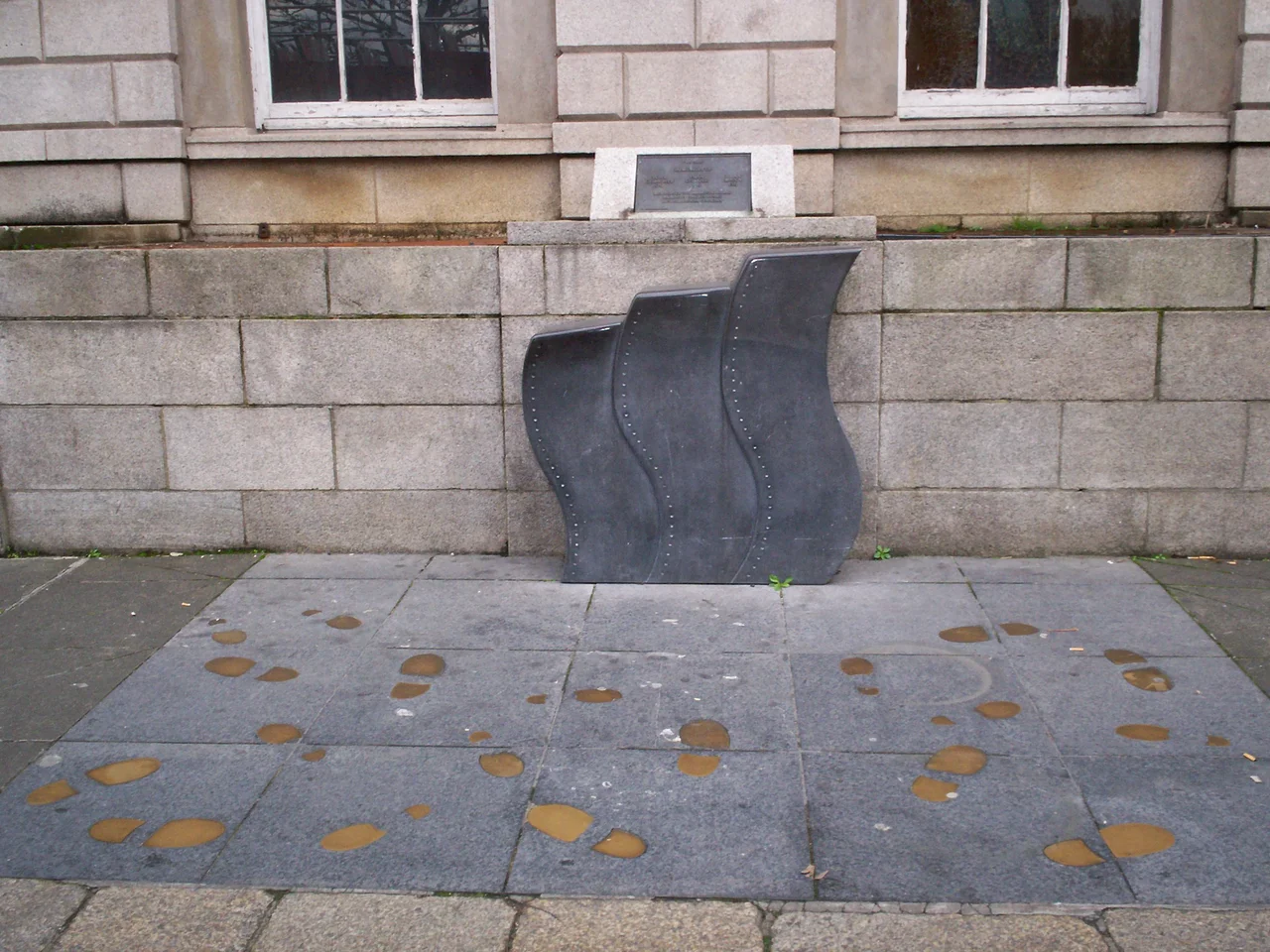
Documents released by the Ministry of Defence in 2020 contain suggestions that the British intelligence officer Captain Robert Nairac had acquired equipment and uniforms for the killers and may have planned the attack. Other accounts dispute this. What is no longer in dispute is that members of the British state's local military and police forces were participants in the murders. The HET report in December 2011 said the killings raised "disturbing questions about collusive and corrupt behaviour." In 2006, Stephen Travers met privately at All Souls Church in Belfast with a senior UVF commander, identified only as "the Craftsman," who apologised and said the gunmen "had panicked" that night. The Craftsman, it later emerged, had helped broker the 1994 loyalist ceasefire. There is a memorial sculpture at Parnell Square North in Dublin, on the site of the National Ballroom where the band often played - limestone, bronze and granite by the Donegal sculptor Redmond Herrity, entitled "Let's Dance," unveiled in 2007. Travers and McAlea were both there. Bertie Ahern, then Taoiseach, made a tribute.
The Music That Was Stopped
Frank McNally of the Irish Times called the massacre "an incident that encapsulated all the madness of the time." The journalist Kevin Myers, writing in 2011, called it "in its diabolical inventiveness against such a group of harmless and naïve young men, easily one of the most depraved" attacks of the Troubles. Showbands continued, but never quite recovered the cross-border audience the Miami had served. Bands stopped travelling north. Musicians stopped trusting the men in uniform who waved them into lay-bys. The English folk singer Jez Lowe wrote a song called "The Miami" for his album Jack Common's Anthem. Near the anniversary each summer, a temporary plaque and fresh flowers appear at the lay-by on the A1 near Buskhill. There is no permanent monument at the spot - just a small memorial that commemorates all five who died there, including the two bombers. The musicians had no part in the conflict. They were people who made other people happy on Friday nights in dance halls. That is who they were when they got into the minibus to go home.
From the Air
The killings took place at a lay-by on the A1 road near Buskhill, County Down, at approximately 54.26°N, 6.32°W - roughly halfway between Banbridge to the north and Newry to the south. Recommended viewing altitude for the area 1,500-3,000 ft AGL. The A1 is now a dual carriageway; the rolling County Down farmland on either side is much as it was in 1975. Nearest international airports: Belfast International (EGAA) about 25 nm north, and Dublin (EIDW) about 50 nm south. The Mourne Mountains rise to the east, providing a useful orientation landmark on clear days.
Nearby Stories
- Ardglass 3.1 km away
- Dungannon 5.9 km away
- Greyabbey 6.3 km away
- Annaglogh Lead Mines 7 km away
- Lisburn 7.3 km away
- Cabra Castle 8.4 km away
- Castlebellingham 17 km away
- German submarine U-1051 38 km away