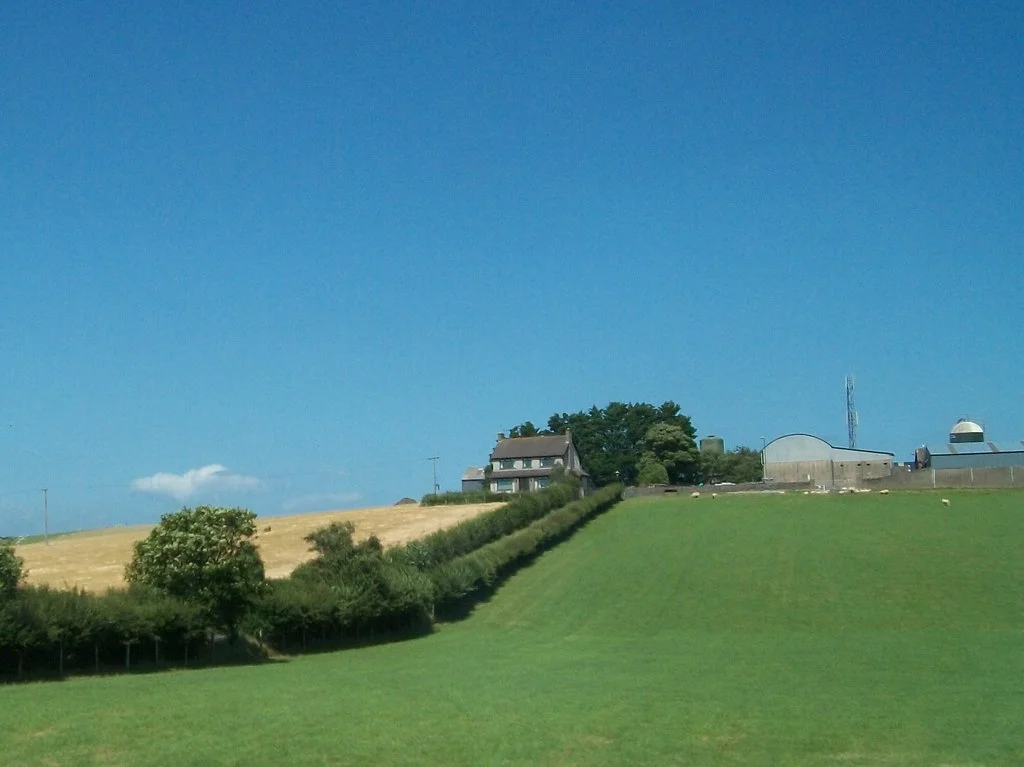

Greyabbey
Affreca came ashore alive. Daughter of Godred Olafsson, King of the Isles, and wife of John de Courcy, the Anglo-Norman who had carved out his own private fiefdom in Ulster, she had survived a sea crossing that should have killed her. In thanksgiving, she did what wealthy medieval women did with thanksgiving: she founded an abbey. The year was 1193. The monks came from Holmcultram in Cumberland, the stone went up almost immediately, and the Latin name they chose was Iugum Dei, the Yoke of God. Eight hundred years later, the abbey is a roofless ruin and the village that grew up beside it is called Greyabbey, though the people who actually live there call it Greba.
Stones That Outlasted Empires
The abbey's working life was short and frequently violent. Edward Bruce's invasion of Ireland between 1315 and 1318 reduced most of the buildings to rubble. The monks rebuilt what they could. In 1541, Henry VIII's dissolution of the monasteries closed the doors for good, and the property was granted to the 11th Earl of Kildare. In 1572, Bryan O'Neill set fire to what was left to deny it as a refuge to English colonists pushing into the Ards Peninsula. The nave was re-roofed in the seventeenth century and served as a parish church until 1778. What survives today is unusual enough to draw architectural pilgrims: an effigy of a sword-seizing knight from around 1300, a worn stone figure long claimed to be Affreca herself (though the style suggests the carver worked a century after her death), and corbel tables carved with oak leaves, human figures and animal heads. Corbel tables are rare in Ireland. The Cistercians have only two: one at Tintern in Wexford, and this one at Greba.
The Green Boys of Greba
On Pike Sunday, 10 June 1798, men from Greyabbey marched with their neighbours from Bangor, Donaghadee and Ballywalter to seize Newtownards. They met musket fire at the market house and broke. The rising was over within hours, but the consequences came slowly. On 2 July, the Reverend James Porter, minister of Trinity Presbyterian Church and a sharp satirist who had skewered Lord Londonderry of Mount Stewart in his pamphlet Billy Bluff, was hanged outside his own church. His wife had walked to Mount Stewart with their seven children to plead for his life. The Marchioness was moved to tears. Her husband was not moved at all. Porter is buried in the old graveyard beside the abbey ruins, and locals still call the rebel men of the village the Green Boys o' Greba. The phrase carries the Ulster-Scots inflection that has survived here for four centuries, the same dialect that turned Grey Abbey into Greba in the first place.
Antiques, Orange Lodges and a Tropical Garden
Greyabbey today is best known for two things that sit uneasily together: antique shops and the Twelfth of July. Several specialist dealers occupy the Georgian and Victorian buildings along Main Street, drawing browsers in search of Belleek china and Edwardian silver. In 2022, the village hosted The Twelfth for the first time in fifty years, the Orange Order's annual commemoration of King William's 1690 victory at the Boyne. Greyabbey Loyal Orange Lodge 1592, founded in 1863, has met continuously ever since, and the village still keeps the traditional Lambeg drums whose enormous percussion goes back to the Williamite wars. Just outside the village, the Mount Stewart estate climbs down to the eastern shore of Strangford Lough. Its sub-tropical garden is one of the strangest things in Ireland: tender plants that should freeze in Ulster winters somehow flourish thanks to the North Atlantic Drift and the lough's protective bowl of warm air. You can walk through both worlds in an afternoon.
Cup Final Hero
In May 1969, Billy McAvoy of Greyabbey scored four goals for Ards Football Club in the Irish Cup Final replay against Distillery. Ards won 4-2 after extra time, the club's third Irish Cup, and McAvoy's four-goal haul equalled the post-war record for goals scored by one player in an Irish Cup Final. Decades later, the record still stands. McAvoy came from a village of fewer than 1,000 people. He played for a club from neighbouring Newtownards. It is the kind of statistic that doesn't travel far beyond Northern Ireland, but the locals remember. They also remember that Flora Montgomery, the actress, was born and raised at Rosemount House, the eighteenth-century mansion that owns the abbey ruins as part of its private parkland. The ruins are publicly accessible. The parkland is not.
From the Air
Greyabbey sits at 54.535 degrees north, 5.560 degrees west, on the eastern shore of Strangford Lough about midway down the Ards Peninsula. From the air, the abbey ruins and the long inland fjord of Strangford Lough to the west make the village easy to locate. Belfast City Airport (EGAC) is about 16 miles to the west-northwest, Belfast International (EGAA) about 25 miles. The Mount Stewart estate immediately to the south of the village shows as a distinctive patch of mature woodland on the lough shore. Lough conditions can be visually striking in late afternoon light, with the tide pattern revealing extensive mudflats at low water.
Nearby Stories
- Pasages (steam trawler) 0.5 km away
- Edward Harland 1.1 km away
- SS Georgetown Victory 4.7 km away
- St Patrick's Isle 18 km away
- Ballymena 19 km away
- Silent Valley Reservoir 20 km away
- Larne 23 km away
- Battle of Glen Trool 39 km away