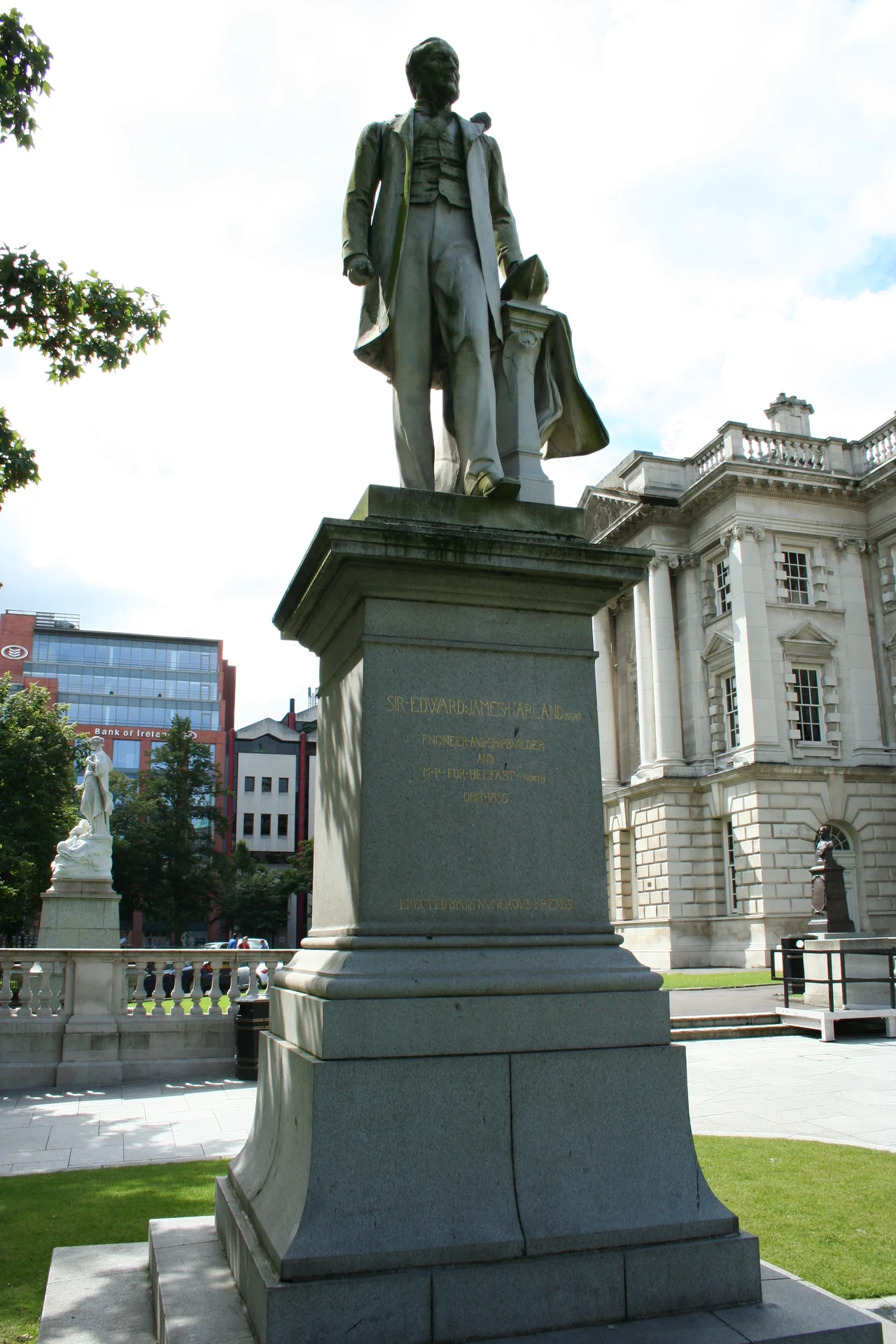

Edward Harland
He arrived in Belfast in 1854, twenty-three years old, sent over to manage Robert Hickson's struggling shipyard at Queen's Island. Four years later he bought it. Three years after that he made his German-born personal assistant a partner. The name they painted on the gates - Harland and Wolff - would, by the end of the century, dominate the skyline of east Belfast with hundred-foot gantries and the largest passenger ships ever built. Edward Harland did not live to see Titanic slide down the slipway in 1911. He had died on Christmas Eve 1895, sixteen years too soon. But the firm that bore his name was already, by then, the largest shipbuilder in the world.
The Apprentice from Scarborough
Edward James Harland was born on 15 May 1831 in Newborough, a neighbourhood within Scarborough on the Yorkshire coast. His father William was a physician; his mother Anne came from Goathland on the moors. Edward was the seventh of ten children and the fourth of six boys. In 1846, aged fifteen, he left home for an apprenticeship at Robert Stephenson and Company in Newcastle upon Tyne, the locomotive engineer whose firm had built the Rocket. Dr Harland was a friend of the Stephensons, which is how a Yorkshire boy with no shipbuilding background ended up in the heart of British industrial engineering. The apprenticeship trained him in iron and steam. He went next to Glasgow, then back to Newcastle, then over to Belfast - the harbour city where Queen's Island had been reclaimed from the Lagan and shipyards were starting to crowd the foreshore.
The Partnership That Made the Yard
During his Newcastle apprenticeship, Harland had met a German-born financier named Gustav Christian Schwabe. The connection mattered. When Harland bought Hickson's shipyard on 21 September 1858 - taking control of the operation on 1 November - Schwabe became one of his backers. In 1861, Harland made Schwabe's nephew, Gustav Wilhelm Wolff, his business partner. The new firm of Harland and Wolff received orders from the Confederate States of America during the American Civil War; the South wanted fast steamers to evade the Union blockade, and Belfast could build them. Harland filed patents in 1871 for improvements in propulsion and in 1878 for screw propeller design. The yard expanded into its own engine works in 1880. By then a third partner had joined - William James Pirrie, a former apprentice, recruited in 1874. He would eventually run the company that built Titanic.
Statesman of the Empire
Harland did not stay only with iron and rivets. He served as a Belfast harbour commissioner and as Mayor of Belfast, helping shape the port that his yard depended on. In 1885 he was knighted and made a baronet. He was a member of the Conservative and Unionist Party, and in 1889 - the same year he retired from the shipyard, leaving Wolff and Pirrie to run it - he was elected Member of Parliament for Belfast North. He moved to London. He was re-elected unopposed in 1892 and 1895. He served on a Royal Commission on industrial disputes in 1891. A Presbyterian who attended Rosemary Street church in Belfast, he never strayed from the disciplined working habits that had carried him from Scarborough to Belfast to Westminster in forty years.
Christmas Eve, 1895
Harland died on 24 December 1895 at Glenfarne Hall, his Irish home in County Leitrim. He was sixty-four. He left no heir to his baronetcy. A statue of him now stands in the grounds of Belfast City Hall, and the firm of Harland and Wolff continued without him for another century and more - building the Titanic, Olympic, and Britannic for the White Star Line in the 1910s, building warships through two world wars, building drilling rigs and offshore platforms when shipbuilding contracted. The yard's twin yellow gantries, Samson and Goliath, still dominate the Belfast waterfront. The Titanic Quarter has been redeveloped around the slipways where the ships were laid down. Harland's great-nephew was Air Marshal Sir Reginald Harland. The name endures because the firm endured, but the firm endured because a Yorkshire physician's son bought a struggling shipyard at twenty-seven and would not let go.
From the Air
Edward Harland's primary legacy is in east Belfast at 54.59N, 5.98W, where Harland and Wolff's yellow Samson and Goliath gantries still stand at the Titanic Quarter on Queen's Island. Best viewed at 1,500 to 3,000 feet on an approach to Belfast City Airport (EGAC), which sits immediately east of the shipyard. The gantries are visible from significant distances - useful navigation references for VFR transit of the Belfast area. Statue at Belfast City Hall is in the centre of the city, around half a mile west of EGAC.
Nearby Stories
- Northern Ireland 2.6 km away
- Mount Stewart 3 km away
- Ballyhornan 5.2 km away
- Ballymena 7.7 km away
- Miami Showband killings 12 km away
- County Londonderry 14 km away
- Annaglogh Lead Mines 15 km away
- Ballantrae Lifeboat Station 49 km away