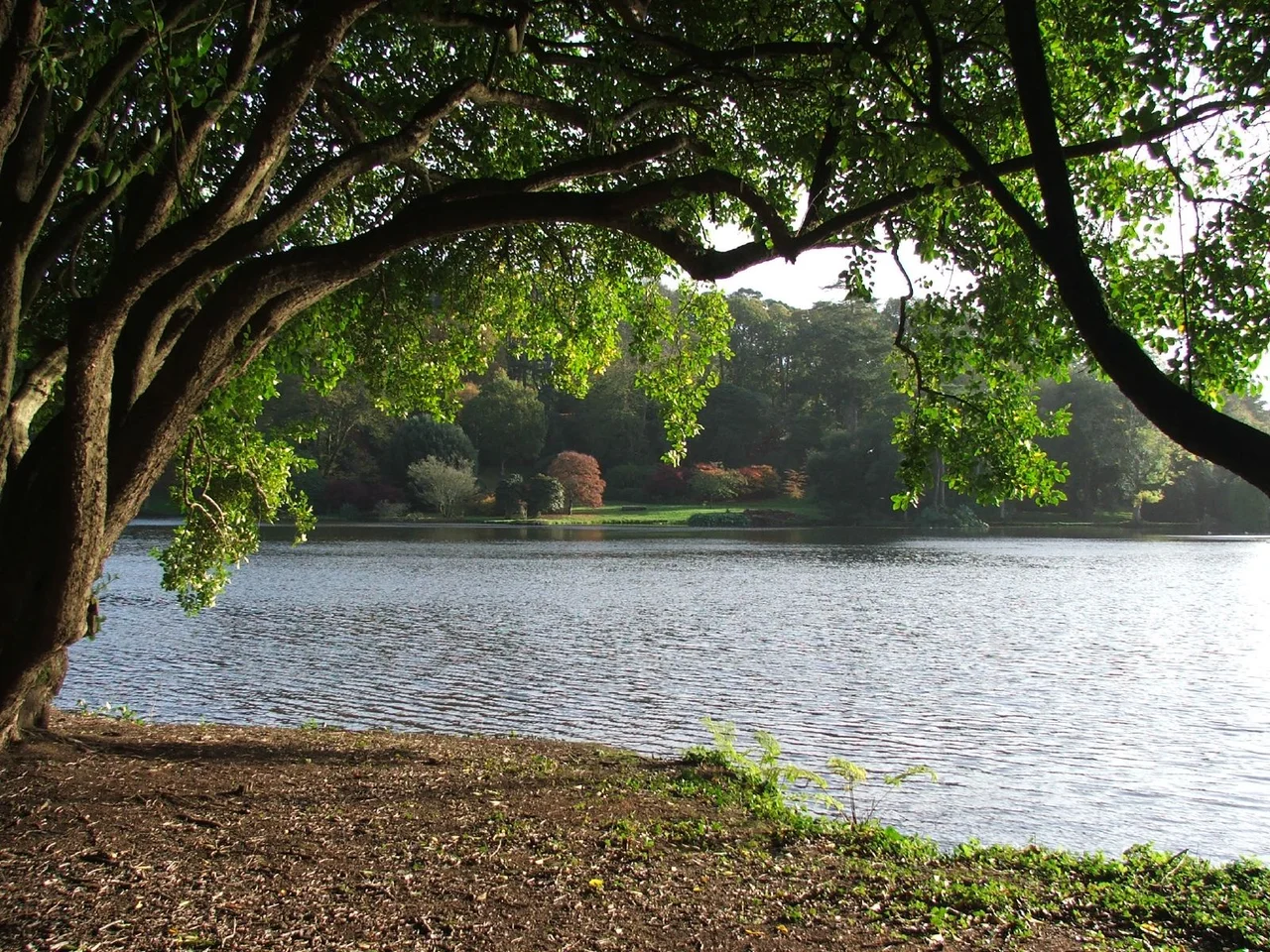

Mount Stewart
On a Strangford Lough morning in May 1936, the German ambassador Joachim von Ribbentrop arrived at Mount Stewart with what the newspapers described as a noisy gang of SS men. The visit lasted four days. Their host, Charles Vane-Tempest-Stewart, 7th Marquess of Londonderry, had recently been forced out as Britain's Air Minister and was attempting his own private diplomacy with Hitler's Germany. The visit made national news. As a parting gift, Reichsmarschall Hermann Göring later sent an Allach porcelain SS flag-bearer figurine that the Marquess displayed on the smoking-room mantelpiece. When war came, neither the figurine nor the Marquess's reputation was quietly disposed of. Both were left exactly where they were. The figurine is still there today, in the house the National Trust now opens to the public, a small, awkward object that refuses to let the past be tidied away.
Linen, Marriage and an East India Fortune
The original house, called Mount Pleasant, was bought in 1744 by Alexander Stewart. The Stewarts were Presbyterians, farmers and linen merchants in a county where the established Anglican church dominated political life. They became wealthy because Alexander married Robert Cowan's sister and heiress; Cowan was East India Company governor of Bombay, and his fortune transformed the family's prospects. As fellow Presbyterians, the Stewarts initially appealed to the county's enfranchised farmers as friends of reform, and Mount Stewart rivalled Hillsborough Castle for political control of County Down. By the troubled 1790s, the family had quietly converted to Anglicanism and made peace with their rivals at Hillsborough. Each estate would return one MP to Dublin, unopposed. The deal held.
Castlereagh and the Map of Europe
Robert Stewart, Viscount Castlereagh, grew up at Mount Stewart and went on to become one of the most consequential British politicians of the early nineteenth century. As Chief Secretary for Ireland, he helped push the 1800 Act of Union through the Irish Parliament after the 1798 rebellion, ending Dublin's separate legislature. As Foreign Secretary, he built the coalitions that defeated Napoleon and led the British delegation to the Congress of Vienna in 1814-15, where the map of post-Napoleonic Europe was redrawn. The chairs he commissioned for his Vienna delegates still sit in the house. He killed himself in 1822, the year after inheriting his father's marquessate, in a state of psychological collapse no one around him had seen coming. In the village of Greyabbey nearby, the Presbyterian minister James Porter had been hanged outside his own church in 1798 on uncertain evidence of rebellion. Porter had savagely lampooned Castlereagh's father in a pamphlet called Billy Bluff. The family did not forget.
A Marquess Refuses Famine Relief
Charles Vane, 3rd Marquess of Londonderry, inherited the house from his half-brother. In 1847, at the height of the Great Famine, he spent fifteen thousand pounds remodelling Mount Stewart and just thirty pounds on soup kitchens. He refused to lower rents. The most supine and inert of his tenants, he insisted in writing, were the only ones suffering. His wife managed her own separate estate in County Antrim very differently: she reduced rents, and in the worst cases waived them altogether. Across Ireland, around a million people died of starvation and disease in those years, and a million more emigrated. Mount Stewart's present exterior, the eleven-bay frontage with its huge central portico, was built while that suffering was at its peak. The house that visitors photograph today is a famine-era building in a way that is rarely said aloud.
The Garden Edith Built
Edith, Lady Londonderry, took over the gardens in 1915 after her husband inherited the title, and over the next forty years she made something almost without parallel in Ireland. The Ards Peninsula sits in the warm path of the North Atlantic Drift; Strangford Lough creates a humid microclimate; frost is rare. Edith realised that plants that should never survive a Ulster winter would actually thrive here. She added the Shamrock Garden, the Sunken Garden, the Spanish Garden and the Italian Garden. She extended the lake. She built the Dodo Terrace, lined with concrete animals modelled on guests at her London parties. Sub-tropical species took root and held. In 1957 she gave the gardens to the National Trust. In January 2025, Storm Eowyn hit Ireland with hurricane-force winds and Mount Stewart lost more than ten thousand trees, including mature specimens with veteran qualities, as the Trust described them, and significant histories. The garden is still there. It is also smaller now in ways that will take centuries to grow back.
The Temple of the Winds
Down at the lough's edge, an octagonal stone building catches the late light. It is the Temple of the Winds, designed in 1782-83 by James Stuart, the architect known as Athenian Stuart for his pioneering studies of Greek antiquities. He modelled it on the Tower of the Winds in the Roman Agora at Athens, whose frieze depicts the eight anemoi, the Greek wind deities. The temple at Mount Stewart was a fashionable allusion in its day, a small building for picnics and views, but it has aged into something that looks almost inevitable: a Greek folly facing a sea-lough in the north of Ireland. Lady Mairi Bury, the last of the Londonderry family to live full-time at Mount Stewart, died in the house in 2009 at the age of 88, in the same four-poster bed hung with red silk damask in which she had been born. Her daughter Lady Rose Lauritzen took over as the family member in residence. The National Trust does the rest.
From the Air
Mount Stewart sits at 54.555 degrees north, 5.608 degrees west, on the eastern shore of Strangford Lough about midway down the Ards Peninsula, a few miles south of Newtownards and just north of Greyabbey. From the air, the estate appears as a substantial patch of mature parkland and woodland sloping down to the lough shore. Strangford Lough itself is the dominant feature, a long sheltered fjord with extensive tidal flats visible at low water. Belfast City Airport (EGAC) lies about 16 miles to the west-northwest, with Belfast International (EGAA) approximately 24 miles to the west-northwest. The Temple of the Winds, near the southern edge of the estate at the lough's edge, is small but visible in clear light.
Nearby Stories
- Pasages (steam trawler) 0.5 km away
- Edward Harland 1.1 km away
- SS Georgetown Victory 4.7 km away
- St Patrick's Isle 18 km away
- Ballymena 19 km away
- Silent Valley Reservoir 20 km away
- Larne 23 km away
- Battle of Glen Trool 39 km away