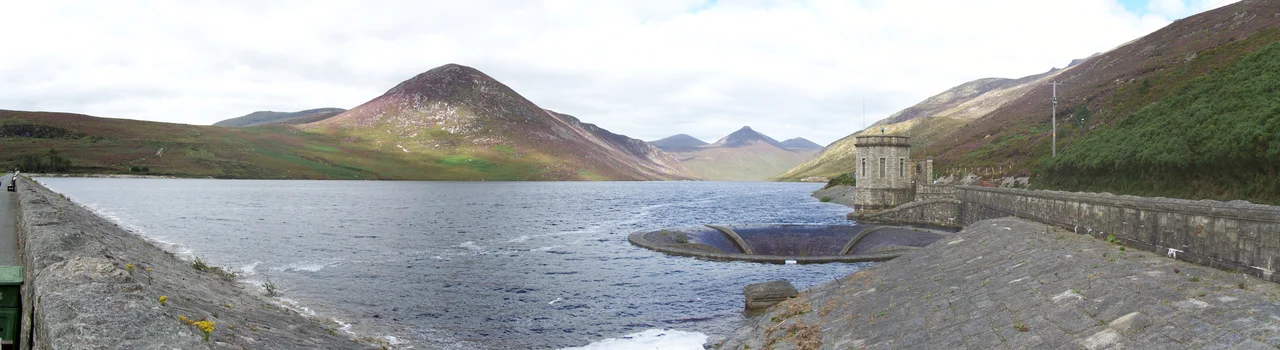

Silent Valley Reservoir
It took ten years and over a thousand men to make a valley into a lake. Between 1923 and 1933, in a fold of the Mourne Mountains near Kilkeel, workers raised an earth-and-concrete dam across the Kilkeel River and filled the basin behind it with mountain rainwater. Nine of them died in the doing. The reservoir they left behind, the Silent Valley, still supplies most of the drinking water for Belfast and the eastern half of Northern Ireland. Walk to the dam wall today and the loudest sound is wind off Slieve Binnian. The name fits.
Why the Mournes
Belfast was growing fast in the 1890s and running out of clean water. In 1891 the Belfast Water Commissioners hired an engineer named Luke Livingston Macassey to find a solution, and he looked south to the Mournes. A 1935 report explained what he found: roughly 9,000 acres of uninhabited mountain land, rising from 330 feet to the 2,796-foot summit of Slieve Donard, drained by two parallel rivers, the Kilkeel and the Annalong. Average rainfall here is 57.6 inches a year. The water has only two degrees of hardness, which is to say almost none at all. It is gathered, in granite, by gravity. All Belfast needed was a way to capture it and a pipe long enough to carry it home.
The Mourne Wall
Before the dam came the wall. Starting in 1904, masons began building a six-foot-high drystone wall around the entire 9,000-acre catchment, marking the boundary the Water Commissioners had purchased and keeping livestock from polluting the streams. It took eighteen years to complete, every stone carried, dressed, and set by hand. The Mourne Wall runs for twenty-two miles, climbing fifteen of the highest summits in the range, including Slieve Donard itself. You can still walk its length. The same hands that built it would soon be needed lower down, in the valley itself, for harder work.
Ten Years in the Valley
The original plan called for a quick conventional dam. The valley refused. The bedrock turned out to be deeply buried under glacial debris, and engineers had to dig down 200 feet before they found rock solid enough to build on. The dam wall, when it finally rose, contained 145,000 cubic yards of concrete. The workforce camped in the valley floor for a decade, in a township of huts and canteens that swelled to over a thousand men. Nine of them never went home: crushed, drowned, or buried by the same earth they were trying to move. Their names are remembered locally; the reservoir is, in a quiet sense, their memorial. The dam was finished in 1933. Water rose behind it through that autumn and into the following spring.
The Tunnel Under Slieve Binnian
Even with the new reservoir, Belfast kept growing and kept thirsty. A second dam in the neighbouring Annalong valley had been planned but was judged too difficult after the Silent Valley experience. Instead, between 1947 and 1951, more than 150 men drove a tunnel straight through Slieve Binnian to bring Annalong water to Silent Valley. Two work gangs began at opposite portals, one at Dunnywater and one near the visitor's centre, and met in darkness almost 800 metres beneath the mountain. They worked by candlelight with primitive equipment. When the headings met, they were inches apart. The tunnel runs eight feet square for 2.25 miles and opened officially on 28 August 1952. A second reservoir, Ben Crom, was added further up the Kilkeel valley between 1953 and 1957.
What the Silence Is Made Of
Stand on the dam wall on a still morning and the surface mirrors the granite peaks above. Wind ruffles the water without much noise. There are no boats, no swimming, no shouting children. The reservoir is a working piece of infrastructure, fenced and protected. The visitor's centre tells the construction story; gardens around the lower dam are open to walkers, and a small information board lists the names of the nine men who died. The valley earned its name long before the dam came, when only sheep and curlews lived here. The dam, oddly, kept the silence. Belfast drinks this water every day. Most of the city has never seen the place where it comes from. They should.
From the Air
The Silent Valley sits at 54.13°N, 6.00°W in the heart of the Mournes, just north of Kilkeel on the County Down coast. From altitude the reservoir appears as an elongated dark mirror set between Slieve Binnian (west) and the eastern Mourne ridge. Best viewed at 3,000-5,000 ft on a clear day. Nearest airports: Belfast City (EGAC) about 35 nm north, Dublin (EIDW) about 55 nm south. The Mourne Wall is visible from altitude as a thin grey line along the ridges; the reservoir feeds Belfast via the Mourne Conduit, much of it buried.
Nearby Stories
- Kilclief Castle 4.8 km away
- Castleblayney 8.4 km away
- Dromore Cathedral 11 km away
- Mornington 11 km away
- Abbey of Kells 15 km away
- Dungannon 21 km away
- German submarine U-1051 22 km away
- Ardglass 22 km away