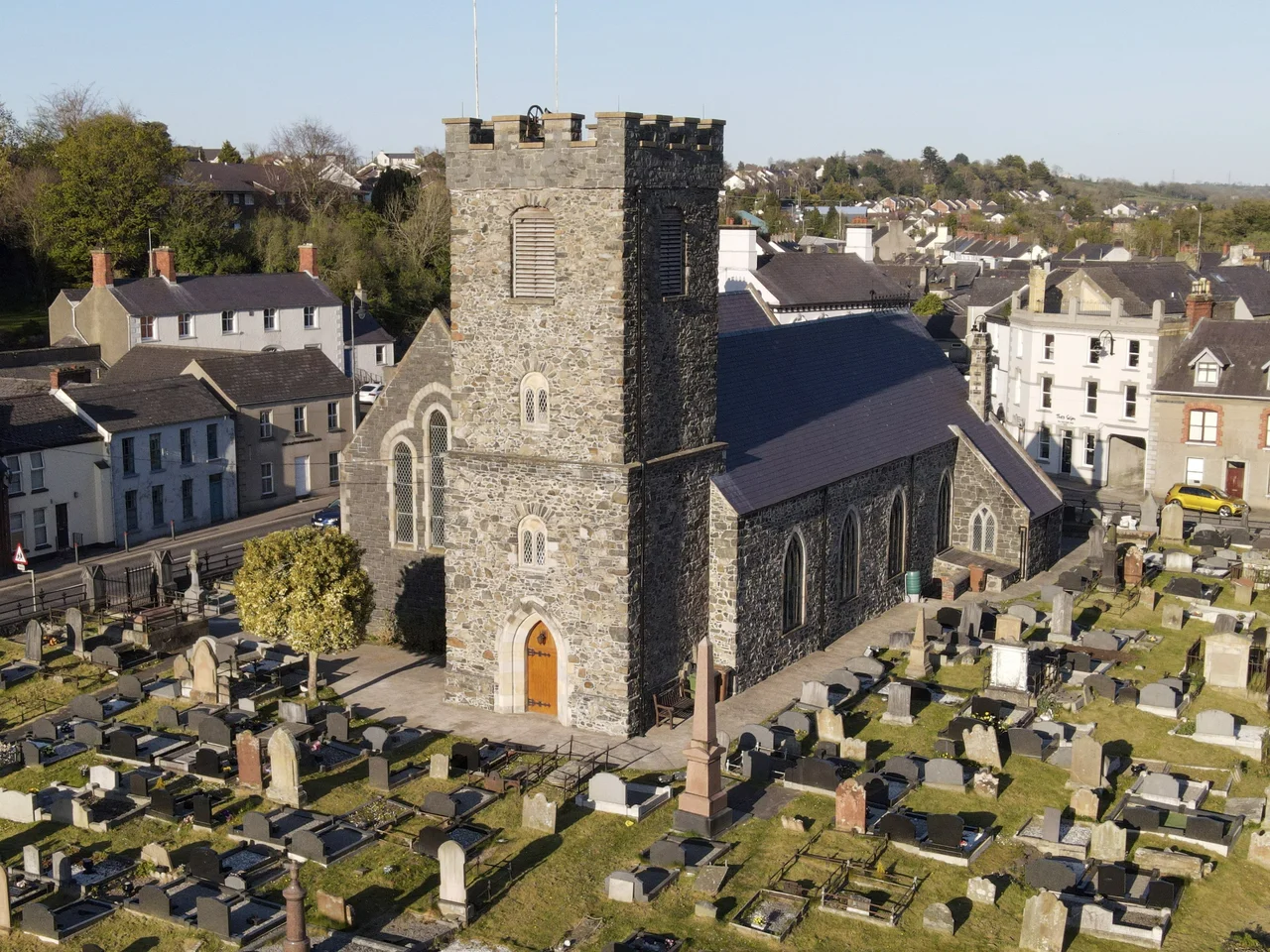

Dromore Cathedral
St Colman planted his church on the banks of the River Lagan in 510 AD, when most of Europe was still a long way from converting. He built it of wattle and daub - woven wooden lattice plastered with mud and dung - the cheapest, fastest, most local kind of structure a small monastic community could put up. The river ran past it then as it runs past now. Fifteen centuries later, the cathedral that stands on the spot is small and L-shaped and made of stone, with seventeenth-century walls and Victorian additions. It is one of two cathedrals serving the Diocese of Down and Dromore in the Church of Ireland, and one of the very few churches anywhere with such a long, continuous record of worship on a single site.
Colman by the Lagan
St Colman of Dromore - one of several Colmans in the early Irish church - founded his community here in the early sixth century, in the dim transition between the time of St Patrick and the medieval Irish church. The original wattle-and-daub building would have been small, perhaps no more than a dozen monks living in beehive cells around a central chapel. The site was carefully chosen. The River Lagan was navigable, the surrounding ridge gave the place its Irish name Druim Mór ("large ridge"), and the location lay on the route between the early Christian centres of Ulster. Colman's chapel was replaced by a medieval church, which was in turn destroyed in the late sixteenth century during the upheavals of the Elizabethan conquest. None of the original fabric survives. What survives is the site, the dedication, and the unbroken memory of fifteen hundred years of worship.
James I's Letters Patent
In 1609 - the same year the official Plantation of Ulster began - King James I issued letters patent giving the rebuilt Church of St Colman a new title and status: The Cathedral Church of Christ the Redeemer, Dromore. Henry II had reorganised the Irish dioceses in the twelfth century, making Dromore a bishopric, but it was James who turned the small church into a formal cathedral. Just thirty-two years later, in October 1641, the cathedral was burned to the ground by Irish insurgents during the rebellion that swept across Ulster. The town of Dromore was destroyed at the same time. The Plantation, only a generation old, had stirred up exactly the kind of communal violence its planners had hoped it would prevent. Among the burned buildings was the cathedral. Twenty years would pass before anyone could build on the site again.
Jeremy Taylor's Church
In 1661 Jeremy Taylor, the newly-restored Bishop of Down and Connor, built a narrow stone structure on the site - 20 feet wide, 100 feet long - that forms what is today the Tower Aisle. Taylor was one of the most distinguished English theologians of the seventeenth century, a friend of John Donne, an Anglican royalist who had been chaplain to Charles I and was sent to Ireland after the Restoration of 1660. His Holy Living (1650) and Holy Dying (1651) are still in print. When he died in Lisburn in 1667 he was buried in the cathedral he had built, where he remains to this day. A semi-circular sanctuary in his memory was designed in 1870 by Thomas Drew, one of Ireland's leading Victorian architects.
Thomas Percy and the Ballads
Bishop Thomas Percy, who served as Bishop of Dromore from 1782 until his death in 1811, added the aisle that still carries his name to the cathedral in 1811. Percy is remembered today not for his episcopal career but for a book he published in 1765, when he was still a country parson: Reliques of Ancient English Poetry, a three-volume collection of old ballads that he claimed to have rescued from a manuscript being torn up by maids in a Shropshire kitchen to light fires. The Reliques helped launch the entire Romantic-era revival of folk poetry. Walter Scott credited Percy with inspiring him to write the Lay of the Last Minstrel. Wordsworth and Coleridge read the book carefully. Percy is also buried in the cathedral, in the aisle he built.
An L-Shape and a Rectangle
The cathedral grew piece by piece. Bishop Percy's aisle in 1811. Drew's sanctuary, the organ aisle and the baptistry in 1870, during the ministry of Canon Beresford Knox - the additions turning the building into an L-shape. Finally, the Harding aisle was added in 1899 parallel to the Tower aisle, squaring the whole structure into a rectangle. The organ was installed by Conacher and Co. of Huddersfield in 1871 and rebuilt in 2008-09 by Trevor Crowe of Donadea in County Kildare. The cathedral does not pretend to grandeur. It is the parish church of about 600 families, an active Anglican congregation in a small Northern Irish town. It is also a cathedral, with all that the word implies about diocesan history and ecclesiastical continuity.
What Continues
Walk in any weekday morning and you will find the cathedral open - quiet, slightly worn, smelling of stone and old wood. The graves of Jeremy Taylor and Thomas Percy lie under the floor; the seventeenth-century walls hold the Victorian additions in a perfectly readable architectural sequence. Outside, the River Lagan still runs past the place where Colman first set out his wattle-and-daub chapel in 510. The Diocese of Down and Dromore now spans two cathedrals - this one, and Down Cathedral at Downpatrick where St Patrick is traditionally said to be buried - and the diocesan headquarters has moved to Belfast. But the small cathedral in Dromore is still here, still in use, still doing what it has done in one form or another for fifteen hundred years.
From the Air
Located at 54.41°N, 6.15°W in the centre of Dromore, County Down, on the banks of the River Lagan. Recommended viewing altitude 1,000-2,000 ft AGL to take in the cathedral, the surrounding market square, and the Norman motte known as 'the Mound' to the east. Belfast International (EGAA) is about 18 nm north; Belfast City (EGAC) about 15 nm northeast. The A1 dual carriageway runs just west of the town. Best viewed from the south on a clear morning, with the cathedral's tower and the river clearly visible against the surrounding pastoral landscape of mid-Down.
Nearby Stories
- Groomsport Lifeboat Station 1.1 km away
- Audleystown Court Tomb 3.5 km away
- Castleblayney 4.5 km away
- Lissan House 5.2 km away
- Castle Upton 5.6 km away
- Warrenpoint Ambush 8.9 km away
- Dungannon 12 km away
- Chicken Rock Lighthouse 53 km away