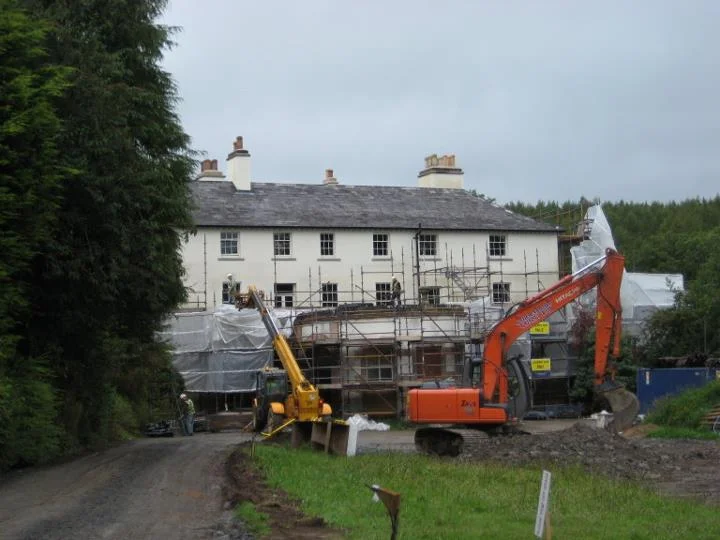

Lissan House
There is a clock at the west end of Lissan House that has been keeping time, more or less, since 1820. Joshua Adams made it for the Market House in Magherafelt; Sir Nathaniel Staples bought the whole tower in the 1880s and grafted it onto his crumbling mansion at the foot of the Sperrin Mountains. The bell can still be heard in Churchtown, four miles away. It is mentioned in the old song "Slieve Gallion's Braes." That clock - inherited, repurposed, defiantly still ticking - is the perfect symbol for the house beneath it. The Staples family lived at Lissan from about 1620 until April 2006: the longest continuous occupation of a single house by a single family in Irish history.
Out of Yate Court
Thomas Staples came over from Yate Court near Bristol in about 1610, one of the smaller players in the great wave of English settlement called the Plantation of Ulster. He settled first in Moneymore - a town the Worshipful Company of Drapers was then building from scratch - before marrying Charity Jones, heiress to the Master of the Vintners' Company, around 1622. Six years later, Charles I made him the first Baronet of Lissan and Faughanvale. When the Irish Rebellion broke out in 1641, Niall Og O'Quinn marched a troop of rebels from Moneymore, seized the estate and imprisoned Lady Staples and her four children in chains at Castlecaulfield for nearly two years. Lady Staples later testified, in records preserved at Trinity College Dublin, that she had watched Anglo-Irish families murdered outside her prison window. The house survived because its iron forge was useful to the rebels.
The House That Robert Built
The present house owes itself to Sir Robert Staples, the fourth Baronet, who married another heiress (Mary Vessey) and built the mansion around 1690, incorporating the older dwelling. Thomas Ashe, surveying for the Archbishop of Armagh in 1703, wrote that "Robert Staples has built a very good stone house; the rooms are noble, lofty and large. There is a very handsome staircase which leads to chambers above with a large parlour and dining room." That oak staircase, rebuilt after collapsing in the 1880s, still dominates the entrance hall. The five-acre walled garden Robert laid out also survives. So does the White Bridge across the Lissan Water, designed by the Sardinian architect Davis Ducart in the 1760s for John Staples - the same Davis Ducart who designed the doomed dry-hurries on Dukart's Canal at nearby Coalisland.
The Barefoot Baronet
By the early twentieth century, the estate was bleeding money. Sir Robert Ponsonby Staples, twelfth Baronet, was a sufficiently accomplished portrait painter to have founded the Grosvenor Gallery with Sir Coutts Lindsay - the gallery that launched the careers of Whistler and Burne-Jones - and to count Edward VII among his friends. His most famous painting, An Imaginary Cricket Match, still hangs at Lord's Cricket Ground. None of this made him rich. He was also remarkable for refusing to wear shoes: he believed the earth exuded a natural electricity beneficial to health, and listed his principal occupation as "barefoot walking" in the 1926 Who's Who. He was reduced to asking the postman for loans and pawning his own paintings. A two-day sale at Lissan stripped the house of most of its remaining furnishings, many of which still hang at nearby Springhill House.
Hazel and the Cunard Years
By 1943, Lissan was bankrupt. The thirteenth Baronet, Sir Robert George Alexander Staples, divided the house into apartments and moved to England to find work, leaving his cousin Harry Radclyffe-Dolling to manage it. For roughly twenty-five years more than a hundred people lived inside Lissan, in flats carved out of what had been drawing rooms and bedrooms. The Baronet's elder daughter, Hazel, joined the Cunard Line as a purser on RMS Queen Mary and the Caronia, expecting never to return. When her father died in 1970, she came back to meet Harry Dolling and within a year had married him. They restored the house to a single dwelling. Harry died in 1986, her mother Vera in 1990. From then on, Hazel lived alone at Lissan, increasingly aware that the family line would end with her.
Restoration
In 2003, BBC television featured Lissan on its Restoration series, which promised a prize of more than a million pounds for the most popular crumbling building in Britain. Hazel, in her seventies, became the face of the campaign. Lissan made the grand final and lost to the Victoria Baths in Manchester by 140 votes. The programme raised public awareness but, in the end, not a single pound of restoration funding. Hazel pressed on. She established the Lissan House Trust, and when she died in April 2006 she bequeathed the entire estate to it - on the condition that a viable restoration scheme be secured within three years. The Trust delivered. Phase I began in 2010: structural stabilisation, re-roofing, removal of 1940s cement render, restored Georgian glazing. In Spring 2012, for the first time in its history, Lissan opened to the public as a tourist attraction.
What the House Still Holds
Sir Richard Molesworth Ponsonby Staples, the seventeenth and last Baronet, died on 8 November 2013, and the title was declared dormant. Debrett's spent more than a decade searching the genealogies of Nova Scotia and Massachusetts for a male-line heir; three candidates were identified, but none has yet proven the connection definitively. The ballroom Sir Thomas Staples added in the nineteenth century - early central heating, double glazing, sprung dovetail floorboards laid without nail or screw, walls hung with hand-painted Chinese wallpaper - is still there, scarlet and black, fragments of the original paper preserved. So is the water turbine that James Head Staples installed on the Lissan Water in 1902, which supplied the only electricity to the house until 2004 and is still in working order. The clock still strikes.
From the Air
Located at 54.67°N, 6.76°W, near the base of the Sperrin Mountains in County Tyrone, Northern Ireland. The house sits about four miles north of Cookstown and ten miles south of Magherafelt; Slieve Gallion (528 m / 1,732 ft) rises about three miles to the north. Recommended viewing altitude 1,500-3,000 ft AGL to take in the ancient woodland and the surrounding parkland. Nearest international airports: Belfast International (EGAA) about 30 nm east-southeast, and City of Derry (EGAE) about 30 nm northwest. Visibility is typical Sperrin maritime; mornings are often misty, with best clarity after late-morning sun has burned off the hill fog.
Nearby Stories
- Limavady Grammar School 5.6 km away
- Altnahinch Dam 6 km away
- Baronscourt 7.9 km away
- Irish Open (golf) 11 km away
- Flight of the Earls 14 km away
- Maze Prison Escape 14 km away
- 1990 British Army Gazelle shootdown 16 km away
- Enniskillen Lifeboat Station 21 km away