
Flight of the Earls
About a hundred people walked down to the shore at Rathmullan on the morning of 14 September 1607 and got into a ship. They carried with them, packed in trunks and in their heads, the political memory of an entire civilisation. Hugh O'Neill, Earl of Tyrone, was sixty years old, recently a guest of King James, and one of the most formidable strategic minds Ireland had ever produced. Rory O'Donnell, Earl of Tyrconnell, was thirty-two and the patriarch of the second great Ulster dynasty. With them were their wives, children, brothers, retainers, and a few bishops. They thought they were going to Spain. Storms drove them into France instead. None of them ever returned. The day they sailed is the day Irish historians, fairly or not, place at the end of Gaelic Ireland.
The Long War Behind Them
To understand why the earls fled, you have to follow them backwards into the Nine Years' War. From 1593 to 1603 Hugh O'Neill and Hugh Roe O'Donnell led a confederacy of Irish lords against the Tudor conquest. Their war was the most serious military challenge the Tudor state faced in Ireland, and Queen Elizabeth I spent two million pounds suppressing it, eight times what she spent on all of her continental wars combined. The end came at the Siege of Kinsale in late 1601, where the confederacy was decimated. Hugh Roe sailed to Spain to plead for more help and died in Simancas of illness on 9 September 1602. English scorched-earth tactics produced a famine across Ulster so terrible that contemporary accounts describe survivors driven to cannibalism. Tyrone signed the Treaty of Mellifont in March 1603 and surrendered to a king he did not yet know was dead. Elizabeth had died six days earlier.
Generous Peace, Slow Strangulation
The newly-crowned James VI and I gave the defeated lords surprisingly mild terms. Tyrone was pardoned and went hunting with the king. Rory was made Earl of Tyrconnell. They kept most of their lands and titles. But the peace came with a knife in it. English common law replaced the Gaelic system of tanistry; Gaelic titles were extinguished; sub-chiefs became freeholders with claims that cut into the earls' authority. Officials who had fought against the earls now devoted themselves to undoing them by paperwork. Arthur Chichester, who became Lord Deputy in 1605, banned Catholic clergy from Ireland and forced attendance at Protestant services. John Davies, the Attorney-General, worked to engineer treason charges. George Montgomery, the new Protestant Bishop of Derry, set himself the task of breaking the marriage between Tyrone's daughter Rose and his vassal Donnell Ballagh O'Cahan, because he understood that estrangement between them would weaken Tyrone's grip on his own land. By May 1607, Tyrone's lawsuit over O'Cahan's territory had collapsed in the Privy Council, and he had snatched a document from O'Cahan's hand and torn it in pieces in front of his enemies.
Why Rathmullan
Rathmullan sits halfway up the western shore of Lough Swilly, the long glacial fjord that cuts north into Donegal. It was Tyrconnell's own coast, accessible from the O'Donnell heartlands but quiet enough to load a ship without attracting English notice. A French vessel, possibly arranged through Cuchonnacht Maguire, the Maguire chieftain whom Chichester had been holding for questioning, was waiting in the lough. The earls' destination was A Coruña; Spain had been their wartime ally and seemed the natural refuge. They never made it. Storms in the Bay of Biscay drove them off course, and on 4 October they put in at Quillebeuf-sur-Seine in France, exhausted, seasick, and far from where they had intended to be. King Philip III refused to let them enter Spain. He had signed the Treaty of London with England in 1604, and a Spanish bankruptcy made another war unthinkable. The Wild Geese, as later Irish exiles would be called, had begun.
Rome, Fever, and Endings
They went on to Leuven in the Spanish Netherlands, where the earls' children were left at the Irish College of St Anthony. The adults trudged south through winter Europe and reached Rome on 29 April 1608. Pope Paul V granted them small pensions. Their apartments were shabby compared to the keeps they had left behind. Tyrconnell died of a fever within three months. He was thirty-three. Tyrone lived another eight years, lobbying tirelessly for a Spanish-backed return to Ireland, writing letters that produced nothing, slowly losing his eyesight. He died in Rome in 1616 and was buried in San Pietro in Montorio on the Janiculum hill, where his grave can still be visited. King James declared the flight treasonous and used it to escheat the earls' lands. Within four years the Plantation of Ulster had begun, settling Protestant farmers from England and Scotland on land that the O'Neills and O'Donnells had held for centuries. The consequences are still being argued out on the streets of Belfast and Derry four hundred years later.
What Sailed With Them
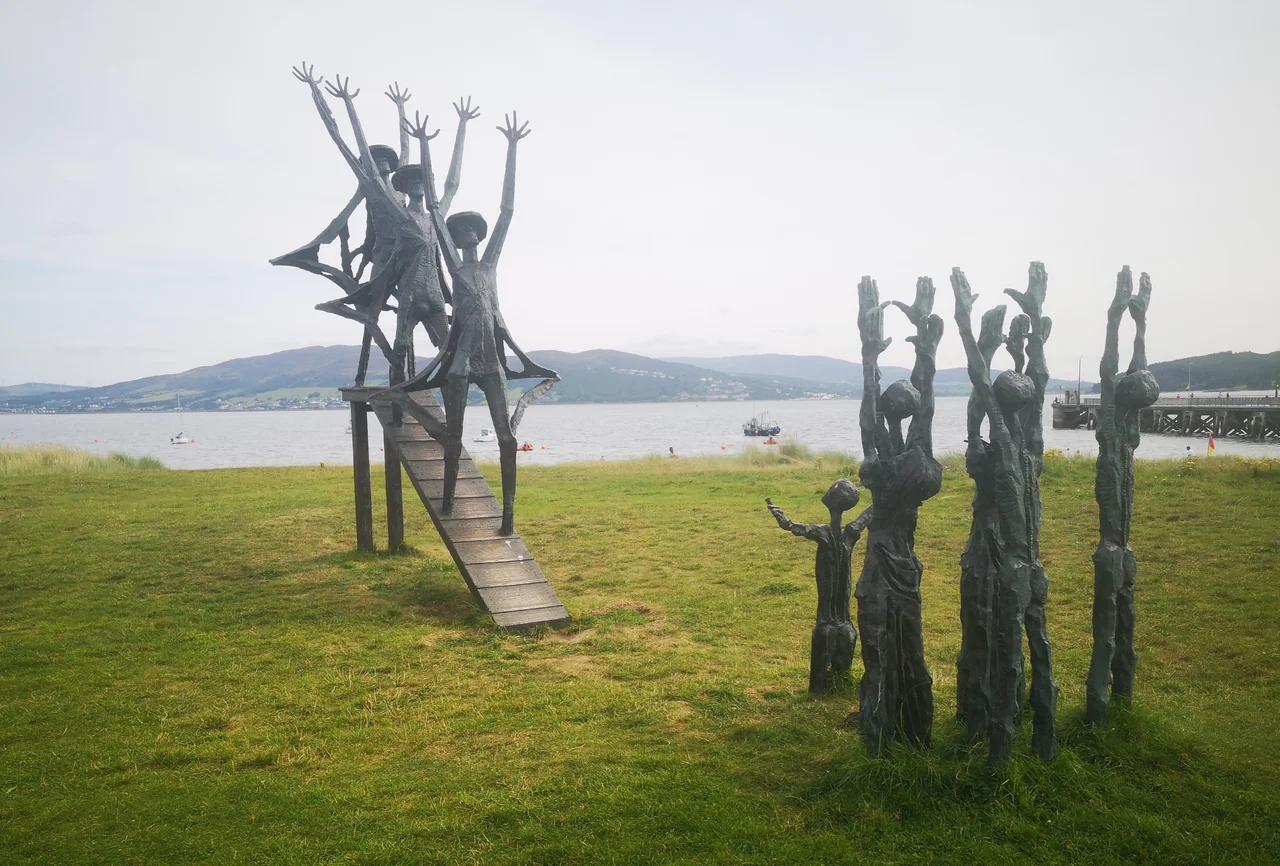
Whether the earls fled to evade arrest or simply chose the long shot of Spanish support over inevitable humiliation in London, historians still debate. What is not in dispute is the symbolic weight of that morning. The two greatest Gaelic dynasties in Ireland walked off their own coast and never came back. The Brehon law and the tanist succession went with them. Gaelic poetry began its long elegy: bards composed Lament for the Princes of Tyrone and Tyrconnell in the years that followed, and James Clarence Mangan's translation kept the wound alive for the nineteenth century. In 2007 President Mary McAleese unveiled a statue at Rathmullan to mark the four-hundredth anniversary. The pier where the earls boarded still juts into Lough Swilly, the same dark water that Saint Colmcille was said to have cleared of a many-eyed sea monster a thousand years earlier.
From the Air
The Flight of the Earls departure point is Rathmullan, on the western shore of Lough Swilly at 55.09 degrees north, 7.55 degrees west. From cruise, look for the long blue inlet of Lough Swilly running south from Fanad Head; Rathmullan sits about a third of the way down on the Fanad side, almost directly across from Buncrana. The nearest controlled airport is City of Derry (EGAE) about 35 km southeast; Donegal Airport (EIDL) lies roughly 35 km west-northwest at Carrickfinn. Belfast International (EGAA) is the closest major hub at around 125 km east. On a clear day the Inishowen peninsula on one side and the Fanad lighthouse on the other frame the lough's mouth into the Atlantic, the same gateway the earls' French ship took out toward Biscay.
Nearby Stories
- Falcarragh 3.4 km away
- Lifford 5.2 km away
- Harry King Goode 7 km away
- German submarine U-218 20 km away
- Donegal Castle 21 km away
- Plantation of Ulster 22 km away
- German submarine U-1005 30 km away
- Port Ellen Distillery 60 km away