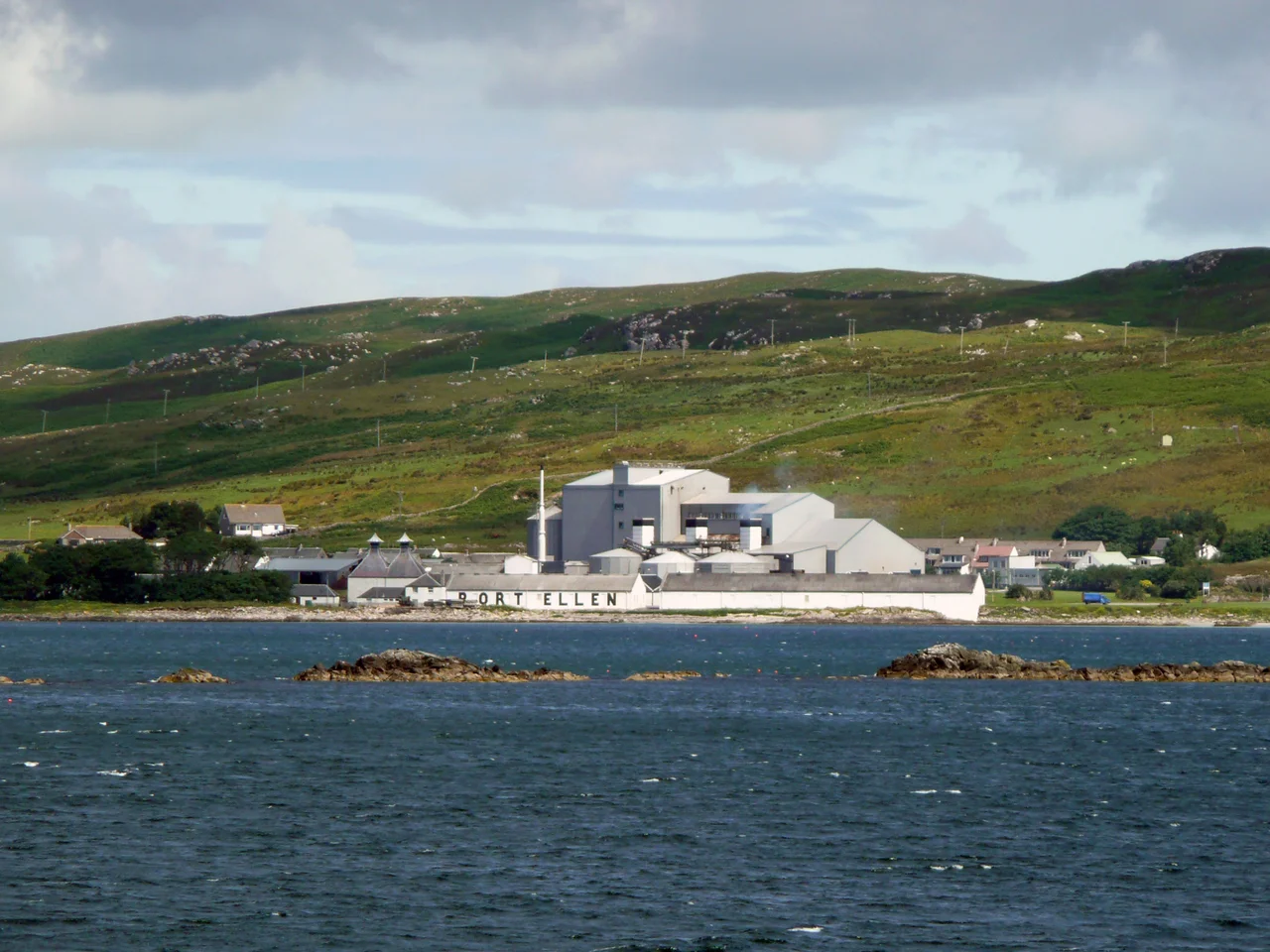

Port Ellen Distillery
In the spring of 1983 a group of men walked through Port Ellen distillery on Islay and broke the stills. The Distillers Company - DCL, owner of half the brand names in Scotch - had decided the world had too much whisky in it. Demand had collapsed; production had not. Something had to give. They picked Port Ellen, along with Brora in Sutherland and a few others. The copper was cut up and sold for scrap. Some warehouses were repurposed. The famous old maltings, which had been built in 1973 to supply the floor-malted barley that every other Islay distillery was starting to phase out, was kept running under contract. The rest of Port Ellen became, in industry shorthand, a ghost distillery. There were perhaps four thousand casks left in the warehouses. Nobody at DCL thought they were worth much.
The Accidental Treasure
Port Ellen had been founded in 1825 as a malt mill and was developed into a distillery by John Ramsay between 1833 and 1892. The warehouses Ramsay built still stand and are listed buildings - long, low, slate-roofed structures pressed close to the shore of the bay. For most of its modern history Port Ellen made whisky for blending. Its smoky, mineral, slightly maritime spirit went into the Johnnie Walker family and Bell's, where it added depth that drinkers experienced without ever hearing the distillery's name. After 1983, with no new production possible, Diageo and its predecessors began bottling the surviving casks as a single malt for the first time. The first official annual release came in 2001. Each year's bottling was smaller than the last as the warehouses emptied. Each year's price went up. By the mid-2010s a single bottle of Port Ellen at official release was selling on the secondary market for several thousand pounds. Independent bottlings of single casks ran higher still. The whisky tasted of saline and peat smoke and beeswax and tropical fruit, and there were people who paid five-figure sums to drink it neat from a Glencairn glass.
The Bottle That Got Away
By 2018 the situation was peculiar. Port Ellen had been closed for thirty-five years, but a 35-year-old bottle still in its original blue tube was selling for ten times the price of the most expensive working-distillery release. The whisky collectors' market had financialized: people bought Port Ellen, kept it sealed in climate-controlled rooms, and traded it like vintage Burgundy. In 2022 a single 1979 cask, sold by Sotheby's as part of a lot that also included Murano glass artwork by Ini Archibong, made headlines for its price. Five percent of the hammer fee was donated to Care International's work in Ukraine. The auction house took its commission. A buyer somewhere now owns approximately 250 bottles of a spirit that came off the still during the Carter administration, before they were halfway through casking. The question that hung over the whole thing was uncomfortable. If the original 1983 closure had been a bookkeeping error, somebody could fix it. The stills, after all, had only been chopped up. Coppersmiths could build new ones.
The Return
In October 2017 Diageo announced that Port Ellen would reopen. Brora, the other 1983 casualty, would reopen too. Diageo had bought DCL's empire decades earlier; the books, the records, the original drawings of the stills were all still in their archive. New stills were built to the original dimensions, working from photographs and old engineering plans. Diageo found former Port Ellen employees still working at other Islay distilleries and brought them in as consultants on the recreation of the house style. Construction took longer than planned. Costs rose. On 19 March 2024 - forty years and a few months after the original closure - the new Port Ellen distillery began producing whisky again. The original 1973 maltings still sits next door, still supplying floor-malted barley to most of Islay's distilleries under an industry agreement signed in 1987. In September 2025 the first new release was announced: the Port Ellen 200th Anniversary Edition, marking the bicentennial of the 1825 founding. It was limited to 150 bottles worldwide. The Port Ellen Gemini, drawn from three 1978 European oak casks remaining from the original distillery, was being aged alongside it.
What the Stills Make Now
Whether the new spirit tastes like the old spirit is a question nobody will be able to answer for years. Whisky needs time. The first whisky distilled at the new Port Ellen in 2024 would have to age until at least 2027 to be legally called Scotch, and most observers expect the first official release to come in the mid-2030s. By then the original 1983 casks will be effectively gone, except as auction-house artefacts and the occasional pour at a tasting that costs more than a car. The reopening matters for what it says about industrial heritage and the limits of corporate decisions. Port Ellen was killed in 1983 because spreadsheets said it should be. It came back in 2024 because spreadsheets - now drawn from the secondary auction market - said it should. The whisky between those two dates, the closed-distillery whisky that became more valuable than wine, will eventually disappear. The new whisky will become something else, made on the same site by craftspeople trying to honour what they think the place tasted like. Most visitors to Islay drive straight from the ferry at Port Ellen toward Lagavulin and Laphroaig. Now there is one more reason to stop.
From the Air
Port Ellen distillery sits at 55.63°N, 6.20°W, on the southern tip of Islay just east of the village ferry harbour. From the air the distillery and its long line of waterfront warehouses are visible just east of the harbour, with the original 1970s maltings tower the most distinctive feature. Islay Airport (EGPI) lies 3nm to the west on the same southern coastal plain. The Mull of Oa rises just southwest of the village. Beautiful low-altitude run east along the coast from Port Ellen takes you past Laphroaig, Lagavulin, and Ardbeg distilleries in quick succession, all within 4nm. Expect strong winds off the open Atlantic; Atlantic weather changes fast at Islay's southern tip.
Nearby Stories
- Rathlin Island 8.9 km away
- Saddell Abbey 14 km away
- Oronsay 14 km away
- North West 200 20 km away
- Tighnabruaich 24 km away
- Ailsa Craig 35 km away
- German submarine U-218 43 km away
- Skerryvore 54 km away