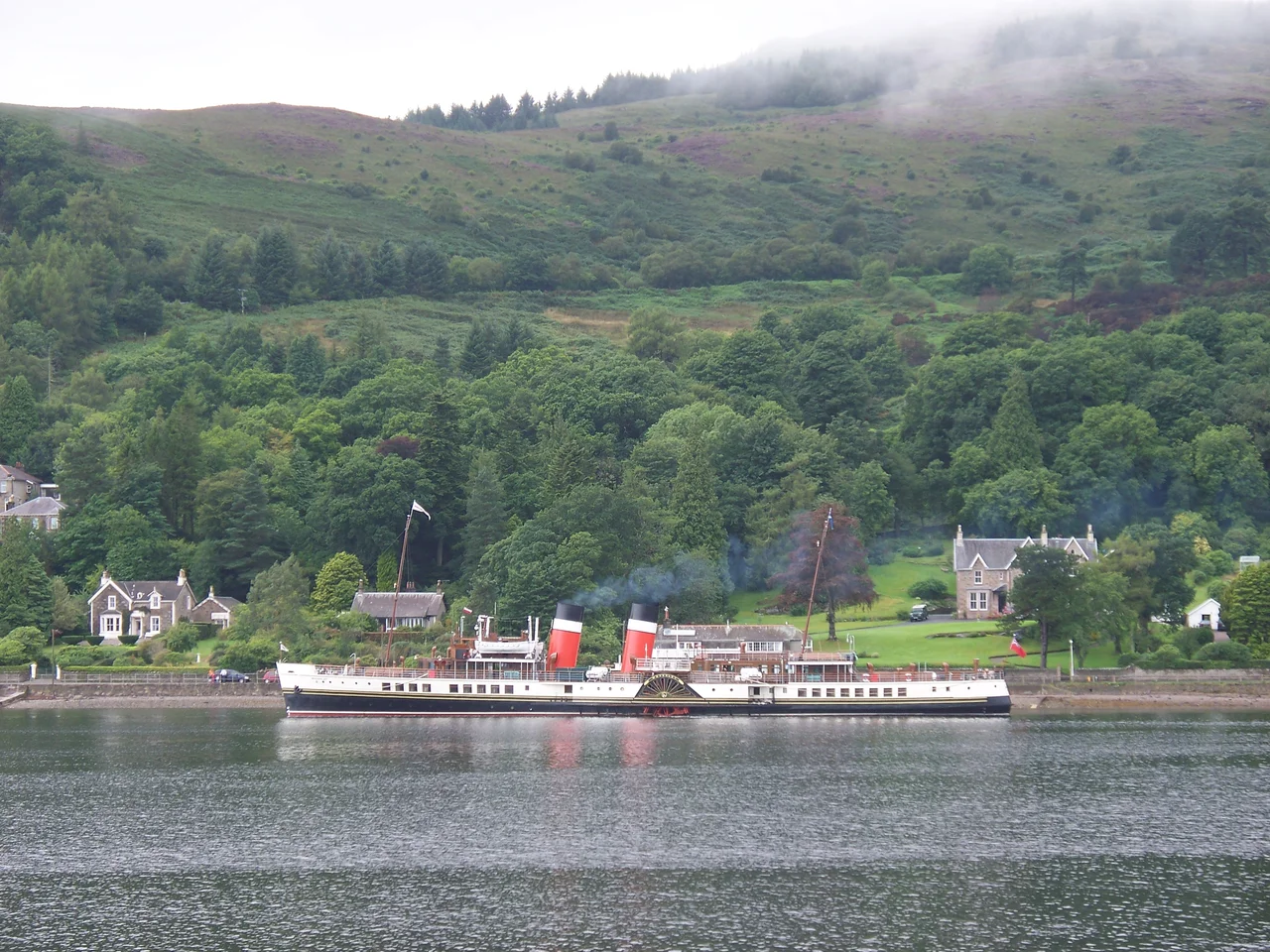

Tighnabruaich
Tighnabruaich means house on the hill, in Gaelic, and the name fits exactly. The village climbs in terraces above the western arm of the Kyles of Bute, looking across the strait at the Isle of Bute, and from any of those terraces the view down to the water is the kind of view that wins prizes. In 2002 the village was voted the prettiest in Argyll, Lomond and Stirlingshire, and it appeared in Penelope Keith's Hidden Villages on More4. For most of its history, though, Tighnabruaich was not pretty so much as practical. It existed because the steamers needed somewhere to stop, and the road needed somewhere to end, and the people needed somewhere to land their fish.
The Pier and the Steamers
A pier here was probably built around the 1830s by the Castle Steamship Company, a forerunner of Caledonian MacBrayne. It was rebuilt in wood in 1885 by the Tighnabruaich Estate, which owned the pier from 1840 until 1950, when George Olding bought it. The local council took it on in 1965. Through all those changes, the function stayed the same: a stop for the paddle steamers and Clyde puffers that connected Glasgow to the west coast. After Henry Bell's PS Comet entered service in 1812, Clyde tourism developed rapidly, and cruises through the Kyles of Bute, around Bute itself, and along Loch Fyne became one of the great Victorian and Edwardian leisure routes. Tighnabruaich's pier is currently under new ownership and closed for extensive renovations, as of 2025.
The Late Arrival of the Road
The A8003 road that brings cars into Tighnabruaich today is only eight miles long, and it was not built until the 1960s. Before then, the older B8000 traced the west coast of the Cowal peninsula from Newton in the north, a longer and slower route. The village's reliance on the sea is built into its history because for most of its existence the sea was the faster connection. Now the 478 bus runs from Dunoon down to Portavadie six days a week, operated by West Coast Motors, and from Portavadie a CalMac ferry crosses Loch Fyne in 25 minutes to Tarbert on Kintyre. A separate ferry from Skipness on Kintyre reaches Lochranza on the Isle of Arran. The village is on National Cycle Route 75, which runs all the way from Edinburgh to Tarbert.
Shinty Country
For a village whose 2011 population was 660, Tighnabruaich punches improbably above its weight in one particular sport. Shinty is the major sport here, and it is home to Kyles Athletic, a club that has won the Camanachd Cup more times than any other team except Newtonmore and Kingussie. Shinty is a Highland stick sport related to Irish hurling, with twelve players per side swinging caman sticks at a small leather ball at improbable speeds. Kyles Athletic field teams from the village and surrounding farms; their success has made the small coastal strip from Tighnabruaich to Kames a serious shinty address. The village also hosts a sailing school and is one of the main bases for yachting on the Kyles.
Still on the Steamer Route
The pier is still on the summer schedule of the paddle steamer Waverley, the last sea-going paddle steamer in the world. When the Waverley pulls in during her summer Clyde season, you can stand on the pier and watch a ship operating to the same broad design that brought thousands of Glaswegians here in the 1880s. Tighnabruaich is now part of a continuous coastal strip of housing that runs into the adjoining village of Kames. The Royal National Lifeboat Institution maintains an Atlantic 85 class lifeboat, the James and Helen Mason, at the village harbour. Most visitors come for the views, the sailing, the walking, and the kind of quiet that is hard to find without three hours of driving and a ferry. The shinty matches, in season, are a bonus.
From the Air
Tighnabruaich sits at approximately 55.908 north, 5.235 west, on the western arm of the Kyles of Bute on the Cowal Peninsula. From altitude the village is a coastal strip rising in terraces above the strait, with the Isle of Bute lying opposite to the southeast. The Kyles wrap around northern Bute in a tight S-curve. EGPF Glasgow lies about 40 nautical miles east; EGPK Prestwick is roughly 35 nautical miles south-southeast. Recommended viewing altitude 2,500 to 4,000 feet to appreciate the geometry of the Kyles. Weather is variable; the strait can look calm from above and still hold tricky cross-tides at the surface.
Nearby Stories
- Loch Katrine 3.4 km away
- Dumbarton 4.4 km away
- Easdale 5.1 km away
- Stewarton 5.9 km away
- Gigha 9 km away
- Loch Awe 9.4 km away
- HMS Dasher (D37) 12 km away
- Jura, Scotland 13 km away