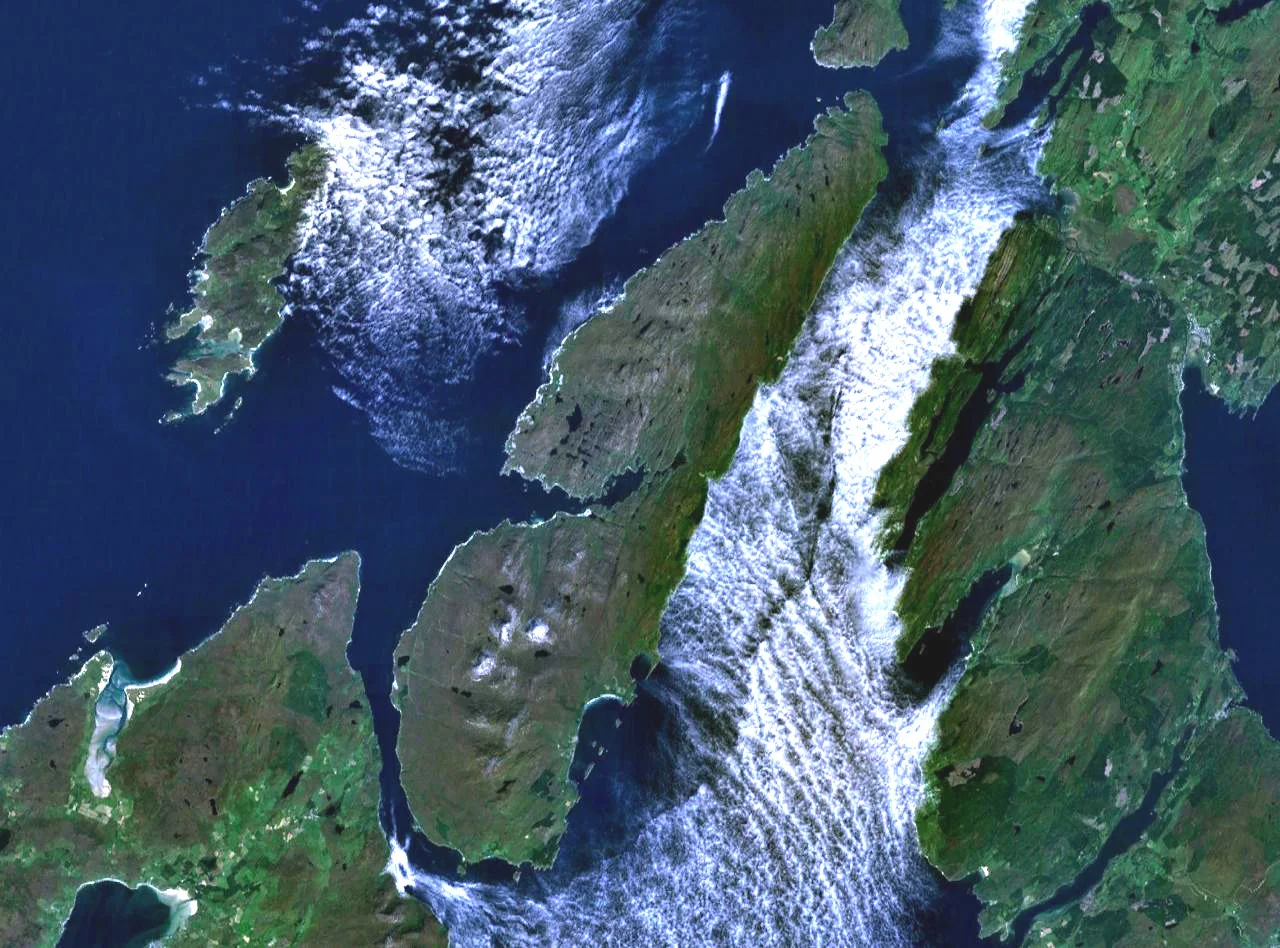

Jura, Scotland
There are roughly six thousand red deer on Jura and about two hundred and fifty-eight human residents - the latter figure recorded by the 2022 census, the former a rough ongoing average. The island has one road of any significance, the single-track A846, which clings to the south and east coasts. The west side has no road and almost no people. Three quartzite peaks called the Paps rise from blanket bog in the centre. At the northern tip, four miles from the nearest road, stands a farmhouse called Barnhill where Eric Blair, writing as George Orwell, finished Nineteen Eighty-Four during the wet autumn of 1948.
The Wildest Island of the Inner Hebrides
Jura is what the Highland imagination calls bare. The interior is blanket bog laid over Dalradian quartzite - one of the hardest metamorphic rocks Scotland has - and the famous Paps of Jura, three steep cones of grey stone, dominate the southern half. On the west coast a series of basalt dykes formed 56 million years ago, in the early Palaeogene, stand out as natural walls where the softer surrounding rock has eroded around them. The raised beaches on that same coast, lifted by post-glacial rebound after the ice sheets retreated, are considered geological features of international importance. The island measures 36,692 hectares, ranks 29th in population among Scottish islands, and is described in the literature as "the wildest island of the Inner Hebrides." It is almost bisected by West Loch Tarbet, a long inlet that all but cuts it in two.
One Village, Three Spirits
Craighouse, halfway down the east coast, holds almost everything: the shop, the church, the primary school, the petrol pumps run by the community, a gallery, a tearoom, the Jura Hotel, and the Jura Distillery whose 1810 origins make Isle of Jura single malt one of the older established whiskies in Scotland. Since 2015 the Lussa Gin distillery has operated from Ardlussa at the north end of the island; in 2021 Deer Island Rum opened in Craighouse, making Jura one of the few small Scottish islands with three working distilleries. North of Craighouse a thin string of settlements - Keils, Knockrome, Ardfernal, Lagg, Tarbert, Ardlussa, Inverlussa - holds the rest of the population. The west coast holds nothing but deer.
Barnhill
Eric Blair came to Jura in April 1947, exhausted by London, tubercular, and in a hurry to finish a novel. He rented Barnhill from the Fletcher family - it sits at the northernmost end of the island, overlooking the Gulf of Corryvreckan, four miles from the end of the road. To the residents he was Mr Blair, not Mr Orwell. He kept a goat, fished, gardened, and typed by oil lamp. The first draft was finished after the August 1947 boating accident in the gulf in which he and his three-year-old son nearly drowned. He sent the final manuscript to Secker and Warburg on 4 December 1948. They published Nineteen Eighty-Four on 8 June 1949. Orwell died in London seven months later, in January 1950. Barnhill is still owned by the Fletcher family. It has a generator, a gas refrigerator, a coal-fired Rayburn for heat, and four bedrooms. "He would recognise the place instantly," Damaris Fletcher told The Guardian. You can rent it.
Sealords and Campbells
In the sixth century Jura may have been Hinba, the contemplative retreat where Columba went when Iona felt too busy. The Cenel nOengusa, a kindred of Dal Riata, held the island until the Norse arrived in the late eighth century. Somerled - whose descendants split into the great clans of MacDougall, MacDonald, and MacRory - built Claig Castle on a tidal islet at the southern tip in the twelfth century, controlling the sea traffic between mainland Scotland and the Hebrides. From the sixteenth century onwards the Campbells of Craignish ruled most of the island and held it through eleven successive lairds. In 1920 the Campbell estates began to be sold off; the northern two-thirds went to the American-born politician Waldorf Astor, whose wife Nancy was the first woman to take her seat in the House of Commons. The Tarbert Estate is still in Astor hands today, with David Cameron - whose wife Samantha is Lord Astor's stepdaughter - a frequent visitor.
The Long Hush
Jura's population peaked at 1,312 in 1831. By 1961 it had fallen below half; by the early twenty-first century it sat in the low two hundreds. Gaelic, spoken by 86.6 percent of islanders in 1881, dropped below half by 1961 and to roughly ten percent by 2001. The southern third of the island is a National Scenic Area covering 30,317 hectares. The Ardfin Estate at the south, bought by Australian hedge-fund manager Greg Coffey in 2010, was converted into a private 18-hole golf course that opened in 2019, with a luxury hotel in the former farm buildings - a development that has drawn the kind of attention Jura's older residents tend to avoid. The Corryvreckan whirlpool still roars off the northern tip three or four times a day. The deer still outnumber people by something like thirty to one. Two hundred people. One road. Three peaks. The island remains, by most measurements that matter, exactly what Orwell saw.
From the Air
Jura lies at 56.083N, 5.75W in the Inner Hebrides, northeast of Islay and separated from it by the narrow Sound of Islay. The three Paps of Jura - Beinn an Oir (785m), Beinn Shiantaidh (757m), and Beinn a' Chaolais (734m) - are unmistakable quartzite cones in the southern half. The Gulf of Corryvreckan whirlpool roars between Jura's northern tip and the island of Scarba. Craighouse and the Jura Distillery sit on the southeast coast at 55.84N, 5.95W; Barnhill (Orwell's house) is at the northern tip near 56.05N, 5.71W. Islay airport (EGPI) is the nearest, with onward connections via Loganair. Oban (EGEO) is roughly 70 km northeast. Best photographed from 4,000-6,000 ft to capture the Paps in profile.
Nearby Stories
- Fingal's Cave 1 km away
- Bonawe Iron Furnace 3 km away
- Torosay Castle 7.7 km away
- Jura Distillery 12 km away
- Strachur 13 km away
- Erraid 15 km away
- Bruichladdich Distillery 15 km away
- Rothesay Castle 15 km away