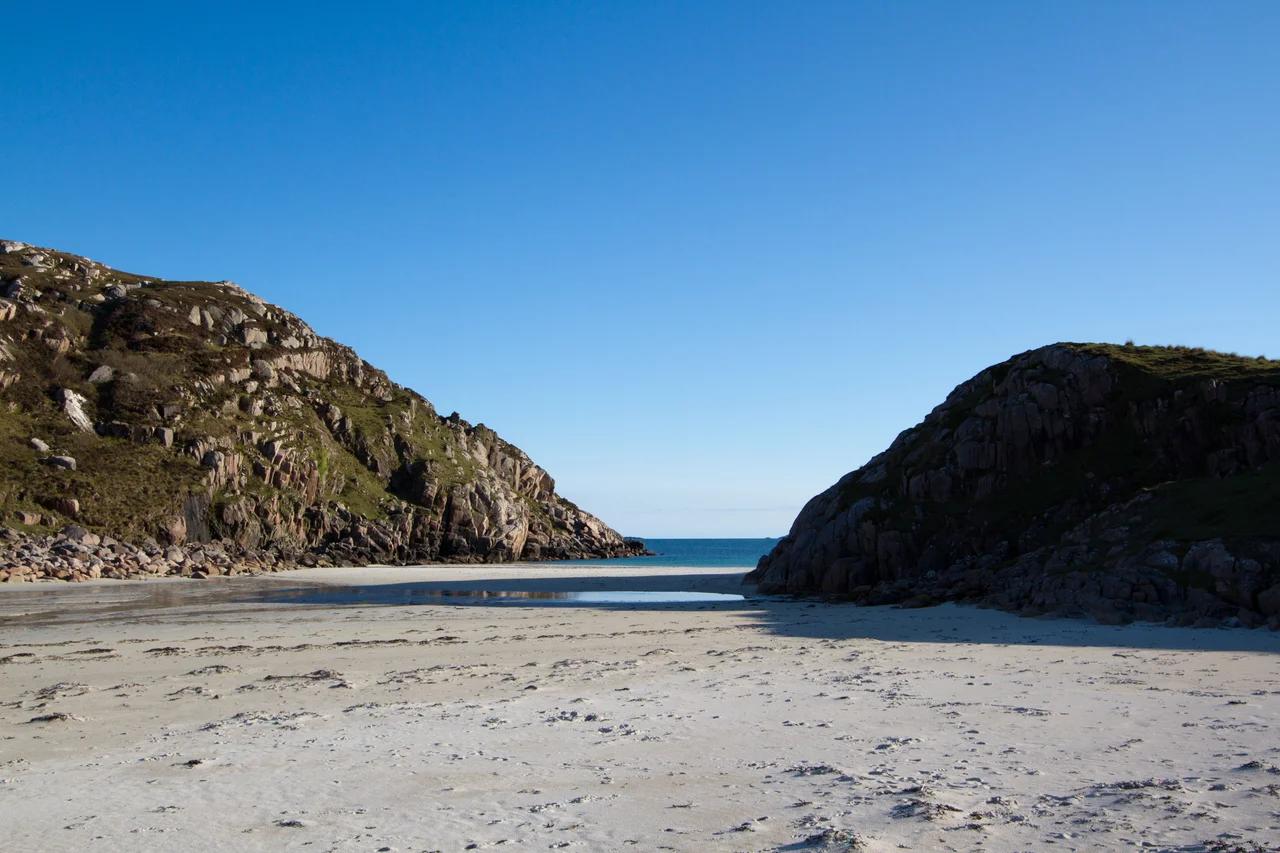

Erraid
Davie Balfour starved for almost a hundred hours on Erraid before he worked out he could walk off it. The fishermen who came back to look at him a second time could see what he could not: that the place was a tidal islet, and twice a day at low water you could simply leave. Robert Louis Stevenson, who wrote Davie's predicament into Kidnapped, knew the island intimately. His father Thomas had quarried it for stone, his uncles built lighthouses on it, and the young Robert Louis had visited often enough to remember the texture of the rock beneath his boots.
A Mile of Granite
Erraid is roughly one mile square, attended by a small archipelago of islets with poetic names: Eilean Dubh (two of them), Eilean nam Muc, Eilean Chalmain, Eilean Ghomain, Eilean na Seamair. It lies west of the Ross of Mull, separated by a beach passable on foot at low tide, and southeast of Iona across the open sound. The bedrock is granite, the same coarse pink stone that quarrymen split out of the Ross of Mull to build the great Hebridean lighthouses of the nineteenth century. Despite sitting in some of the wettest territory in Europe, Erraid receives about 1,000 millimetres of rain a year and roughly 1,350 hours of sunshine, making it one of the driest and sunniest places on the western seaboard of Scotland. A narrow but deep channel separates the island from the westernmost Eilean Dubh, useful enough that the Northern Lighthouse Board chose Erraid as a working base when they built Dhu Heartach offshore on the Torran Rocks.
Stevenson's Island
Thomas Stevenson, Robert Louis's father, was one of the engineers who designed and built lighthouses for the Northern Lighthouse Board. Stones for Dhu Heartach were quarried on Erraid and fitted together on the island before being shipped to the reef where the tower was assembled. The Board built a small terrace of granite cottages on Erraid to house lighthouse keepers and their families, and the row still stands. Young Robert Louis Stevenson visited several times, recording one excursion in his autobiographical Memories and Portraits. The landscape worked its way into his fiction. The island of Aros in his short story The Merry Men is recognisably Erraid in disguise. And when he needed to maroon Davie Balfour somewhere bleak and confusing for the middle of Kidnapped, he wrecked the brig Covenant on the Torran Rocks south of Erraid and washed Davie ashore. The whole island, Stevenson wrote, is nothing but a jumble of granite rocks with heather in among.
The Limpet Diet and the Findhorn Connection
Davie Balfour stayed alive on limpets and periwinkles. I knew indeed that shell-fish were counted good to eat, Stevenson wrote in his hero's voice, and among the rocks of the isle I found a great plenty of limpets, which at first I could scarcely strike from their places, not knowing quickness to be needful. And so hungry was I, that at first they seemed to me delicious. The hunger and the cold and the rage at his fate kept Davie from noticing the obvious tide. A sea-bred boy, he conceded, would not have stayed a day. After the lighthouse keepers left, Erraid passed through private hands, and a small intentional community linked to the Findhorn Foundation now lives in the old keepers' cottages. In September 2021, Ben Fogle visited the island for an episode of his Channel 5 series New Lives in the Wild, sitting down with permanent community member Philip Hetherington in a row of nineteenth-century granite that Stevenson's father built.
From the Air
Erraid lies at 56.29 N, 6.37 W, a tidal islet at the southwestern tip of the Ross of Mull. No airport on the island; the nearest is Tiree (EGPU) some 25 nm northwest. Glenforsa (EGEH) on the east side of Mull is the other practical field for light aircraft. Recommended viewing altitude 1,500-2,500 ft. Visual landmarks: Iona to the north across the sound; the Torran Rocks reef southwest, where Stevenson wrecked Davie Balfour's brig; Dhu Heartach lighthouse 14 mi southwest; the Ross of Mull granite quarries on the mainland east. At low tide the connecting beach to Mull is exposed; at neap tides much less so.
Nearby Stories
- Coll 4.6 km away
- Skerryvore 5.4 km away
- Moy Castle 7.5 km away
- Eden (2016 TV Series) 17 km away
- Oronsay 17 km away
- Jura Distillery 27 km away
- Barra Head 42 km away
- SS Justicia 62 km away