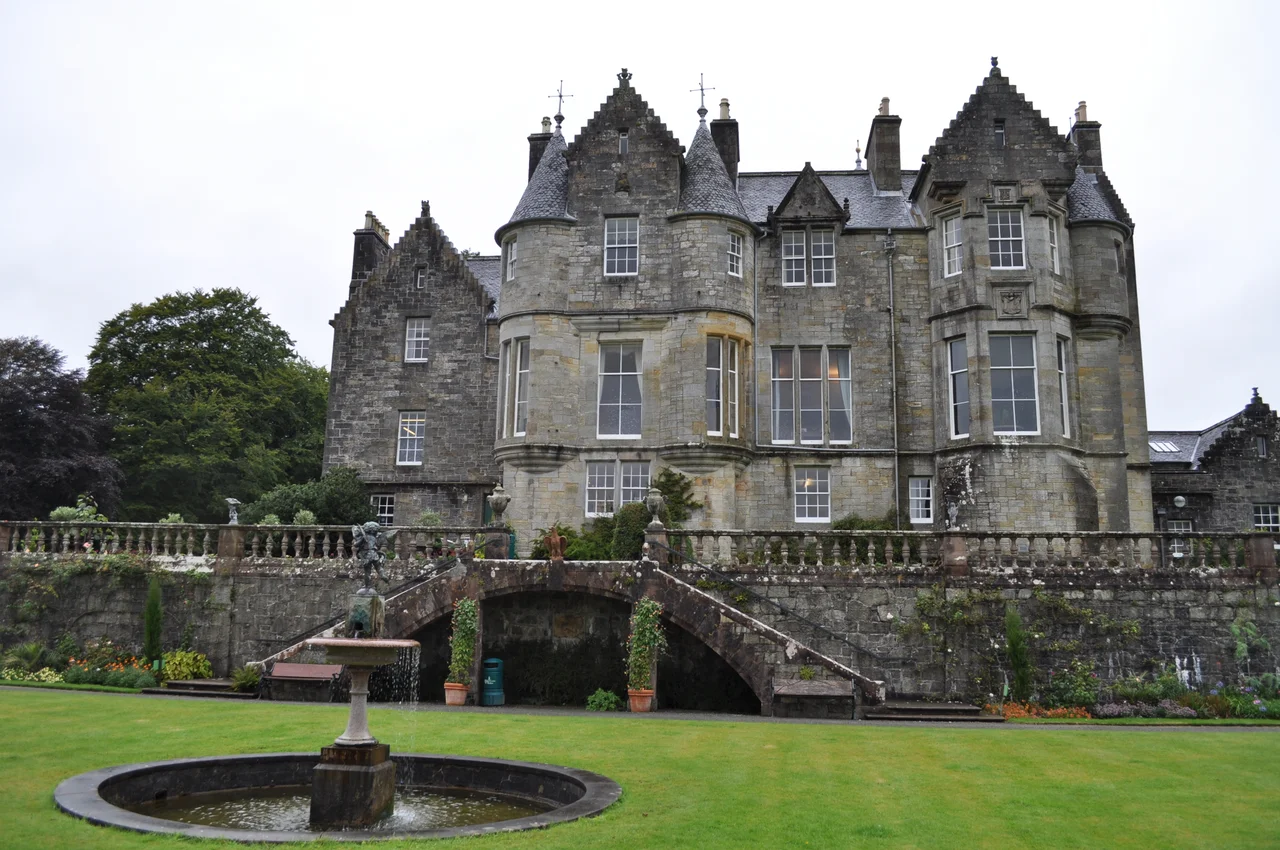

Torosay Castle
In July 2008, someone opened a dark wooden sideboard at Torosay Castle and pulled out a bottle that had been locked inside it for at least 111 years. The label read Veuve Clicquot, 1893. The cork was sound, the contents in mint condition. At the time of its discovery it was the oldest known bottle of Clicquot champagne in existence. It is now considered priceless and lives behind glass at the Veuve Clicquot visitor centre in Reims, France. Whoever shut that sideboard door in the 1890s never came back to open it.
David Bryce's Scottish Baronial Vision
The castle was not, originally, a castle at all. A modest Georgian house stood on the site in the early nineteenth century, owned by Colonel John Campbell of Possil. In the 1850s the Colonel's son, also named John, inherited the estate and decided the existing building was insufficient to his ambitions. He had it demolished. In its place he commissioned David Bryce, the Edinburgh architect who more than any other figure popularised the Scottish Baronial style of the Victorian era - all crowstepped gables, conical turrets, and corbelled bartizans. The new house, completed in 1858, was called Duart House. It was later renamed Torosay to avoid confusion with the genuinely medieval Duart Castle, the MacLean seat that stands a few miles south on the Sound of Mull. Historic Scotland formally listed the buildings and gardens in 1987.
Italian Statues as Ballast
The grounds at Torosay are arguably more famous than the house. Walter Murray Guthrie, the estate's owner around the turn of the twentieth century, learned that an abandoned garden near Milan was being broken up. He bought nineteen marble statues in the style of the Italian sculptor Antonio Bonazza and arranged to have them shipped to Scotland - not as freight, which would have been prohibitively expensive, but as ballast in the holds of returning cargo ships. The statues now line the Statue Walk, a formal terrace bordered by clipped hedging that descends through the gardens toward the Sound of Mull. Olive Guthrie, who managed the estate in the early twentieth century, was Winston Churchill's aunt by marriage. Churchill visited in the 1930s. So did King George of Greece. The thriller writer Angela Thirkell dedicated her 1940 novel Weep No More to Olive Guthrie of Torosay.
Closed Doors, Open Gardens
For decades the castle was open to the public, linked to the Craignure ferry terminal by the narrow-gauge Isle of Mull Railway. That arrangement ended in 2012, when Christopher Guthrie-James - the fifth laird and last of his line at Torosay - sold the property. He spoke of relief rather than regret. The buyer, the McLean Fund, closed the house for renovation. Kenneth Donald McLean, who became the sixth laird, has reportedly spent more than a million pounds on the work. The castle is now permanently closed to visitors. The gardens, however, still open on the first Sunday of each month from April to October - so the statues that Walter Guthrie shipped from Milan as ballast still stand under Mull's western light, a small piece of Italy at the edge of the Scottish Hebrides.
From the Air
Located at 56.46N, 5.69W on the east coast of the Isle of Mull, just south of Craignure on the Sound of Mull. The Scottish Baronial mansion sits in landscaped gardens overlooking the sound. Nearest airport: Oban (EGEO), about 22 nm east-southeast. Glasgow (EGPF) lies roughly 80 nm south. Recommended viewing altitude 1,500-3,000 ft to see the castle and its formal gardens, the Sound of Mull stretching east toward Oban, and the nearby Duart Castle on its headland to the south.
Nearby Stories
- Castle Tioram 1.9 km away
- Cairnburgh Castle 3.3 km away
- Lunga, Firth of Lorn 7.2 km away
- Bonawe Iron Furnace 8.8 km away
- West Highland Museum 11 km away
- Inveraray Castle 12 km away
- Bullough Mausoleum 22 km away
- Dubh Artach 23 km away