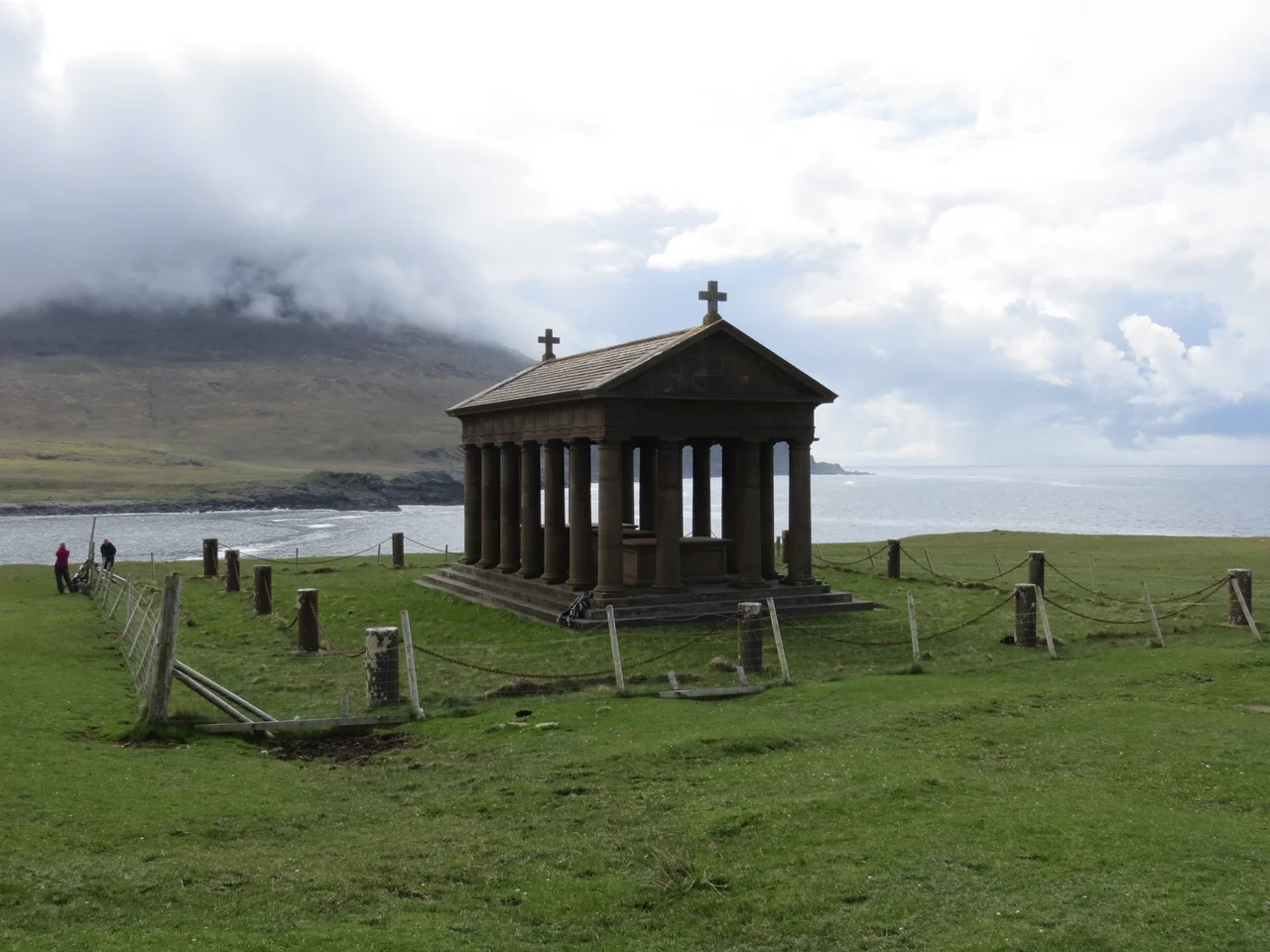

Bullough Mausoleum
Sir George Bullough's first mausoleum on the Isle of Rum had elaborate ceramic tiling. It was finished around 1900 to hold his father's bones, and George was apparently quite pleased with it. Then a houseguest, surveying the interior, remarked that it was "redolent of a public lavatory in Waterloo Station." George had it blown up. What stands now on the western shore of Rum, above the depopulated village of Harris, is a Greek temple in polished sandstone, eighteen Doric columns on a plinth, pink granite tombs beneath the open peristyle, the Atlantic crashing a few hundred yards below.
The Lancashire Cotton Money
John Bullough was a Lancashire textile-mill owner, the kind of late-Victorian industrialist who made an enormous fortune from cotton machinery and decided to spend it on a Scottish island. He leased Rum in 1879 and bought it outright in 1888. When he died in 1891 his son George inherited the island, the cotton interests, and the Edwardian habit of building dramatically. Rum at that point had been largely cleared of its native population during the previous century; what George inherited was a sporting estate, beautiful and empty, where he could indulge himself without anyone telling him no. He did exactly that, for the rest of his life.
The First Mausoleum
George commissioned the architect William James Morley to construct a tomb on the western shore of the island, overlooking the sea at Harris. Morley produced an elaborate, tiled structure intended to honour John Bullough's memory. The guest's comparison to a railway-station toilet was apparently uttered, and apparently believed. George had the whole thing demolished. A small remnant of the original tiling survives in the grass nearby, like a fragment of a different building that briefly existed and then did not. It is one of the more remarkable acts of architectural insecurity recorded in Hebridean history.
The Doric Temple
The replacement, built in the early 20th century, is a tetrastyle Doric temple in the Greek manner. The architect is uncertain. Some sources credit James Miller; the architectural firm Page & Page, surveying the estate in the early 21st century, concluded that Leeming & Leeming, the firm responsible for Kinloch Castle, also designed the mausoleum. Eighteen polished sandstone columns support a flat roof. The structure stands open to the weather; you can walk between the columns and stand among the tombs. John Bullough lies in a polished sandstone sarcophagus. George, who died in 1939, and his widow Monica, who was buried here in 1967 at the age of 98, lie in pink granite. Three people, in a temple of an empty god, on an island they once owned.
The Setting
What makes the building extraordinary is not the architecture, which is competent imperial pastiche, but its position. Harris was a settlement before the clearances; it is now a depopulated stretch of grass and stones on the southwestern shore of Rum. The mausoleum stands alone above the cliffs, the Atlantic stretching unbroken toward Canna and the outer Hebrides beyond. There are no other buildings within sight. The wind is constant, sometimes furious. In good weather the view from between the columns takes in twenty miles of empty sea. In bad weather, which is most weather, cloud rolls in off the water and the temple disappears into white.
What Remains
Kinloch Castle and the rest of the estate were sold in 1957, after George's trustees gave up on the cost of maintaining the island. Only the mausoleum was kept by the family. It is now protected as a category B listed building. To reach it you walk for several hours over rough track from Kinloch on the eastern side of the island, or sail in by your own boat. Reasonably few people make the trip. Those who do find a Lancashire industrialist's idea of dignity, transplanted from a textile town to a Hebridean cliff, weathered by 120 years of Atlantic salt, and somehow improved by the journey.
From the Air
Located at 56.9751°N, 6.38517°W on the southwestern shore of the Isle of Rum, near the depopulated village of Harris. From the air the temple is a small but distinctive white-stone rectangle on green machair grass, set well back from the cliff edge. Useful landmarks include Kinloch Castle on the east coast of Rum, about 10km to the east, and the Rum Cuillin ridge (Askival 812m) to the south. Nearest airports are Glenforsa on Mull (EGEL) about 35nm south, Oban (EGEO) 50nm southeast, and Inverness (EGPE) 75nm northeast. Recommended viewing altitude 1500-2500 ft AGL to keep the mausoleum and the western Cuillin in frame; the island generates significant orographic turbulence and lee-side rotor in west and southwest winds.
Nearby Stories
- Wiay, Inner Hebrides 3.7 km away
- Eden (2016 TV Series) 6.2 km away
- Sabhal Mòr Ostaig 8.1 km away
- SS Politician 15 km away
- Coll 17 km away
- Applecross 17 km away
- SS Polonia 47 km away