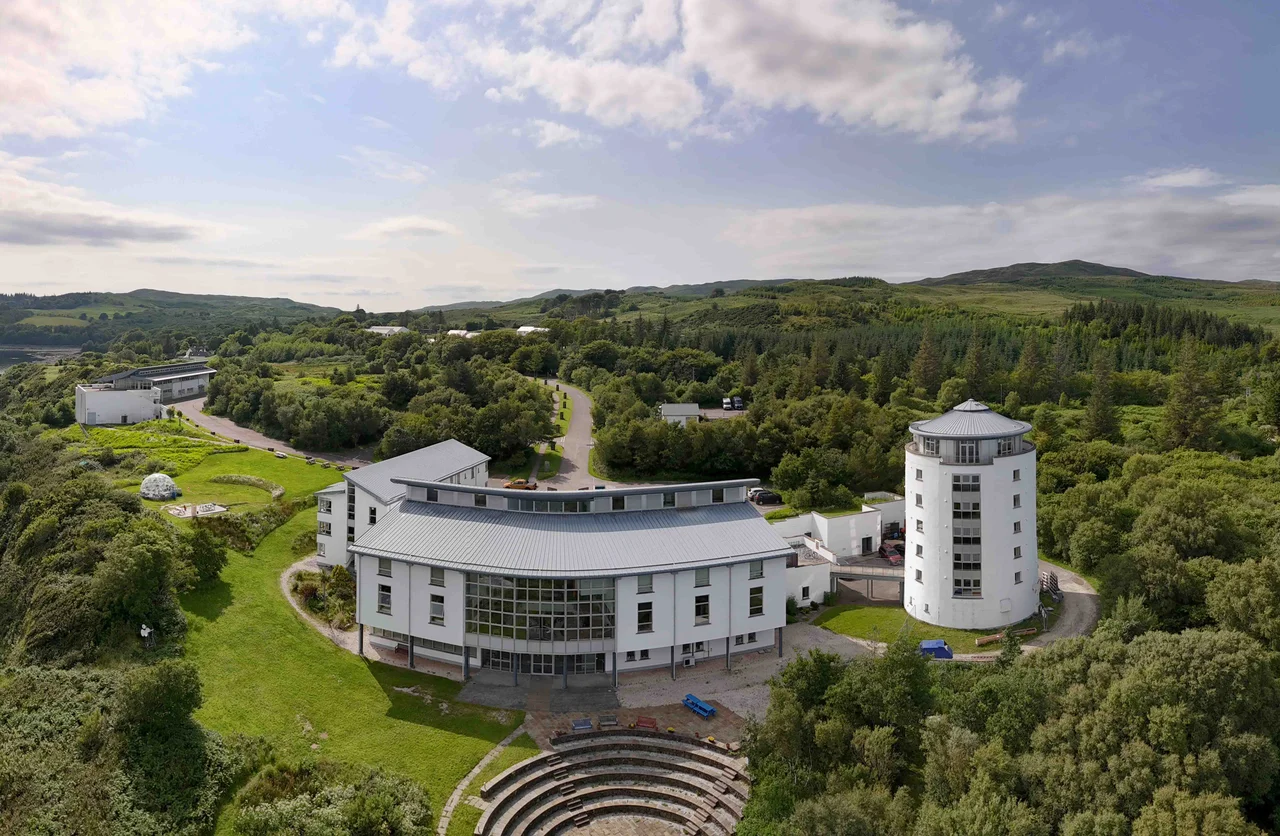

Sabhal Mòr Ostaig
Iain Noble went to the Faroe Islands in the late 1960s and came back with an idea. He had seen how a small population, fewer than fifty thousand, sustained an active literature, broadcasting, and university life in their own language. In 1972 he bought the northern portion of the Sleat estate at the south end of Skye and started recruiting Gaelic speakers to work in fishing and textile enterprises - the first step toward something more ambitious. The next year, in a converted nineteenth-century farm steading two miles from Armadale ferry, Sabhal Mòr Ostaig opened its doors. Its name means "the big barn at Ostaig." Its sole medium of instruction on degree courses, then and now, is Scottish Gaelic.
A College in a Barn
The original Ostaig steading had been built on a U-plan in the late 1820s by Major Allan MacDonald of Belfinlay, who held the lease of the farm. By 1973 it was a weathered shell. Four trustees - urrasairean - were appointed: Iain Noble himself; the poet Sorley Maclean, whose own collection now sits in the college library; Donald Ruaraidh Macdonald, a teacher at Portree High; and Gordon Barr, a Dundee biochemistry lecturer who took a year's sabbatical to serve as the college's first fear-stiùiridh, or director. The early activities were modest: a lecture series, a Gaelic playgroup, night classes for adult learners, events for Gaelic-speaking schoolchildren. The Calouste Gulbenkian Foundation provided three years of funding for a full-time director in 1974. The college survived on small grants and stubborn conviction.
Building for the Long Game
Under director Norman Gillies, who served from 1987 to 2009, Sabhal Mòr secured £1.4 million from the Scottish Office, Highlands and Islands Enterprise, Scottish Television, and Grampian Television to build Àrainn Ostaig - the Ostaig Campus - which opened in autumn 1993 with 36 student bedrooms, teaching spaces, dining facilities, and a television studio. A postgraduate diploma in Gaelic Broadcasting launched the same year and proved remarkably popular. Then came the larger grant: £33.35 million toward new buildings across the University of the Highlands and Islands network. In 2008 the £8 million Ionad Fàs centre for creative and cultural industries opened on campus, with television studio, workshop and exhibition spaces, and Gaelic-medium childcare. The Kilbeg Village scheme, begun in 2013, will eventually add up to 75 houses between the two campuses.
A Language with Infrastructure
Sabhal Mòr Ostaig is now an Academic Partner in the University of the Highlands and Islands and hosts research projects that have given Gaelic the kind of scholarly architecture that established languages take for granted. Faclair na Gàidhlig is building a comprehensive historical dictionary of Scottish Gaelic. Ainmean-Àite na h-Alba is the advisory partnership on Gaelic place-names. Soillse is the national research network for language maintenance and revitalisation. Tobar an Dualchais - Kist o Riches - is digitising thousands of hours of folklore recordings. The library holds over 6,000 volumes in its special collections, including the Celtica Collection from Fort Augustus Abbey, Sorley Maclean's personal library, and historic 78-rpm recordings of Gaelic singers donated by the BBC. An associate campus opened in Bowmore on Islay in 2002.
Living the Language
The student association is called Comann nan Oileanach. The walking club is Club Coiseachd. Students take degrees with names like Cànan is Cultar na Gàidhlig (Gaelic Language and Culture) and Gàidhlig agus Ceòl Traidiseanta (Gaelic and Traditional Music); a postgraduate MSc covers Cultar Dùthchasach agus Eachdraidh na Gàidhealtachd - Material Culture and Highland History. The college hosts cèilidhs, concerts, plays, and films open to the wider community, while pubs and hotels around Sleat run weekly music sessions. There are writers, musicians, artists, and dramatists in residence. Whatever else Sabhal Mòr is, it is the place where a language that once governed kingdoms and is now spoken by fewer than 60,000 people gets to be a working language again - the medium of seminars, lab notes, drinks at the bar, and the small daily acts of intellectual life.
From the Air
Coordinates 57.087°N, 5.872°W on the Sleat peninsula at the south end of Skye. From 2,500-3,500 ft AGL the campus is visible as a cluster of buildings about 2 nm northeast of Armadale ferry pier, set against rolling green ground with the Sound of Sleat to the east. The Knoydart peninsula rises on the mainland across the Sound. Nearest fields: Plockton (EGPO) 18 nm northeast, Oban (EGEO) 55 nm south. Watch for orographic cloud against the Sleat ridge in westerlies and rapid weather changes typical of the western seaboard.
Nearby Stories
- Rùm 4.7 km away
- Eden (2016 TV Series) 6.2 km away
- Plockton 9.7 km away
- Wiay, Inner Hebrides 11 km away
- Ballachulish 14 km away
- Stand-off at the Fords of Arkaig 19 km away
- Coll 22 km away
- Affric-Beauly hydro-electric power scheme 29 km away