
Rùm
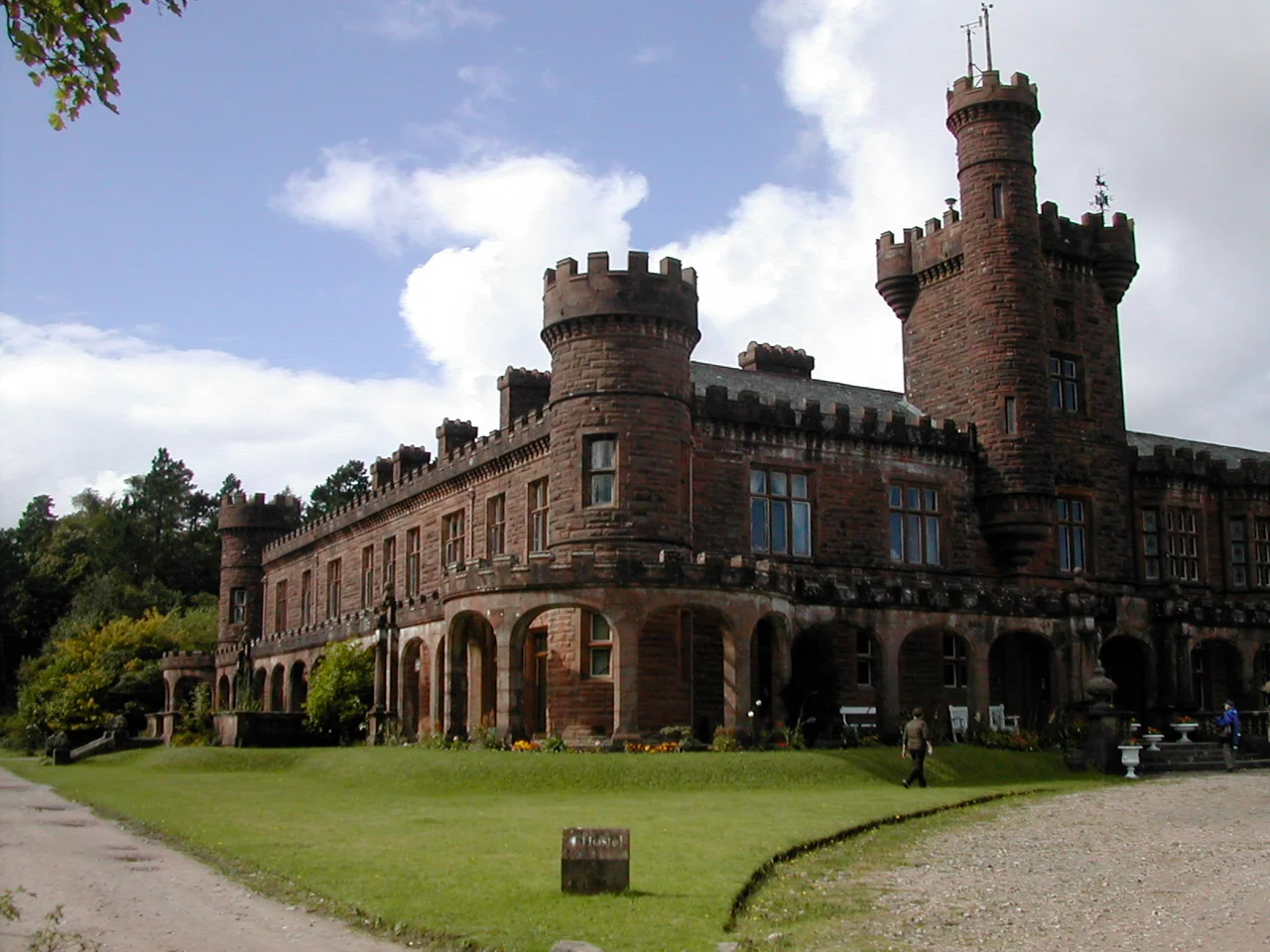
Rùm has been continuously inhabited since the eighth millennium BC. It has also, in that long time, been largely uninhabited. The numbers swing depending on what story Britain is telling itself: 400 people early in the 19th century during the brief Hebridean kelp boom, then almost none after the Highland Clearances emptied the island to make room for sheep, then a few dozen at the height of Sir George Bullough's Edwardian sporting estate when he kept alligators among the other expensive whims at Kinloch Castle, then almost none again. Today around 30 people live here, all of them at Kinloch on the eastern shore, outnumbered ten to one by feral mountain goats.
The Cuillin of Rùm
The southern third of Rùm is a ridge of basalt and gabbro hills called the Rùm Cuillin, distinct from the more famous Cuillin on Skye but cut from similar volcanic stone. The highest summit, Askival, reaches 812 metres - a Corbett, in Scottish hill-walking taxonomy, meaning between 2500 and 3000 feet. The full ridge traverse from Kinloch and back is 20 kilometres and twelve hours of scrambling over steep and rocky ground. It can be done in a long day if you start before dawn, or split with a night at the Dibidil bothy on the southern coast. The walk is not crowded. On a good day in summer you might meet two other parties on the entire ridge.
The Clearances and the Sheep
In the 1820s the small population that had built a way of life on this hard ground was evicted, transported to Cape Breton in Nova Scotia and other parts of the diaspora, so the island could be turned over to sheep. The pattern repeated itself across the Highlands and the Islands. A century later the sheep had been replaced by a deer forest and a textile heir's millions. Sir George Bullough built Kinloch Castle in 1900, complete with a glass orangery and the famous alligators, none of which made any economic sense and most of which fell into disuse within decades of his death in 1939. The trustees struggled with the cost of maintenance until 1957, when they sold the island to the Nature Conservancy Council.
Manx Shearwaters in the Sky
Rùm holds one of the largest breeding colonies of Manx shearwaters in the world, with around 100,000 pairs nesting in burrows on the high slopes of the Cuillin. Shearwaters are creatures of the deep ocean; they spend most of their lives at sea and come to land only to breed, in burrows, by night. At dusk in late summer the parents return to feed their chicks, and the entire upper slope of Askival becomes a wheeling, calling cloud of birds. The sound is otherworldly, half-laugh, half-cough, channelled by the dark and the wind. The chicks fledge in September and fly south to spend the winter off the coast of Argentina, then return.
Kinloch and the Community Trust
In 2010 the Isle of Rùm Community Trust took over the area around Kinloch Village from the government conservation body, giving the residents of the island some control over their own homes and livelihoods. The trust has built new houses for incomers, restored the pier, and steadied a long demographic slide. There are no pubs and no bars. The General Store serves coffee, soup and snacks, and sells beer that the residents drink at outdoor tables when the evening is fair. The Village Hall has wifi and a community computer. The red BT phone box still works. The rest of the island, all of it beyond Kinloch, is wilderness.
The Mausoleum at Harris
Six miles across the island, on the depopulated western shore at Harris, stands Sir George Bullough's Doric mausoleum, where he, his wife Monica and his father John are buried beneath polished sandstone columns. A track leads from Kinloch over the hill, and walking it takes you the length of the island through landscape that holds none of Kinloch Castle's gaudy ornament. White-tailed sea eagles ride the thermals. Red deer move through the bracken. Otters fish along the rocky coast. From the columns of the temple you look out across the Atlantic toward Canna and, on a good day, the Outer Hebrides. It is one of the strangest and most beautiful spots in Britain.
From the Air
Located at 57.00°N, 6.35°W in the Small Isles. The island is roughly diamond-shaped, about 8 miles across, with the Rùm Cuillin ridge dominating the south (highest peak Askival 812m / 2664 ft). The village of Kinloch and ferry pier are on the eastern shore at the head of Loch Scresort. Nearest airports are Glenforsa on Mull (EGEL) about 35nm south, Oban (EGEO) 50nm southeast, Inverness (EGPE) 75nm northeast, and Stornoway (EGPO) 60nm northwest. Recommended viewing altitude 3000-5000 ft AGL to clear the Cuillin ridge; expect strong orographic effects in any wind, with significant rotor and turbulence on the lee side. Cloud caps Askival frequently and visual approaches around the southern hills are not advisable in marginal weather.
Nearby Stories
- Wiay, Inner Hebrides 3.7 km away
- Eden (2016 TV Series) 6.2 km away
- Sabhal Mòr Ostaig 8.1 km away
- SS Politician 15 km away
- Coll 17 km away
- Applecross 17 km away
- SS Polonia 47 km away