.jpg)
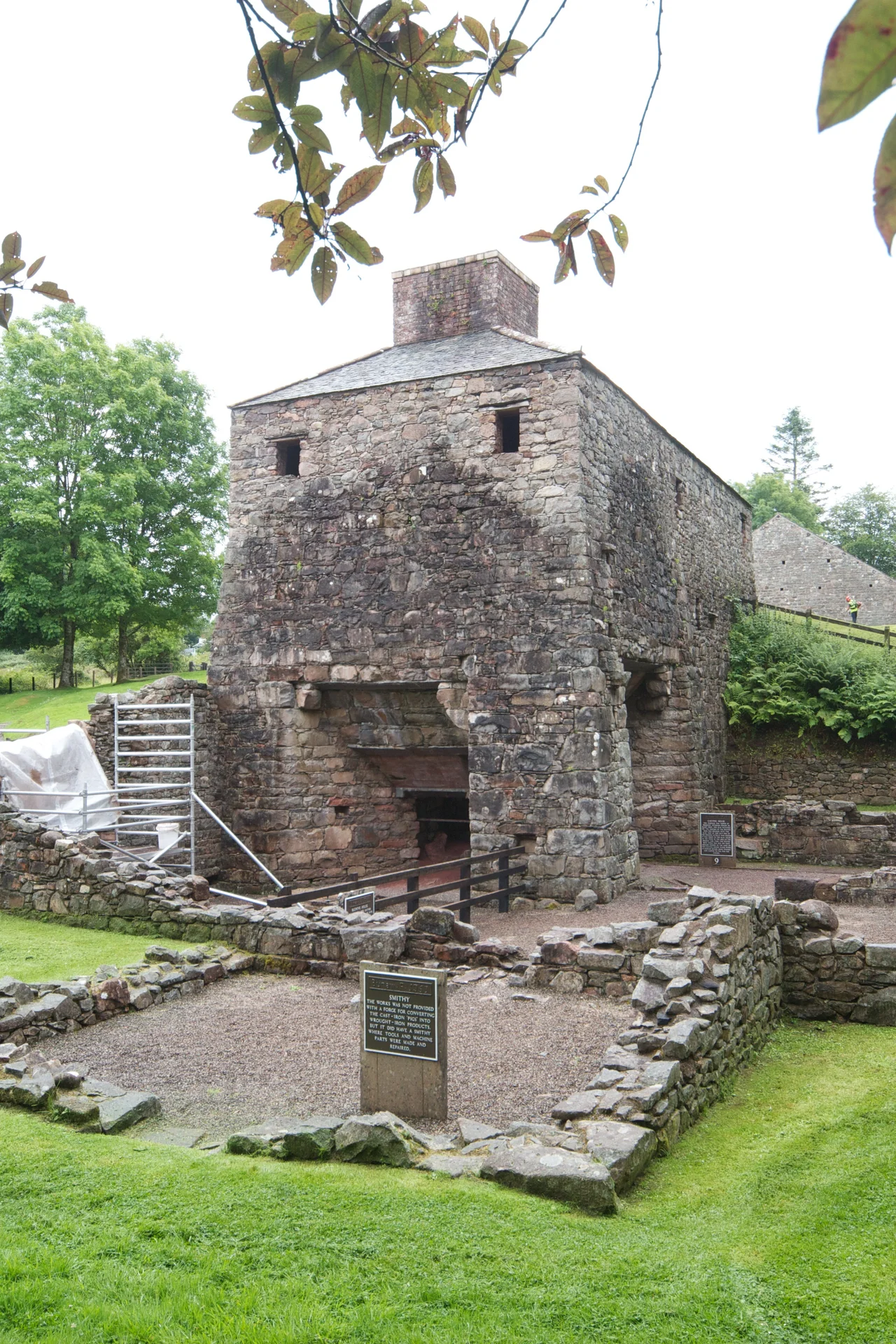
Bonawe Iron Furnace
It took a week to bring the furnace up to heat. Once lit, it ran almost continuously for nine months. Six hundred people were needed to keep it fed, most of them stripping the forests of Lorn for charcoal. A water wheel on the river Awe drove the bellows. Pig iron poured into moulds in the casting house, much of it bound for ships at Liverpool, some of it cast on the spot into cannonballs for Britain's wars. Bonawe was an English company operating a Scottish forest, and for over a hundred years it worked.
Why Here
In 1753, Richard Ford's Newland Company chose this stretch of Loch Etive for one reason: trees. The Cumbrian firm needed enormous volumes of charcoal to fuel a blast furnace, and the Argyll oakwoods could supply it. The river Awe gave them the water pressure to drive a wheel. The loch gave them a pier. Almost everything else, including most of the building materials, came north from Cumbria. The blast furnace itself was managed by a local representative of the firm, but the iron ore arrived by sea, and most of the finished pig iron was shipped back south for further processing. Bonawe is an unusually clean example of an early industrial colony: Cumbrian capital, Argyll forest, English management, and a workforce drawn from the surrounding glens to burn the trees.
The Daily Burn
The site was four buildings in serious conversation with one another. Two charcoal storehouses, dug into the bank so material could be loaded from the back at the high side and drawn out at the low side at the front. One ore store, built on a slope for the same reason, packed with hematite and limestone. And the furnace itself, with its charging house on the south, its blowing house on the north driving air through bellows kept in motion by the water wheel, and its casting house on the west, where molten iron ran into moulds shaped like piglets at a sow. The two charcoal sheds held more than 2,500 cubic metres between them. Daily output could reach 2,500 kilograms of pig iron, about 700 tonnes a year. The slag, the by-product, went outside to cool.
The End of Charcoal
Around 1750, ironmakers were beginning to switch from charcoal to coke. The first coke-fired blast furnace in Scotland went into operation near Falkirk in 1759, six years after Bonawe was built. From that point on, Bonawe was running an older technology, and its margins thinned as the century turned. Production fell through the nineteenth century. The furnace finally shut in 1876, more than a hundred and twenty years after it was lit. The forest, having grown back and been cut and grown back again to feed the burn, was left alone. The buildings remained. Today the site is a scheduled monument managed by Historic Environment Scotland, and what survives is more complete than almost any other charcoal-iron complex of its period in Britain.
What's Left
Walking through Bonawe is a study in industrial geometry. The slope-built storehouses still terrace the bank. The furnace stack still rises where the bellows blew. The casting house still faces the same direction the iron once flowed. Visitors can see how a pre-modern factory worked when its only inputs were trees, water, and human labour, and when its products were heavy enough to need a sea pier rather than a road. There is also a quieter story embedded in the bark piles: the felled timber's bark was sold on to tanneries, so even the by-product had a buyer. Nothing on a site like this was wasted, because nothing could be.
From the Air
Bonawe Iron Furnace sits at 56.438 N, 5.230 W on the north shore of Loch Etive in Argyll and Bute, just east of Taynuilt. Recommended viewing altitude 1,500-2,500 ft AGL. Visual references: Loch Etive's narrow ribbon running northeast into the mountains, with Ben Cruachan rising sharply to the southeast. Nearest ICAO airport is Oban (EGEO) about 8 nm west-southwest; Glasgow (EGPF) is the wider regional alternate to the south. Expect Atlantic weather rolling in off the loch; visibility can drop quickly on the western approaches.
Nearby Stories
- Slate Islands, Scotland 1.2 km away
- Inveraray Castle 2 km away
- Lochaber 3.3 km away
- English ship Dartmouth (1655) 4.4 km away
- Fort William 4.5 km away
- Ben Alder 7.6 km away
- Loch Achray 11 km away
- Meggernie Castle 15 km away