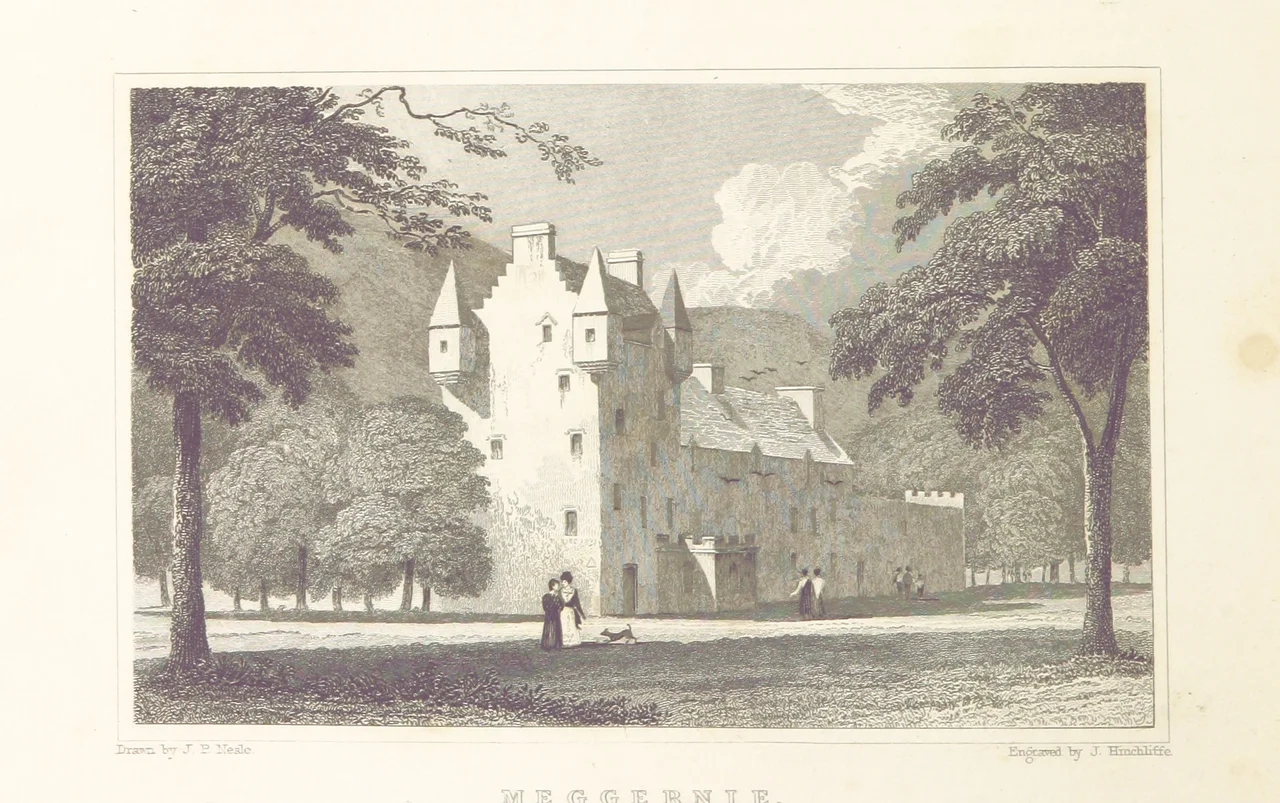
_p.296_-_Meggernie_-_John_Preston_Neale.jpg)
Meggernie Castle
Workmen restoring Meggernie Castle in the mid-19th century broke through a wall in one of the towers and found a chest. Inside the chest were the upper-half skeletal remains of a woman. They removed the bones for proper burial. The ghost sightings did not stop. That was the strange thing. Guests at the castle had been reporting the same apparition for generations: the upper half of a woman's body, floating through the rooms, sometimes through the walls into the next chamber. One visitor woke to the sensation of a red-hot kiss on his cheek and watched her torso drift away from his bed and vanish into the wall. Meggernie sits halfway up Glen Lyon, the longest enclosed glen in Scotland, where the River Lyon runs through some of the loveliest and loneliest country in Perthshire on its way to join the Tay. The castle is five storeys of solid stone with walls five feet thick. And it has the most peculiar haunting story in the Highlands.
Boggy Meadow
The name is older than the building. Meggernie may be of Pictish origin, possibly cognate with the Welsh migwernedd, meaning boggy meadow. That gives some sense of how long people have been here, naming the land in tongues that have since been swept away by Gaelic and English. Before the castle there was a thatched keep on the site, of indeterminate age. The current building is conventionally dated to around 1585, though the documentary evidence is mostly indirect. In March 1603, King James VI granted the Campbell family ownership of land in the area to form the Barony of Glenlyon, naming as its chief seat the Tower named Meggernie. The original builders, however, were almost certainly the MacGregors of Clan Gregor, who held the lands before being slowly driven out. The Barony was created in part by transferring their territory to their rivals. Robert Campbell of Glenlyon added a slated roof to the original keep, and additions accumulated over the following centuries.
Architecture of Defence
The castle is a working piece of late-medieval military architecture, even with its softer additions. The walls are about five feet thick, in keeping with its defensive role, and the keep stands five storeys tall. At each corner is a small square tower bracketed out from the main body, a typical feature of Scottish tower houses. The original castle had very few windows, just narrow slits cut into the masonry to allow archers and later musketeers to fire from cover while presenting almost no target themselves. The style is entirely conventional for the late 16th century, when peace in the glens was a fragile thing and a laird's house had to double as a fortress. A more modern mansion house was attached to the original keep at some point, though in a style that respected the older work. The four small corner towers and the long, low mansion are the architectural signature of the building today. From 1920 until his death in 1958, the castle was owned by Sir Ernest Wills, 3rd Baronet, of the tobacco family. His son Sir Edward de Winton-Wills held it until 1979.
The Menzies Murder
The haunting story is older than the Wills baronets. It dates to a time when Meggernie was occupied by the Menzies of Culdares. An early Menzies of Culdares married a young woman much younger than himself, and her youth and beauty drove him to jealousy. He murdered her in a fit of rage. He concealed her body in a locked chest in one of the castle towers, then absented himself for a long stretch, returning with a story that his wife had drowned during their travels in Europe. The locals believed him. But Menzies grew anxious. He decided to dispose of the body in the nearby churchyard. To carry it discreetly, he cut it in two. He managed to bury the lower half one night in the graveyard, leaving the upper half still locked in the chest for the next trip. Before he could complete the work, he was killed. His body was found the next morning at the entrance to the tower where the upper half of his wife still lay. No one was ever tried for his murder. The lower half is said to haunt the churchyard. The upper half wanders the castle.
From the Air
Meggernie Castle sits at 56.584°N, 4.356°W, halfway up Glen Lyon in Perth and Kinross. Glen Lyon is the longest enclosed glen in Scotland, running roughly east-west between Loch Tay to the south and Loch Rannoch to the north. The River Lyon flows the length of the glen, emerging at its eastern end into the broader Tay valley. From the air, the castle is recognizable as a substantial whitewashed building with corner towers, set in mature parkland on the valley floor. Nearest airports: Glasgow (EGPF) approximately 60 nm south-southwest, Edinburgh (EGPH) approximately 55 nm southeast. Recommended viewing altitude 4,000-5,000 ft AGL to follow the line of Glen Lyon from above. Surrounding peaks include Ben Lawers to the south and Schiehallion to the north-east. The glen is narrow enough that strong terrain-channelled winds and downdrafts are common in unstable weather.
Nearby Stories
- Loch Achray 2.6 km away
- Ben Nevis 5.4 km away
- Ben Alder 5.9 km away
- Inveraray Castle 9.5 km away
- Kilchurn Castle 14 km away
- Massacre of Monzievaird 14 km away
- Battle of Dollar 16 km away