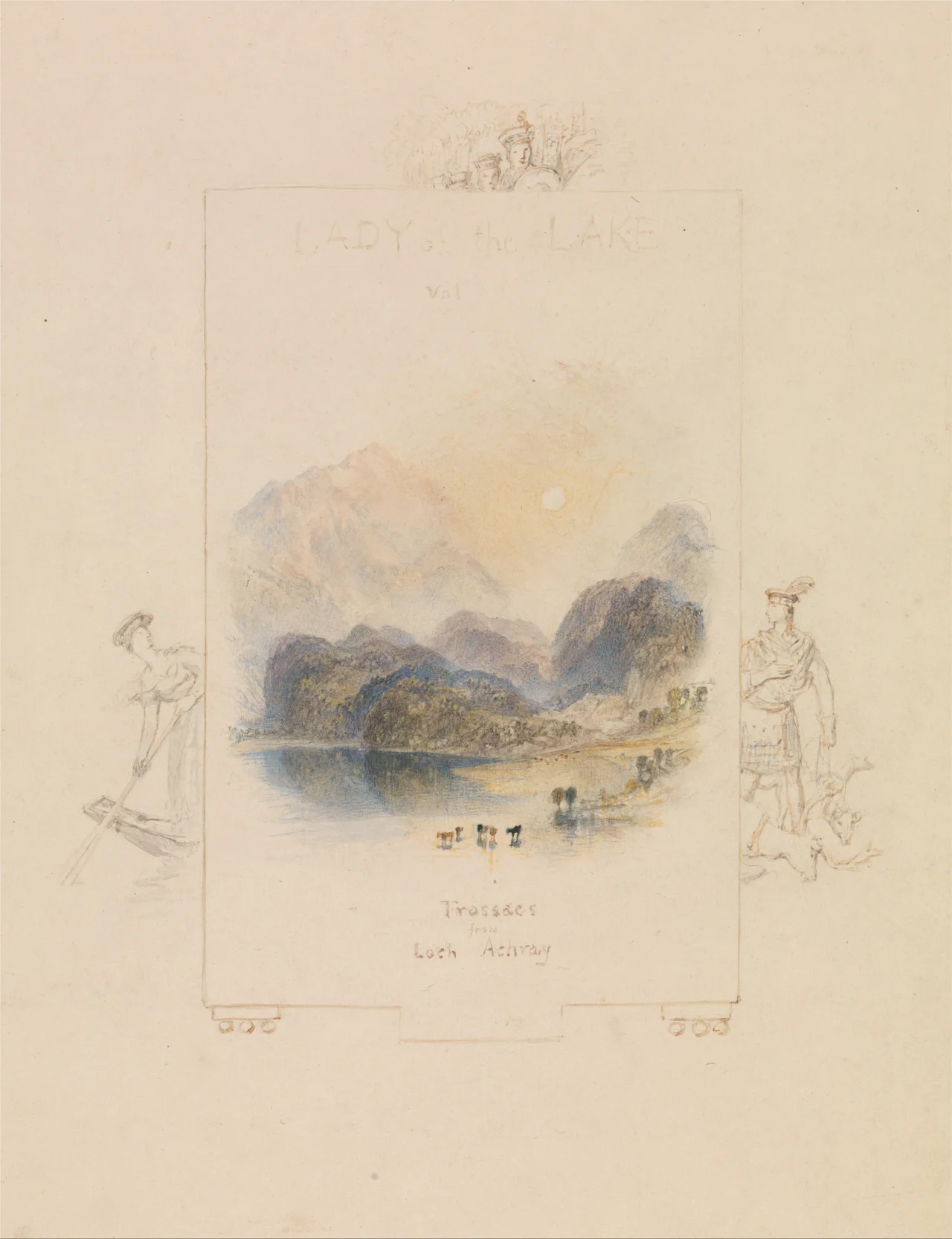

Loch Achray
A magpie's nest, the Argyll hunters called it - that small wooded island at the western end of Loch Achray, where Little James Stewart kept his hunting lodge. The men had come up from Argyleshire to poach the King's deer in Glenartney and Glensinglais, and they meant the insult plainly. Little James, keeper of those royal forests, answered just as plainly. The magpie, he warned, had a way of calling the local hawks to council. When the Argyll party returned, few rode home to tell the tale.
A Loch Between Lochs
Loch Achray sits in the heart of the Trossachs, west of Callander in what is now the Stirling council area. It is a freshwater loch, modest in size, with an average depth of about 11 metres and water that takes on the moss-green of the surrounding hills. Loch Katrine lies to the west, Loch Venachar to the east, and Achray slips between them like a quiet hinge in the chain. The shore is broken by birch and oak, the kind of hardwood pocket that survives wherever the deer cannot reach. Mist rises off the surface most mornings before the wind shifts down from Ben Venue. There is something distinctly Trossachs about the scale of the place - small enough to walk around, big enough to vanish into.
The Stewart Who Came Home
The history that anchors Achray begins with a family disgrace. In 1425, James I of Scotland executed Murdoch Stewart, Duke of Albany, for treason. Murdoch's son James Mor Stewart, known to history as James the Fat, fled into exile in Ireland and never returned. His own son, James Beag Stewart - Little James, born around 1410 - did manage to come back. He secured a royal pardon, settled in the Trossachs, and built a small hunting lodge on the island at Loch Achray's western end. The place, according to the chronicler Alexander Campbell, served as a refuge whenever danger came calling. Little James could not inherit the lost Albany estates, but he founded a line. He is the ancestor of the Stewarts of Ardvorlich on Loch Earn, the family whose feuds and tragedies later furnished Sir Walter Scott with material for A Legend of Montrose.
The Hawking Match
The Argyll story is the one that stuck. A party of Campbells came east to hunt the royal forests of Glenartney and Glensinglais without asking the keeper's leave. They killed deer and roebucks freely. On their way back, weary from the chase, they encountered Little James himself near his island and made the mistake of taunting him about it. They asked what magpie had built its nest on that tiny isle. He answered that this magpie scorned greedy hawks from any quarter. The Campbells promised to return with their own hawks soon enough. James warned that the local hawks of these glens had a way of holding council, and might not allow strangers to hunt within their ancient range. The Campbells kept their word and came back. Little James kept his. He gathered his people from the glens he controlled and met the raiders so warmly, in Campbell's dry phrase, that few returned home to tell of the hawking match for which they had so merrily departed.
What the Painters Saw
By the 19th century, the Trossachs were the engine of Scotland's first tourism boom, lit by Scott's poetry and the steamers on Loch Katrine. Loch Achray became a stop on the picturesque circuit, painted by William Leighton Leitch and others in that romantic register where every rock looks soft and every loch holds a story. The original Trossachs Hotel, built nearby in 1849, fed the trade for over a century before being converted to holiday apartments in the 1990s. The campsite on Achray's southern shore is still one of the most photographed in the national park. The water still mirrors the hills the same way it did when Scott put pen to paper, and the small island - the magpie's nest - is still there, low and wooded, in the western bay.
From the Air
Loch Achray sits at 56.23 N, 4.39 W in the central Trossachs, between Loch Katrine to the west and Loch Venachar to the east. The nearest controlled airspace belongs to Glasgow (EGPF) about 35 nautical miles south-southwest. Edinburgh (EGPH) lies 45 nm southeast, and Cumbernauld (EGPG) is about 25 nm south. From 3,000 to 5,000 feet AGL on a clear day, the three-loch chain reads like a chevron pointing west into the Highlands, with the bulk of Ben Venue rising sharply on Achray's south side. Weather here is reliably Atlantic - low cloud, fast-changing visibility, and orographic showers off the hills, even when the lowlands to the south are clear.
Nearby Stories
- HMS Repulse (1916) 0.6 km away
- Killin 6.5 km away
- Strachur 9 km away
- Shotts 9.3 km away
- Rothesay Castle 11 km away
- Tullibardine Distillery 12 km away
- Bonawe Iron Furnace 19 km away
- Dunkeld Cathedral 23 km away