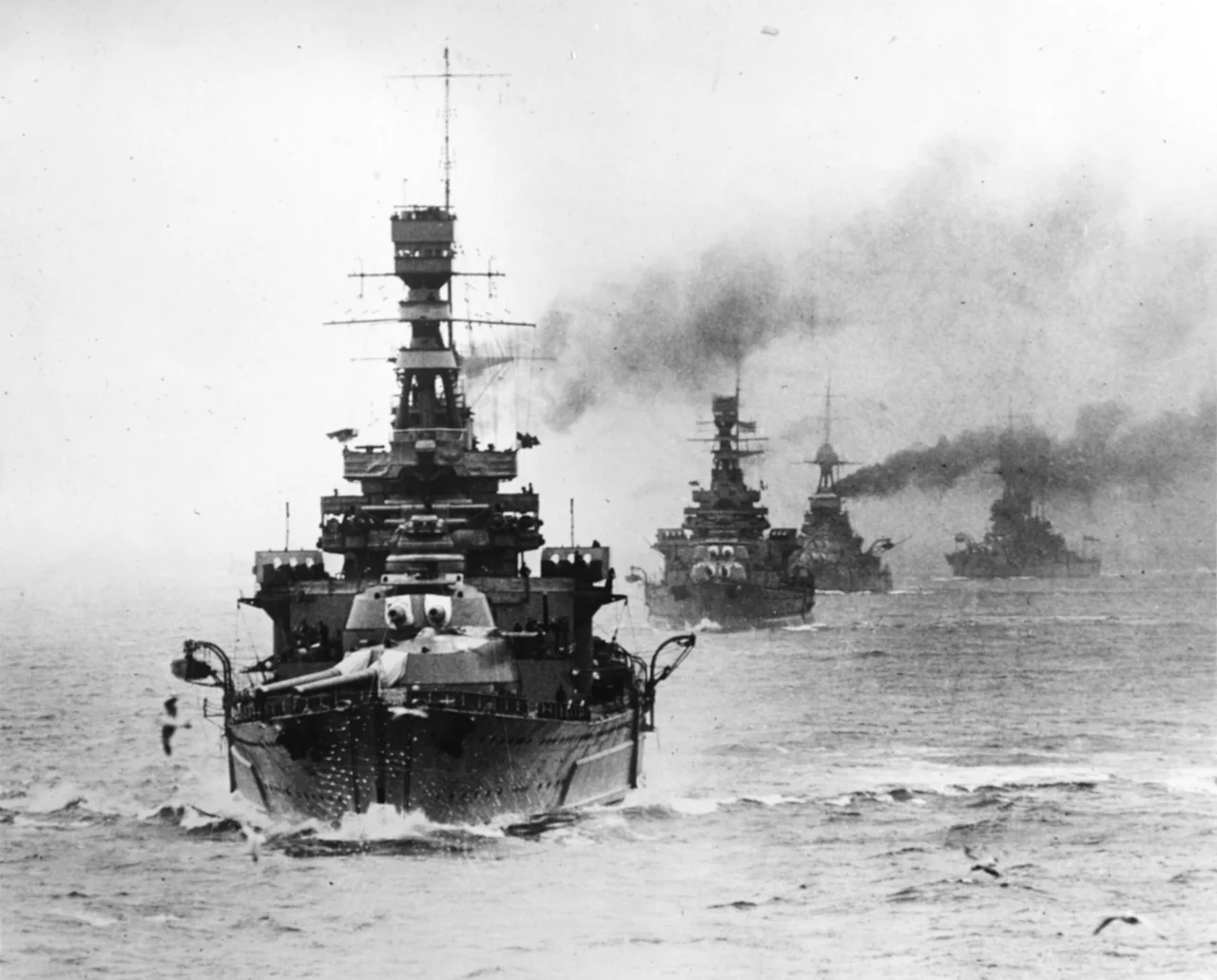

HMS Repulse (1916)
At 12:23 on 10 December 1941, HMS Repulse rolled hard to port, capsized and went down by the stern into the South China Sea. The battlecruiser had been hit by between four and five torpedoes from Japanese bombers in the space of a few catastrophic minutes. Of the 1,309 officers and men aboard, 508 went with her - clerks and stokers and gunners and engine room artificers, men in their twenties and thirties whose families would not hear what had happened for days. The ship herself was 25 years old that December, a child of the Clyde launched into the closing months of the First World War. The story between those two dates is the story of a generation of Royal Navy sailors and the world that ended around them.
A Battlecruiser in Fifteen Months
Repulse began life as a battleship laid down for the Royal Navy in 1914. Her construction was suspended when war broke out because she would not be ready in time. Then Admiral Lord Fisher became First Sea Lord and pushed through a startling redesign: turn her into a battlecruiser - faster, more lightly armoured, optimised for chasing down enemy ships rather than slugging it out in a fleet action. Director of Naval Construction Eustace Tennyson-d'Eyncourt drew up an entirely new design in days, and the John Brown yard at Clydebank agreed to deliver in fifteen months. They missed that mark slightly. Repulse was laid down on 25 January 1915, launched on 8 January 1916, and completed on 18 August 1916 - just after the Battle of Jutland had shown the world what battlecruisers could do and, terribly, what they could not survive. She and her sister ship Renown were the fastest capital ships in the world when they entered service.
Twenty-Five Years on Imperial Stations
Her only Great War action came at the Second Battle of Heligoland Bight in November 1917, where she fired 54 fifteen-inch shells and scored one hit on the German light cruiser Konigsberg. She was present at the surrender of the German High Seas Fleet at Scapa Flow on 21 November 1918. Between the wars, Repulse became one of the showpiece ships of the Empire. From November 1923 to September 1924 she joined HMS Hood on the Cruise of the Special Service Squadron - a ten-month round-the-world tour via the Panama Canal, intended as a floating display of British naval power. She was refitted twice, in the 1920s and again more thoroughly in the 1930s. A squash court was fitted on her starboard side between the funnels for the Prince of Wales' tours of Africa and South America, along with a sauna and bubble bath. In the late 1930s she carried 500 refugees from Valencia and Palma de Mallorca to Marseille during the Spanish Civil War. She was sent to Haifa during the Arab Revolt of 1938. She escorted King George VI and Queen Elizabeth on the first half of their 1939 Canadian tour.
Force Z
By late 1941, with Japanese intentions in the Far East growing increasingly clear, Winston Churchill ordered a small group of fast capital ships to Singapore as a deterrent. The plan called for the new battleship Prince of Wales, the battlecruiser Repulse, and the modern aircraft carrier HMS Indomitable. Indomitable ran aground in the Caribbean and never arrived. Prince of Wales, Repulse and their escorting destroyers reached Singapore on 2 December 1941 as Force Z. Six days later, on the evening of 8 December - the day after Pearl Harbor - Force Z sailed north to attack Japanese troop convoys landing in Malaya. They were spotted by submarine on 9 December and shadowed by Japanese floatplanes. Admiral Sir Tom Phillips turned back, then was diverted by reports of further landings at Kuantan. At 02:20 on 10 December the Japanese submarine I-58 spotted Force Z and reported their position. Eighty-six bombers and torpedo bombers were launched from Saigon. They found the British ships at 10:15.
Eleven Minutes
The first attack came at 11:13 when eight Mitsubishi G3M bombers dropped 250-kilogram bombs from 11,500 feet. One penetrated through Repulse's hangar to explode on the armoured deck below, killing men and damaging the ship's Supermarine Walrus seaplane, which was pushed over the side to remove a fire hazard. Captain Bill Tennant handled his ship superbly through what followed. He dodged 19 torpedoes. His gunners shot down two attacking aircraft and damaged eight more. But around noon, 17 Mitsubishi G4M torpedo bombers came in from both sides at once in a coordinated pincer attack. Four or five torpedoes hit in rapid succession, and there was no recovering. Repulse listed to port, capsized, and went down by the stern at 12:23. Prince of Wales followed her under within the hour. The loss of two capital ships to land-based aircraft in a single afternoon ended the age of the battleship more clearly than any single event of the Second World War.
The Wreck and the Memorial
Repulse rests at 183 feet in the South China Sea, almost upside down, her port side buried in the seabed. In 2002, sixty years after her sinking, the British government designated the wreck a Protected Place under the Protection of Military Remains Act 1986. The protection has not stopped scavengers. In 2014 The Daily Telegraph reported that both Prince of Wales and Repulse were being extensively damaged with explosives by scrap metal dealers seeking the low-background steel that wartime wrecks contain - steel forged before the atmospheric atomic tests of the 1950s and 60s, valuable for sensitive scientific instruments. In May 2023, a Chinese vessel called Chuan Hong 68 was reported illegally scavenging the wreck. The same vessel was detained by Malaysian authorities in July 2024 over paperwork violations after returning to the area. In December 2023 a memorial to both ships was unveiled at Teluk Cempedak beach by King Abdullah of Pahang. The men who went down with them - boys, really, many of them - now have somewhere their families can come to remember them.
From the Air
The Wikipedia article on HMS Repulse is associated with her builder's yard, John Brown of Clydebank, at approximately 55.8978 N, 4.4044 W - about 6 nautical miles west of central Glasgow on the north bank of the River Clyde, near where the John Brown yard launched her on 8 January 1916. The yard's titan crane still stands at Clydebank as a heritage monument. Glasgow International Airport (EGPF) is about 3 nautical miles south. The actual wreck of Repulse lies in the South China Sea off the east coast of Malaya, roughly 60 miles east-north-east of Kuantan. The memorial unveiled in December 2023 is at Teluk Cempedak beach near Kuantan in Pahang state.
Nearby Stories
- Mauchline 3.6 km away
- Shotts 4.2 km away
- HMS Ulysses (1917) 7.7 km away
- Rothesay Castle 8.8 km away
- Inchcailloch 10 km away
- Strachur 14 km away
- Battle of Dollar 16 km away
- Crawford Castle 16 km away