
Battle of Dollar
The Picts disappear from history in 875. Not gradually, not over generations, but in a sudden silence that follows the Battle of Dollar like a curtain drop. King Constantine I led the defence against Halfdan Ragnarsson's Vikings on a patch of central Scottish ground that is now a quiet Clackmannanshire town. He lost. He was driven back to the Highlands of Atholl. The next year he died in a second battle against the same Vikings. After 878, the kings of the Picts are simply never mentioned again.
The Heathen Army Goes North
Halfdan Ragnarsson was one of the leaders of the Great Heathen Army that had landed in England in 865 and spent a decade reducing the Anglo-Saxon kingdoms one by one. York fell to him in 867. By 874 the army was running out of southern targets and split in two; Halfdan took his portion north to a base on the River Tyne, from where he raided the Picts and the Kingdom of Strathclyde. Viking raids on Scotland were not new - the first attacks on Iona had come between 795 and 825, hitting the monastic community four times in thirty years. That pressure had pushed the Picts and Scots into the political union that produced Kenneth MacAlpin as king of both peoples from 843. His son Constantine I inherited the throne in 862.
What Happened at Dollar
The Scottish Chronicle records the location and the result with brutal economy: 'the Scots were annihilated at Atholl.' The Annals of Ulster put it slightly differently: 'the Picts encountered the dark foreigners in battle and a great slaughter of the Picts resulted.' We have no battle plan, no detailed account of formations or casualties or tactics. We have only the outcome - Halfdan won decisively, Constantine was driven back to the Highlands, and the Vikings occupied the east-central lowlands of Scotland for the next year. The battle is also linguistically notable: it is the first occasion on which the Scottish Chronicle uses the word Scoti, the term that would become the modern 'Scots,' specifically to describe the defeated force.
The End of the Picts
Constantine I died in 876 at a battle the chroniclers called inber dub fata, 'long dark river-mouth' - possibly Inverdovat in Fife. He was succeeded after a possible year-long interregnum by his brother Aed. Constantine and Aed are the last rulers in the historical record to be called kings of the Picts. After the devastation of 875-878 the Pictish language, identity, and political existence simply vanish from the documentary record. Whether the Picts were exterminated, assimilated, or merely re-labelled by the chroniclers who followed is one of the great unresolved questions of early medieval Scottish history. Halfdan's army settled in Northumbria in 876 and, as the Anglo-Saxon Chronicle put it, 'proceeded to plough and to support themselves.' Halfdan himself was killed in Ireland in 877 at the Battle of Strangford Lough.
Where It Happened
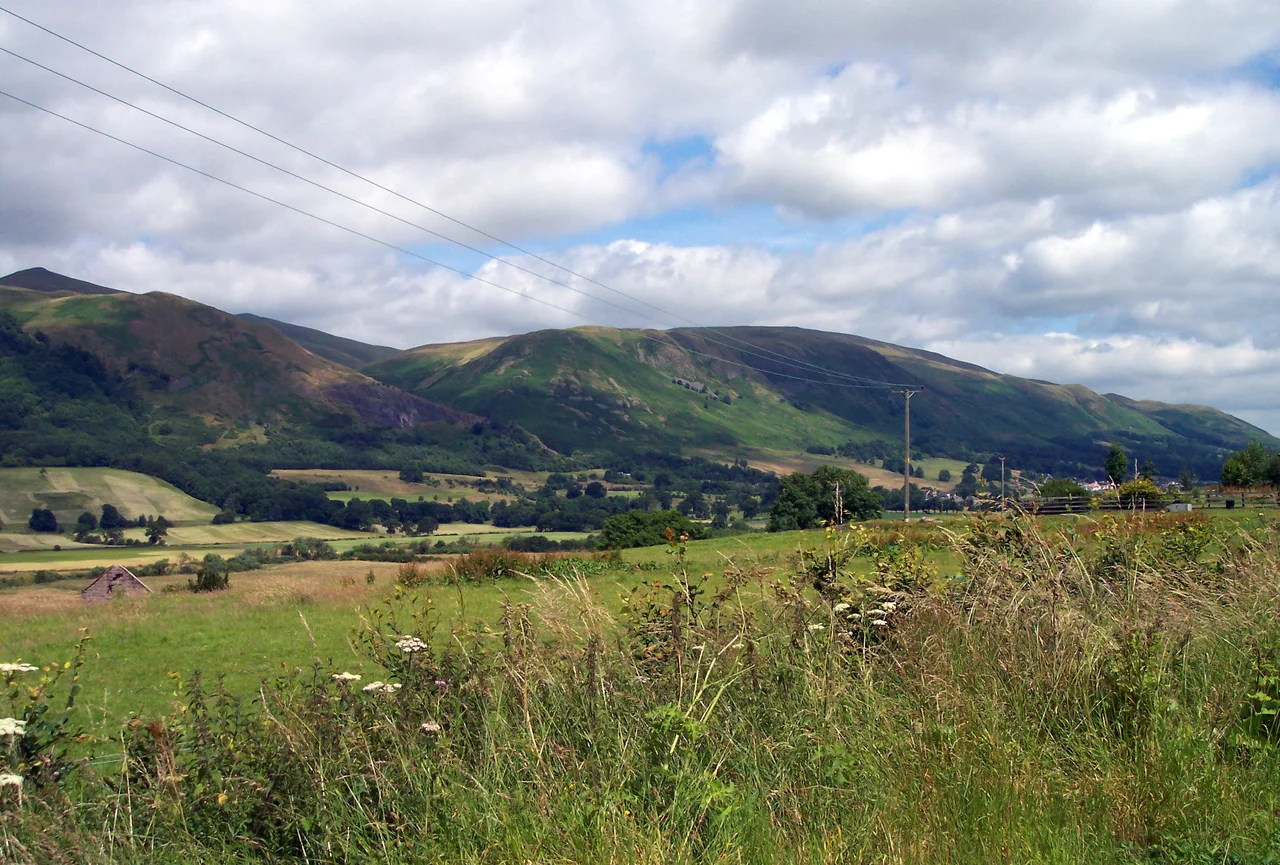
Modern Dollar is a small town in Clackmannanshire on the southern flank of the Ochil Hills - quiet, prosperous, dominated by Dollar Academy and the dramatic ruin of Castle Campbell perched on a cliff above Dollar Glen. Nothing on the ground identifies the battlefield site precisely; the historical sources are too thin to permit confident localisation, and 1,150 years of subsequent occupation have erased whatever evidence there might have been. What survives is the silence after the battle - the long absence of Picts from the record, the awkward gap in the genealogy of medieval Scotland, the sense that one of the kingdoms that had shaped early Scottish history simply ran out of king and never recovered. Constantine I's defeat at Dollar was not an isolated military setback. It was, by accident or by design, the end of one Scotland and the beginning of another.
From the Air
56.162°N, 3.674°W, at Dollar in Clackmannanshire on the southern flank of the Ochil Hills. Best viewed at 2,000-3,500 feet to take in Dollar Glen and the surrounding terrain. Edinburgh Airport (EGPH) is 23 nautical miles east-southeast; Glasgow Airport (EGPF) about 25 nautical miles southwest. Castle Campbell sits on a prominent crag above the town and is visible from the air; the Ochil Hills rise dramatically to the north. The River Devon and the southern edge of the hills form the landscape that Constantine and Halfdan would have fought across.
Nearby Stories
- Melville Castle 3.8 km away
- Stockline Plastics Factory Explosion 4 km away
- Balgonie Castle 4.9 km away
- Killin Stone Circle 7.2 km away
- Invergowrie Rail Accident 7.7 km away
- Burngrange Mining Disaster 8.8 km away
- Loch Achray 13 km away
- Dunkeld Cathedral 17 km away