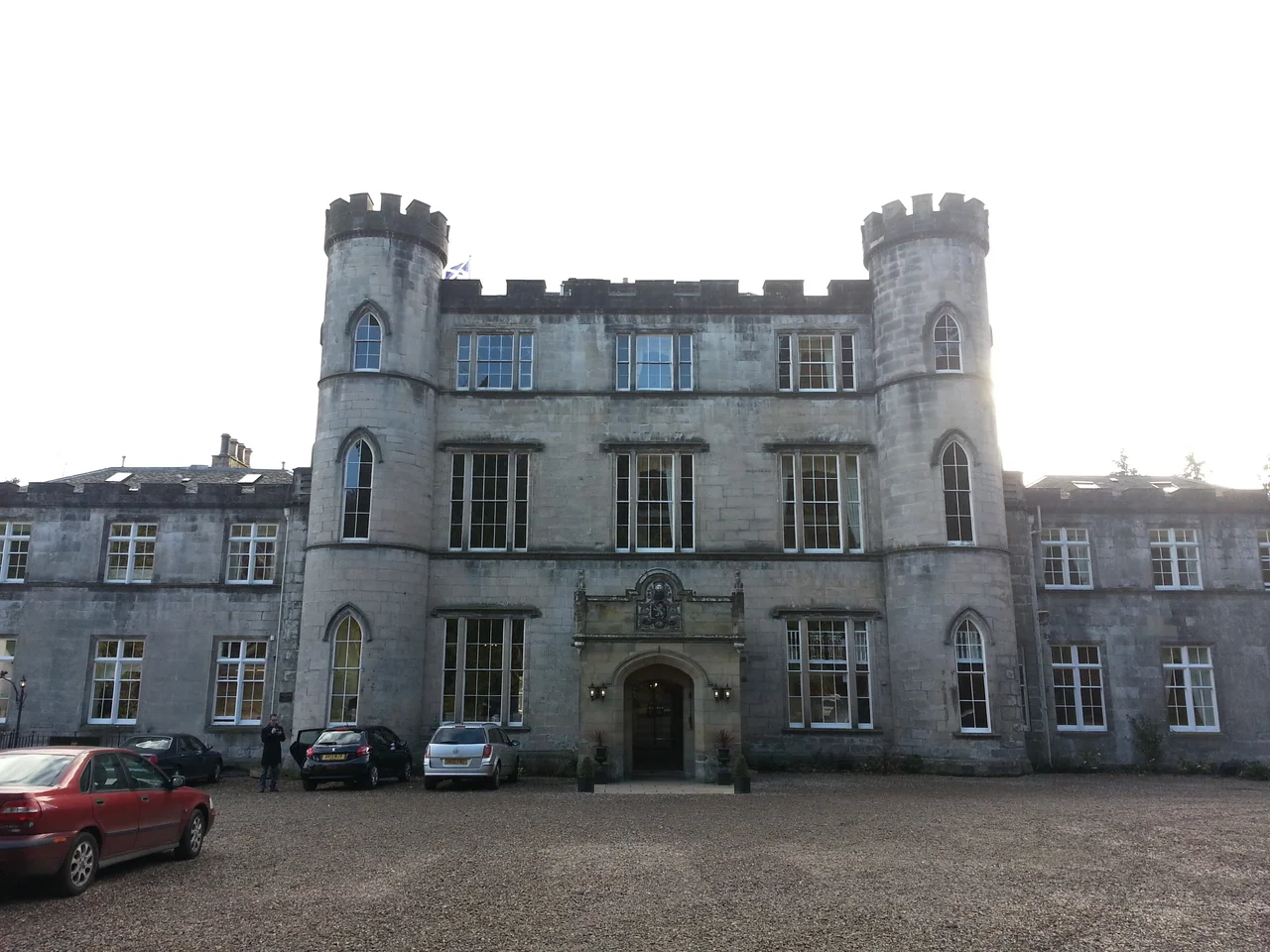

Melville Castle
Five oak trees still line the drive at Melville Castle, planted, by tradition, by Mary, Queen of Scots herself. She came here often in the 1560s, and the king's musician David Rizzio was housed in one of the castle's apartments - until palace gossip and Rizzio's intimacy with the queen turned the friendship to scandal and, soon afterward, to murder back at Holyrood. The castle has watched five centuries of Scottish drama come and go. Today it is a hotel. The oaks remain.
The Original Tower
Records of a castle here go back to 1155, when the estate was held by Galfrid de Malle, Sheriff of Edinburgh and Governor of Edinburgh Castle. The family kept it until 1371, when it passed to Sir John Ross of Halkhead. The Rosses held Melville for several generations before the estate was bought by a man named Rennie, who had made his money in Asia and died not long after returning home. His daughter Elizabeth inherited it. At fourteen, she married Henry Dundas. The marriage did not last - they divorced in 1780 - and the original tower castle was demolished to ground level in the same year. Six hundred years of stonework, gone in a season. Dundas kept the estate.
Henry Dundas Builds Anew
The present Gothic mansion was designed by James Playfair between 1786 and 1791 for Dundas, by then the 1st Viscount Melville and one of the most powerful politicians in the British Empire. Dundas controlled Scottish patronage with such efficiency that he was nicknamed 'Henry the Ninth.' Playfair gave him a three-storey castellated retreat in the new romantic style - towers, pointed arches, the picturesque silhouette that would soon become Walter Scott's Scotland in miniature. Scott himself was a frequent visitor. He nodded to the place in his poem 'The Gray Brother': 'Who knows not Melville's beechy grove, / And Roslin's rocky glen, / Dalkeith, which all the virtues love, / And classic Hawthornden?' For a generation, Melville stood at the heart of literary Edinburgh.
Kings Come Visiting
In 1828 George IV came to Melville Castle, completing a Dundas victory lap that began with Sir Henry Raeburn's portraits and ended with the colossal statue erected to Dundas in St Andrew Square - on the very site originally chosen to commemorate George IV himself. The Dundas family's pull was such that a new road was driven through Dalkeith Country Park to link Melville Castle directly to Buccleuch Palace, where the king was staying, so the visit could happen with appropriate ceremony. Queen Victoria followed in 1842. After the Second World War the Dundas era ended. The ninth Lord Melville moved to a smaller house, the castle became an army rehabilitation centre, then a hotel under a succession of foreign owners. By the late 1980s it was empty and decaying.
Rescue and Reopening
The Hay Trust bought the castle in 1993 and spent eight years on a full restoration. It reopened as a hotel in June 2003. Original Collection took the lease in 2021 and refurbished again. Melville Castle now runs as a wedding venue and hotel with 33 bedrooms, some still with four-poster beds, set in 54 acres of parkland and woodland. The library bar keeps the old building's bones; the marquee handles the modern reception crowds. Among the things guests are quietly told about: a folk song called 'Willie's gane to Melville Castle' once sung at Hibernian football matches; the controversy of Rizzio's lodgings; and those five oaks Mary planted, somewhere along the drive, still adding rings every year as the cars roll past.
From the Air
Melville Castle stands at 55.891 degrees N, 3.104 degrees W, just west-southwest of Dalkeith, Midlothian, near the River North Esk. Edinburgh Airport (EGPH) is about 8 nautical miles to the northwest; Edinburgh city centre is roughly 6 nautical miles north. From the air, look for a castellated three-storey mansion set in 54 acres of mature woodland, with the dark thread of the North Esk close to the south. Cruising altitudes of 2,500-4,500 ft AGL give the best view; the castle reads clearly against the green of Dalkeith Country Park.
Nearby Stories
- Burngrange Mining Disaster 5.9 km away
- Battle of Philiphaugh 6.5 km away
- Ravenscraig Castle 11 km away
- Crawford Castle 12 km away
- Battle of Nesbit Moor (1402) 12 km away
- Battle of Dollar 14 km away
- College Valley 18 km away
- HMS Pathfinder (1904) 19 km away