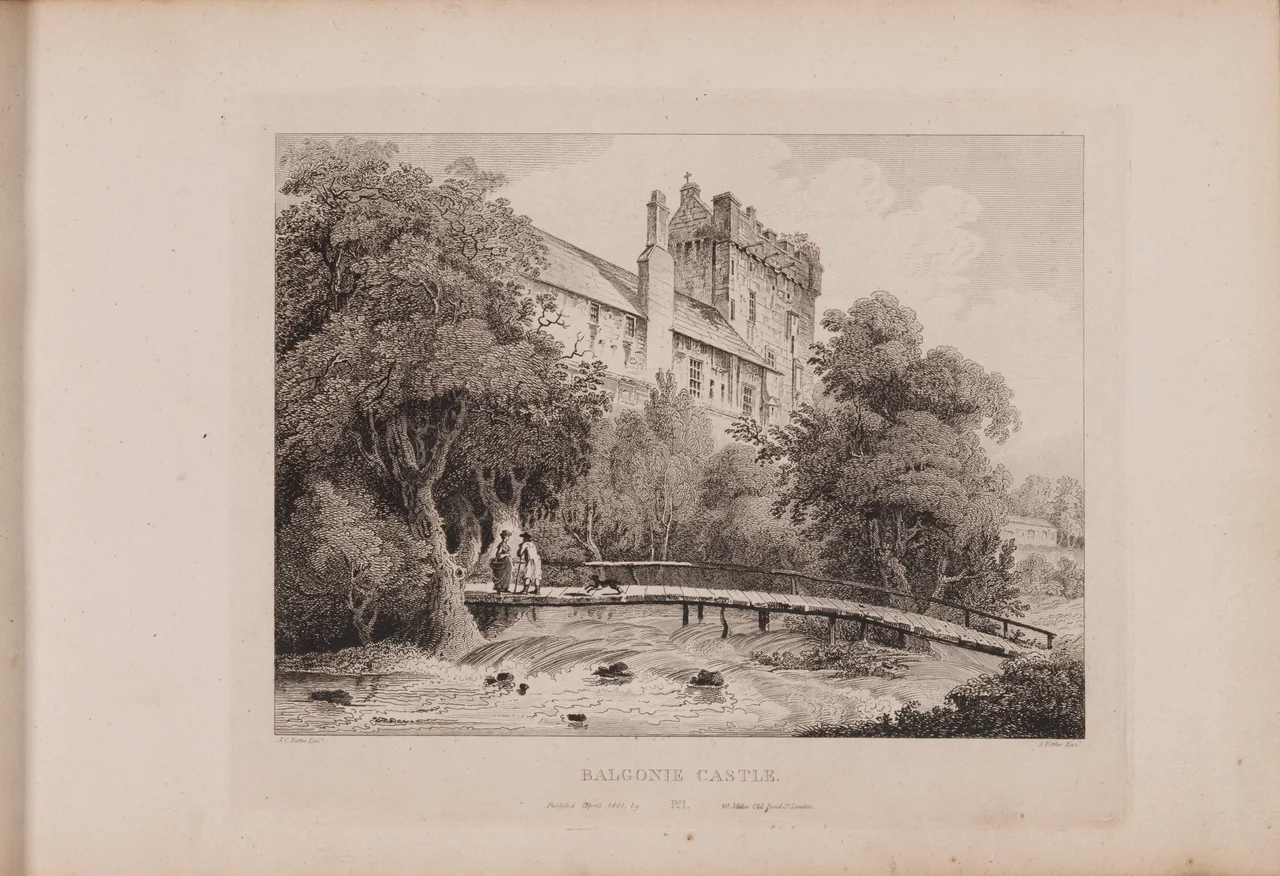

Balgonie Castle
In the mid-19th century the owners of Balgonie Castle had its roofs removed. The reason was bureaucratic. A roofless building paid no property tax. So they tore the lead away, opened the great hall to the sky, let the stair towers fill with rain. The 14th-century keep, the 15th-century range built when James IV himself stopped by to gift eighteen shillings to the masons, the rooms where Field Marshal Sir Alexander Leslie planned the Covenanter campaigns - all of it left to rot for a small tax break. The castle is still standing today only because, in 1971, a man named David Maxwell decided to start putting the roofs back.
Eight Centuries of Owners
The lands of Balgonie were held by the Sibbalds from at least 1246. Around the 1360s they built a barmkin - a fortified courtyard - with a tower house at its northwest corner. The lands passed by marriage to Sir Robert Lundie, who became Lord High Treasurer of Scotland and extended the castle considerably in 1496, adding a two-storey east range with a long hall and a solar. King James IV himself came to inspect the work on 20 August 1496 and tipped the masons eighteen shillings. The Sibbalds had built defensively. The Lundies built comfortably. The two together created what would survive, in altered form, for the next six hundred years.
The Field Marshal
In 1635 the castle was sold to Sir Alexander Leslie - a Scottish soldier who had spent decades fighting for the Swedish army in the Thirty Years War, rising to the rank of Field Marshal under Gustavus Adolphus. Leslie came home and led the Covenanter armies in the Bishops Wars. He was created Lord Balgonie and Earl of Leven in 1641 and retired in 1654, an old man honoured by both Sweden and Scotland. He kept improving Balgonie. He added a two-storey building at the southeast corner of the courtyard. The initials FSAL and DAR, for Field Marshal Sir Alexander Leslie and his wife Dame Agnes Renton, were found carved within. He rebuilt the late-15th-century north range with an extra storey and laid out a deer park around the castle, remnants of which survive. Rob Roy MacGregor captured the castle during a raid in 1716. He was forced to give it back.
The Long Decline
In 1824 Balgonie was sold to James Balfour of Whittingehame - father of James Maitland Balfour and grandfather of Arthur Balfour, who served as British Prime Minister from 1902 to 1905. The Balfours could not arrest the castle's decay. The roofs came off mid-century to dodge taxes. Vandalism in the 1960s did the rest of the damage rain and wind had not. By the time David Maxwell bought it in 1971, Balgonie was a shell. Restoration began that year and continued through the 1970s and 1980s, aided by European funding tied to European Architectural Heritage Year in 1975. The keep and chapel were fully restored. The current owners - Raymond Morris, originally from Walsall, and his family - have continued the work. The chapel and great hall now host weddings. The castle is open to the public. A man from Walsall has done what eight hundred years of Scottish lords, soldiers, and politicians could not - kept the place watertight.
Green Jeanie and the Skeleton
Balgonie comes with its ghost stories. Green Jeanie is said to be the spectre of one of the Lundie occupants, glimpsed in the green dress of an earlier century. A 17th-century soldier walks the courtyard. A dog appears and disappears. A hooded man has been reported in the corridors. The stories may be old, or may not - ghostlore tends to attach itself to old stone places without much regard for evidence. What is documented is more unsettling. During building works in 1912, a skeleton was found in the floor of the great hall. No record explains who they were or how they came to be buried there. The keep stands restored above them. The roofless east range, walls and chimney stacks still rising, frames the courtyard around the well. The deer park walls stretch out beyond. Balgonie is what survival looks like - patched, mended, occupied, still telling stories nobody can quite finish.
From the Air
Balgonie Castle sits at 56.19N, 3.11W, on the south bank of the River Leven 3.5 km east of Glenrothes in Fife. Best viewed at 1,500-2,500 feet to see the restored keep, the roofless east range, the gatehouse, and the surviving deer park walls. Edinburgh Airport (EGPH) lies 20 miles to the south across the Firth of Forth. Glenrothes is the nearest large town to the west. The river valley is wooded - the castle sits in a clearing.
Nearby Stories
- Tay Bridge Disaster 1.4 km away
- Bell Rock Lighthouse 4.5 km away
- Newbattle Abbey 4.9 km away
- Burngrange Mining Disaster 7 km away
- Battle of Dollar 9.8 km away
- Battle of Dunkeld 16 km away
- HMS Pathfinder (1904) 19 km away
- Battle of Nesbit Moor (1402) 19 km away